Versuchen GOLD - Frei
No Neutral Move
Outlook
|May 21, 2025
The sudden legislative dismantling of waqf institutions is a calculated political step
“The breakdown of constitutional morality is always signalled not by the violation of laws, but by their cynical manipulation to achieve morally indefensible ends.”
—Gautam Bhatia, The Transformative Constitution, 2019
ON February 13, 2025, US President Donald Trump announced a sweeping “reciprocal tariff” policy targeting countries like India for their high duties on American goods. The stock markets plunged in response.
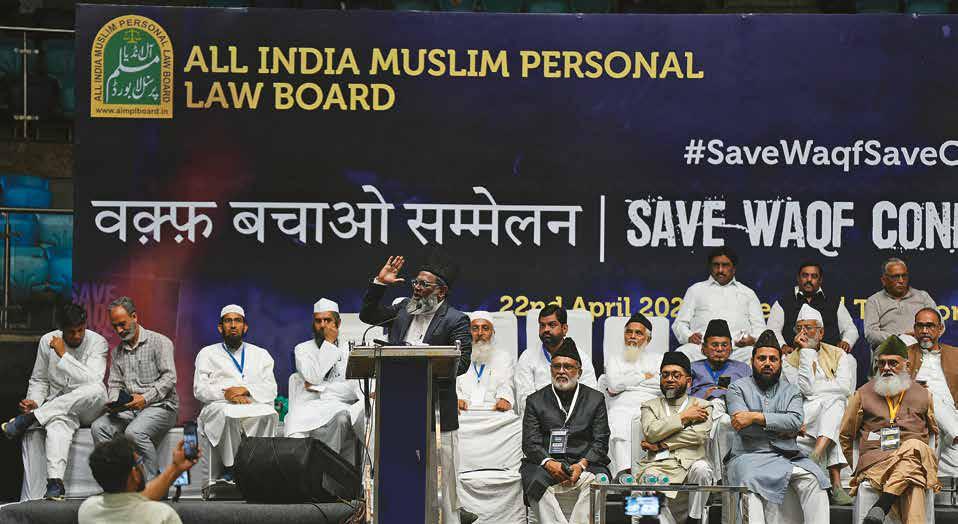
 In India, the government busied itself with pushing through the controversial Waqf (Amendment) Bill, 2025 at this time. Passed in the Lok Sabha (288-232) and the Rajya Sabha (128-95) after midnight debates on April 4, the bill received presidential assent the next day. Critics argue it grants sweeping powers to the state over waqf properties, undermining the rights of the Muslim community. Several petitions have been filed in the Supreme Court, which has stayed parts of the Act and scheduled a hearing for May 5 (now deferred to May 15), after the government—unable to respond to the Court’s pointed questions—sought more time.
Waqf and the Bharatiya Janata Party (BJP)
The institution of waqf—charitable endowments made by Muslims for religious or community welfare purposes—has been under increasing scrutiny from the BJP and affiliated organisations over the past several years. While waqf properties have historically existed as a parallel domain of community-held assets governed by Islamic law and administered by state waqf boards, the BJP has sought to question their legitimacy and management under the guise of transparency, national interest, and “equal treatment” of religious institutions.

Diese Geschichte stammt aus der May 21, 2025-Ausgabe von Outlook.
Abonnieren Sie Magzter GOLD, um auf Tausende kuratierter Premium-Geschichten und über 9.000 Zeitschriften und Zeitungen zuzugreifen.
Sie sind bereits Abonnent? Anmelden
WEITERE GESCHICHTEN VON Outlook

Outlook
Get the Right Partner
The broking industry is now in a price-war phase, but cost is no longer the key differentiator. The choice will depend on how you plan to use a broking platform

4 mins
July 06, 2026

Outlook
Balanced Fertilizer Push for India
As India faces fertilizer import shocks; Deepak Shah, Chairman of CCFI calls for shift to high NUE solutions for food security and growth.
2 mins
July 06, 2026

Outlook
India’s Anaemia Paradox
From disputed estimates to hidden causes, India’s anaemia story is entering a new phase, one that could reshape how the country understands and addresses a condition affecting millions
5 mins
July 06, 2026

Outlook
Record Placements Anchor PIMR Legacy
Prestige Institute of Management and Research, Indore (Deemed to be University): Anchoring Three Decades of Academic Vanguard and Frontier Leadership
3 mins
July 06, 2026

Outlook
Clinical Excellence in High precision Radiation Therapy
Driven by the conviction that healing begins with humanity, radiation oncologist Dr. Amit Jain has impacted countless lives
2 mins
July 06, 2026

Outlook
A Paradise Worth Protecting
Ancient rainforests, endemic and rare mammals, birds and reptiles, exotic species of trees, breathtaking corals and indigenous tribes... Great Nicobar is home to all this and a lot more
5 mins
July 06, 2026

Outlook
Your Future Starts Here
Adichunchanagiri University (ACU), nurturing visionary thinkers, global leaders, and bold entrepreneurs who are ready to drive impact in a fast-evolving digital economy
3 mins
July 06, 2026

Outlook
Building a Sustainable Airport Ecosystem in Bengaluru
At Kempegowda International Airport Bengaluru (BLR Airport), sustainability is a guiding philosophy shaping infrastructure, operations, growth, resilience and workplace culture.
4 mins
July 06, 2026
Outlook
Intelligent Imaging for Smarter Healthcare
Dilip Bhosale, shares with Outlook, how Agfa Radiology Solutions is leveraging advanced digital technologies, workflow automation and global expertise to shape the future of diagnostic imaging in India in conversation with Aditi Chakraborty
2 mins
July 06, 2026

Outlook
Advancing the Future of Oncology in Eastern India
A champion of accessible and patient-centred cancer care, Dr Soma Mukhopadhyay is leading NCRI Hospital towards new standards of excellence in oncology
2 mins
July 06, 2026
Listen
Translate
Change font size