Versuchen GOLD - Frei
Bang Bang That Awful Sound
Outlook
|January 21, 2025
What happens when we listen closely to the soundscape of war?

WHAT happens when we attempt to hear war, become aural witnesses rather than engage, again and again, in the act of seeing wide-scale devastation? Following a catastrophic event, powerful images and visuals from war-torn regions often become our primary means of constructing a lexicon of war. Most of us are attuned to prioritising our faculty of sight over others, but a shift towards sonic territories allows us a different register to make sense of the happenings of war. Is not the aural landscape merely noise, one might enquire?
 Loud, chaotic, ambiguous, and indecipherable. It is, still it is more. The pandemonium of war remains heavy with the silence of suffering and pain, and when its end is nowhere in sight—the murmurs of everyday chores, giggles of children, whispers of prayers and cries, the clanking of ladles against vessels, and the artist's splashing of paint on the canvas become part of war's monotony. By shifting our perspective to the living, we bear witness to the ghosts of voices surviving amidst unfathomable grief.
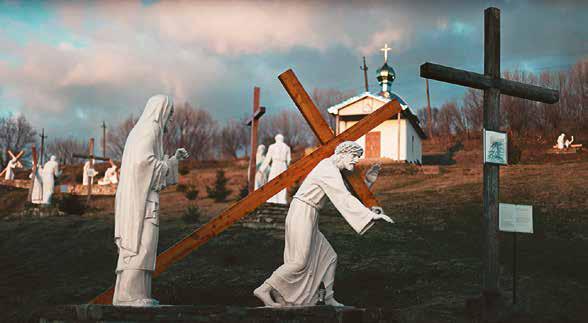 Liturgy of Anti-Tank Obstacles (Dmytro Sukholytkyy-Sobchuk, 2022), a short film documenting the lives of a group of sculptors in Ukraine after the Russian invasion, begins with a hymn sung by a church choir as the camera pans across the ruins near Lviv. While the operatic psalm continues, the soundscape materialises intricately—we hear the footsteps of a soldier patrolling and alongside him, the rapacious breathing of a military dog, the siren of an ambulance nearby, the tyres of a few cars speedily hum on the road, and finally, inside the artists's workshop, a radio informs of the lack of resources for those defending Mariupol.

Diese Geschichte stammt aus der January 21, 2025-Ausgabe von Outlook.
Abonnieren Sie Magzter GOLD, um auf Tausende kuratierter Premium-Geschichten und über 9.000 Zeitschriften und Zeitungen zuzugreifen.
Sie sind bereits Abonnent? Anmelden
WEITERE GESCHICHTEN VON Outlook

Outlook
'Why GDP Growth Doesn't Always Translate Into Votes'
The recent election results have once again shown that economic growth alone does not guarantee electoral victory.

3 mins
June 06, 2026
Outlook
Lights, Camera, Othering
The establishment of Israel has been accompanied by a national cinema devoted to negating and erasing the Palestinian Other
5 mins
June 06, 2026

Outlook
Goodbye to All That
Booker-winning British author Julian Barnes' Departure(s) is a unique hybrid work: playful, philosophical, whimsical
4 mins
June 06, 2026

Outlook
Collapse of Trust
As the NEET-UG 2026 paper leak forced the cancellation of India’s biggest medical entrance exam, more than 22 lakh aspirants find themselves trapped in uncertainty
11 mins
June 06, 2026

Outlook
NO LONGER A TWELFTH MAN
Bihar cricket, which has languished in the shadows for long, is all set to improve its strike rate, thanks to Vaibhav Sooryavanshi, the new Bihari kid on the block
5 mins
June 06, 2026

Outlook
BLAZE OF GLORY
The challenges of being a celebrity cricketer at a young age can be tough to handle
5 mins
June 06, 2026

Outlook
THE SWASHBUCKLERS
A new generation of fearless stars is emerging and finding its feet at the very top of an extremely competitive cricketing environment
5 mins
June 06, 2026

Outlook
THE TEEN TORNAD
At the age of 15, Vaibhav Sooryavanshi is already a cricketing legend
10 mins
June 06, 2026

Outlook
A Journey to Remember
The prerecorded message crackled over the din in the compartment: ‘Welcome to the Shatabdi Express.
4 mins
June 06, 2026

Outlook
Crossing Borders
Ruth Martin is the translator of German-Iranian author Shida Bazyar’s novel The Nights are Quiet in Tehran (originally written in German), which has been shortlisted for the 2026 International Booker Prize.
4 mins
June 06, 2026
Listen
Translate
Change font size