Versuchen GOLD - Frei
What's the worst that could happen?
Psychologies UK
|November 2023
Learn to choose your thoughts carefully and consciously, and take a more positive and productive path

How often do you have an anxious thought that transports you to the absolute worst possible outcome? The tendency to assume something catastrophic will happen in the future is known as worst-case-scenario thinking, and this particular type of thinking is remarkably prevalent in anxiety disorders. Worst-case-scenario thinking possesses the extraordinary ability to transform a simple headache into a brain tumour; cancelled plans into personal rejection; or a routine flight into a catastrophic crash. It seems that your mind is inclined to persuade you that the absolute worst outcome is not only possible but highly probable.
Your mind's ability to imagine vividly is so powerful that, simply by thinking things that haven't happened, you can feel as if they're happening right now. This ability to imagine the worst has an adaptive advantage for our survival, but we rarely need to use this function nowadays. It’s when you experience this level of disturbance in your thoughts constantly that you can easily feel overwhelmed. We’re all capable of imagining all sorts of scary, weird, wonderful and exciting things. But because an anxious brain is biased in favour of fear, it readily grabs onto things that fit with that – usually doom and catastrophe.
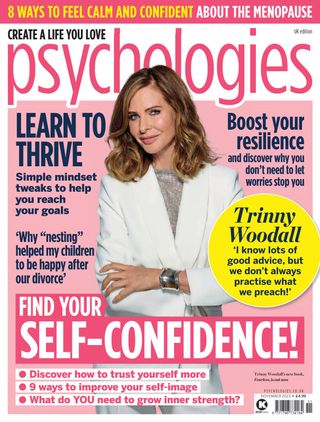

Diese Geschichte stammt aus der November 2023-Ausgabe von Psychologies UK.
Abonnieren Sie Magzter GOLD, um auf Tausende kuratierter Premium-Geschichten und über 9.000 Zeitschriften und Zeitungen zuzugreifen.
Sie sind bereits Abonnent? Anmelden
WEITERE GESCHICHTEN VON Psychologies UK

Psychologies UK
The strange comfort of CRIME
Scroll through any streaming service or podcast chart and a clear pattern emerges. Murders, disappearances, wrongful convictions, cold-case investigations, genteel English villages hiding deadly secrets. Whether it's forensic documentaries, courtroom dramas, investigative podcasts or cosy mysteries set in picture-perfect communities, crime stories dominate our cultural landscape.

4 mins
May 2026

Psychologies UK
Baby brain may be real - but it could help build bond
Brain changes during pregnancy appear to prepare women for caring for their newborns - and most grey matter returns within six months
1 min
May 2026

Psychologies UK
Naz Shah MP
After her abused mum was sent to prison, Naz found the strength to campaign for justice and push against the misogyny she was raised to obey
2 mins
May 2026

Psychologies UK
SPEAKING VOLUMES without saying a word
A soft smile. A shift in tone. The way someone leans in — or pulls away. These are the signals we absorb long before language forms, and they stay with us for life. While we often focus on finding the “right words,” much of what we communicate — and understand — happens silently.
4 mins
May 2026

Psychologies UK
WHY CAN'T WE JUST GO WITH THE FLOW?
I'm groggy as my alarm goes off hours earlier than usual. Still, this is to help myself, I think, as I roll out of bed. I head with my husband to the swimming pool, just in time for it opening. It's surprisingly busy, and for a moment I feel a little smug, being here at 6.30am, starting my day with movement. Yet while I enjoy slipping into the cool water and swimming some lengths, afterwards I find that I'm tired out for the rest of the day.
4 mins
May 2026

Psychologies UK
Flourishing and enjoying the fruits of our labour
A flourishing garden and a productive garden may seem like one and the same, but in reality, they represent two very different concepts, both in the garden and in our lives.
2 mins
May 2026

Psychologies UK
Quick tip: Turn off the TV, turn down depression
Reducing your number of hours spent in front of the box can make a massive difference to mood and wellbeing, say researchers
1 min
May 2026

Psychologies UK
How a USELESS CORNER OF MY HOUSE changed my life
I do this brilliant thing every morning that's low key changed my life: I go and sit by the window. Stay with me! I used to just roll over in bed and dive straight into the chaos of my phone, and as irresistible as it was, it was starting to make me feel miserable. But every effort to simply stop grabbing it failed spectacularly, because the habit was too deeply ingrained.
5 mins
May 2026

Psychologies UK
Seed the life that you really want
When we've cleared the ground, the next step is deciding what to plant.
2 mins
May 2026

Psychologies UK
Bright beginnings, uncertain skies
Why the qualities we're drawn to first aren't always the ones that create stability, and how to recognise what truly matters in a partner
4 mins
May 2026
Translate
Change font size