
Mit Magzter GOLD unbegrenztes Potenzial nutzen
Erhalten Sie unbegrenzten Zugriff auf über 9.000 Zeitschriften, Zeitungen und Premium-Artikel für nur
Versuchen GOLD - Frei
Wordsworth & Darwin
Philosophy Now
|February/March 2024
Christine Avery wonders whether poetry can help us to deal with science.
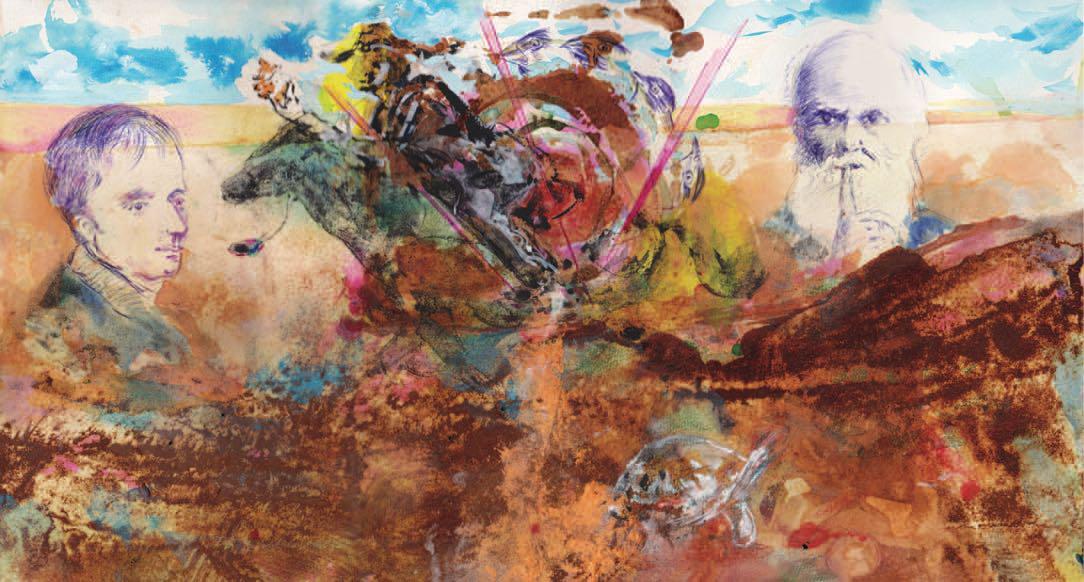
In his poetic autobiography The Prelude (1799), William Wordsworth describes a dream in which he saw an Arab horseman riding by at desperate speed carrying a stone and a shell. The stone represented reason and science, while the shell stood for poetry and prophecy. Both were seen to be in urgent danger, and it's clear that Wordsworth attributed equal and supreme value to both of them.
Whether the danger to these values has increased or diminished since Wordsworth's time (1770-1850) would be hard to estimate, but it seems clear that reason and science have steadily gained prestige at the expense of poetry and imagination. This has only been strengthened by the forces of positivism and reductionism, with their battering formula of 'this is only that'. According to reductionism, biology in the end boils down to chemistry, and chemistry to physics, and the implication drawn might be that poetry boils down to biology. But the battle is far from over.
In her excellent 2009 book Darwin's Plots: Evolutionary Narrative in Darwin, George Eliot and 19th Century Fiction, Gillian Beer contrasts the disciples of reason with more imaginative creators. Beer lays out Sigmund Freud's claim that “the universal narcissism of men, their self-love, has up to the present suffered three severe blows from the researches of science” (originally from ‘A Difficulty in the Path of Psycho-Analysis’, 1953). These blows are, in chronological order: the Copernican revolution displacing the Earth from the centre of the universe; the Darwinian argument that ‘man is not a being different from animals or superior to them’; and, thirdly, Freud's own demonstration that ‘the ego is not master in its own house’ since we often act with unconscious motivation. These ‘blows’ to humanity's sense of specialness, are connected as successive steps forward of the rational mind.

Diese Geschichte stammt aus der February/March 2024-Ausgabe von Philosophy Now.
Abonnieren Sie Magzter GOLD, um auf Tausende kuratierter Premium-Geschichten und über 9.000 Zeitschriften und Zeitungen zuzugreifen.
Sie sind bereits Abonnent? Anmelden
WEITERE GESCHICHTEN VON Philosophy Now
Philosophy Now
Bilbo Theorizes About Wellbeing
Eric Comerford overhears Bilbo and Gandalf discussing happiness.

9 mins
December 2025 / January 2026

Philosophy Now
What Women?
Marcia Yudkin remembers almost choking at Cornell
11 mins
December 2025 / January 2026
Philosophy Now
Islamic Philosophers On Tyranny
Amir Ali Maleki looks at tyranny from an Islamic perspective.
4 mins
December 2025 / January 2026

Philosophy Now
Peter Singer
The controversial Australian philosopher defends the right to choose to die on utilitarian grounds
5 mins
December 2025 / January 2026

Philosophy Now
Another Conversation with Martin Heidegger?
Raymond Tallis talks about communication problems.
7 mins
December 2025 / January 2026

Philosophy Now
Letters
When inspiration strikes, don't bottle it up. Email me at rick.lewis@philosophynow.org Keep them short and keep them coming!
17 mins
December 2025 / January 2026
Philosophy Now
The Philosophy of William Blake
Mark Vernon looks at the imaginative thinking of an imaginative artist.
9 mins
December 2025 / January 2026

Philosophy Now
Philosophical Haiku
Peering through life’s lens God in nature is deduced: The joy of being.
1 mins
December 2025 / January 2026

Philosophy Now
Philosophy Shorts
More songs about Buildings and Food' was the title of a 1978 album by the rock band Talking Heads. It was about all the things rock stars normally don't sing about. Pop songs are usually about variations on the theme of love; tracks like Rose Royce's 1976 hit 'Car Wash' are the exception. Philosophers, likewise, tend to have a narrow focus on epistemology, metaphysics and trifles like the meaning of life. But occasionally great minds stray from their turf and write about other matters, for example buildings (Martin Heidegger), food (Hobbes), tomato juice (Robert Nozick), and the weather (Lucretius and Aristotle). This series of Shorts is about these unfamiliar themes; about the things philosophers also write about.
2 mins
December 2025 / January 2026
Philosophy Now
Hedonic Treadmills in the Vale of Tears
Michael Gracey looks at how philosophers have pursued happiness.
8 mins
December 2025 / January 2026
Listen
Translate
Change font size