Versuchen GOLD - Frei
The Uses and Misuses of Socrates
Philosophy Now
|August/September 2022
Dennis Sansom says we shouldn't be too quick to pluck philosophers out of their own historical contexts in order to put them into ours.

I want to emphasise the value of caution when using ancient philosophers and texts for contemporary causes. Let us examine how Socrates has been interpreted over the centuries, how he has been used and abused by admirers and critics. We will learn an important lesson: we must be careful in reaching conclusions about ancient and complicated authors - especially ones from whom we do not have any direct authorial sources, such as Socrates, whose words were all written down by others.
Histories of Socrates
Socrates was born in Athens in 469 BC, to a stonemason and a midwife. He fought with distinction in the Peloponnesian war against the Spartans, and served on the Athenian boule or council. He married Xanthippe (who was said to be 'shrewd'), and had three sons late in life. He was not particularly handsome being bald, fat, squat, and pug-nosed - and his walk was more of a shuffle that an athletic gait; but he was convivial and loquacious, and knew many people with whom he loved to talk about serious intellectual matters. He lived in a suspicious and demoralized city which had suffered defeat in the war, followed by a short-lived Spartan-imposed regime called the Thirty Tyrants, a period marked by collaborators, spies and mutual mistrust, and had become cynical about itself. It was a dangerous time to be asking questions. We have nothing Socrates wrote, and indeed he didn't trust written philosophy because you could not interrogate it. We mainly know him from the writings of his student Plato. Plato's early dialogues, Apology, Crito, and Euthyphro are probably close to verbatim accounts of his debates, and several others, such as Meno and Phaedo, are also thought to be close to Socrates' actual words. Socrates died in 399 BC, at the age of seventy, drinking a court-ordered draught of poison after a controversial trial convicted him of being a threat to Athenian society.
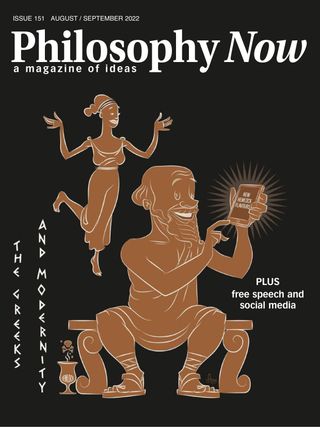

Diese Geschichte stammt aus der August/September 2022-Ausgabe von Philosophy Now.
Abonnieren Sie Magzter GOLD, um auf Tausende kuratierter Premium-Geschichten und über 9.000 Zeitschriften und Zeitungen zuzugreifen.
Sie sind bereits Abonnent? Anmelden
WEITERE GESCHICHTEN VON Philosophy Now

Philosophy Now
Bilbo Theorizes About Wellbeing
Eric Comerford overhears Bilbo and Gandalf discussing happiness.

9 mins
December 2025 / January 2026

Philosophy Now
What Women?
Marcia Yudkin remembers almost choking at Cornell
11 mins
December 2025 / January 2026
Philosophy Now
Islamic Philosophers On Tyranny
Amir Ali Maleki looks at tyranny from an Islamic perspective.
4 mins
December 2025 / January 2026

Philosophy Now
Peter Singer
The controversial Australian philosopher defends the right to choose to die on utilitarian grounds
5 mins
December 2025 / January 2026

Philosophy Now
Another Conversation with Martin Heidegger?
Raymond Tallis talks about communication problems.
7 mins
December 2025 / January 2026

Philosophy Now
Letters
When inspiration strikes, don't bottle it up. Email me at rick.lewis@philosophynow.org Keep them short and keep them coming!
17 mins
December 2025 / January 2026
Philosophy Now
The Philosophy of William Blake
Mark Vernon looks at the imaginative thinking of an imaginative artist.
9 mins
December 2025 / January 2026

Philosophy Now
Philosophical Haiku
Peering through life’s lens God in nature is deduced: The joy of being.
1 mins
December 2025 / January 2026

Philosophy Now
Philosophy Shorts
More songs about Buildings and Food' was the title of a 1978 album by the rock band Talking Heads. It was about all the things rock stars normally don't sing about. Pop songs are usually about variations on the theme of love; tracks like Rose Royce's 1976 hit 'Car Wash' are the exception. Philosophers, likewise, tend to have a narrow focus on epistemology, metaphysics and trifles like the meaning of life. But occasionally great minds stray from their turf and write about other matters, for example buildings (Martin Heidegger), food (Hobbes), tomato juice (Robert Nozick), and the weather (Lucretius and Aristotle). This series of Shorts is about these unfamiliar themes; about the things philosophers also write about.
2 mins
December 2025 / January 2026

Philosophy Now
Hedonic Treadmills in the Vale of Tears
Michael Gracey looks at how philosophers have pursued happiness.
8 mins
December 2025 / January 2026
Translate
Change font size