Versuchen GOLD - Frei
The Philosophical Method of Exception
Philosophy Now
|August/September 2025
Peter Keeble spotlights and critiques a common philosophical technique.
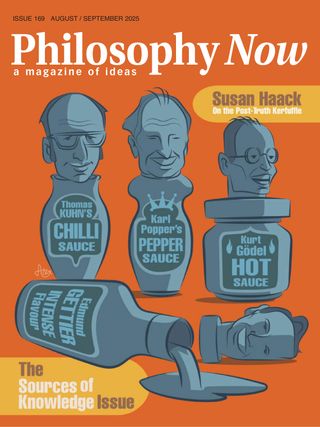
One of the ways philosophy works is this. You define some useful concept, such as knowledge, or morality, or inductive reasoning. Then someone comes along with an example of knowledge, or a moral act, or a property concerning inductive prediction that seems to lie beyond those defining characteristics. This happened not so long ago in all these cases. Knowledge was well established as ‘justified true belief until Edmund Gettier’s brief 1963 article ‘Is Justified True Belief Knowledge?’ gave apparent counterexamples. Immoral acts, we would always have previously assumed, must involve some harm to someone until Derek Parfit’s Reasons and Persons in 1984. Inductive reasoning, though always held in suspicion by philosophers, became doubly so with Nelson Goodman’s Fact, Fiction and Forecast (1955). We want to be sure about what constitutes knowledge, morality, and inductive reasoning, since we use these concepts every day. We think we understand them, but , do we really?
Gettier on Knowledge
Here’s one of Gettier’s counterexamples to knowledge being justified true belief. Smith and his friend Jones apply for a job. At his interview, the CEO strongly suggests to Smith that Jones will be the successful candidate. For some bizarre reason, while Jones is interviewed, Smith counts the coins in his friend’s pocket: there are ten. Smith therefore feels he knows that the successful candidate will have ten coins in his pocket. But it turns out he, not his friend, gets the job. And it just so happens that he also has ten coins in his pocket. It seems therefore that he had a justified true belief that the successful candidate would have ten coins in his pocket. Yet we do not feel it right to say he knew this.

Diese Geschichte stammt aus der August/September 2025-Ausgabe von Philosophy Now.
Abonnieren Sie Magzter GOLD, um auf Tausende kuratierter Premium-Geschichten und über 9.000 Zeitschriften und Zeitungen zuzugreifen.
Sie sind bereits Abonnent? Anmelden
WEITERE GESCHICHTEN VON Philosophy Now
Philosophy Now
Bilbo Theorizes About Wellbeing
Eric Comerford overhears Bilbo and Gandalf discussing happiness.

9 mins
December 2025 / January 2026

Philosophy Now
What Women?
Marcia Yudkin remembers almost choking at Cornell
11 mins
December 2025 / January 2026
Philosophy Now
Islamic Philosophers On Tyranny
Amir Ali Maleki looks at tyranny from an Islamic perspective.
4 mins
December 2025 / January 2026

Philosophy Now
Peter Singer
The controversial Australian philosopher defends the right to choose to die on utilitarian grounds
5 mins
December 2025 / January 2026

Philosophy Now
Another Conversation with Martin Heidegger?
Raymond Tallis talks about communication problems.
7 mins
December 2025 / January 2026

Philosophy Now
Letters
When inspiration strikes, don't bottle it up. Email me at rick.lewis@philosophynow.org Keep them short and keep them coming!
17 mins
December 2025 / January 2026
Philosophy Now
The Philosophy of William Blake
Mark Vernon looks at the imaginative thinking of an imaginative artist.
9 mins
December 2025 / January 2026

Philosophy Now
Philosophical Haiku
Peering through life’s lens God in nature is deduced: The joy of being.
1 mins
December 2025 / January 2026

Philosophy Now
Philosophy Shorts
More songs about Buildings and Food' was the title of a 1978 album by the rock band Talking Heads. It was about all the things rock stars normally don't sing about. Pop songs are usually about variations on the theme of love; tracks like Rose Royce's 1976 hit 'Car Wash' are the exception. Philosophers, likewise, tend to have a narrow focus on epistemology, metaphysics and trifles like the meaning of life. But occasionally great minds stray from their turf and write about other matters, for example buildings (Martin Heidegger), food (Hobbes), tomato juice (Robert Nozick), and the weather (Lucretius and Aristotle). This series of Shorts is about these unfamiliar themes; about the things philosophers also write about.
2 mins
December 2025 / January 2026
Philosophy Now
Hedonic Treadmills in the Vale of Tears
Michael Gracey looks at how philosophers have pursued happiness.
8 mins
December 2025 / January 2026
Listen
Translate
Change font size