
Mit Magzter GOLD unbegrenztes Potenzial nutzen
Erhalten Sie unbegrenzten Zugriff auf über 9.000 Zeitschriften, Zeitungen und Premium-Artikel für nur
Versuchen GOLD - Frei
Terry Pinkard
Philosophy Now
|December 2023 / January 2024
Professor of Philosophy at Georgetown University in Washington DC, talks to AmirAli Maleki about how Hegel can help us make sense of modern social, cultural and political hot topics.

What is Hegel’s view of freedom?
His ideas about freedom have to do with four different questions. First, what is freedom? Second, what is its role in history? Third, how important is it? Fourth, what does it take to actually be free?
To take up the first issue: Freedom has three components. To be free is to be at one with oneself – what Hegel calls in German Beisichsein. One is at one with oneself when self-consciously acting out of a law that’s part of one’s own nature – acting according to ideas and principles of one’s own, not principles arbitrarily imposed from without.
This aspect of freedom involves being independent, but independence is often mistakenly identified with freedom itself, instead of being recognized as merely a component of freedom. Genuine freedom for Hegel involves not only independence, but also a kind of structured dependence on others. All three of these components – being at one with oneself, independence, and structured dependence – have to be in play for there to be full freedom instead of partial or even self-undermining freedom.
Hegel thought this was easy enough to understand in practice, although difficult to grasp in theory. In particular, saying that freedom involves both dependence and independence might itself look like a self-undermining contradiction. However, the
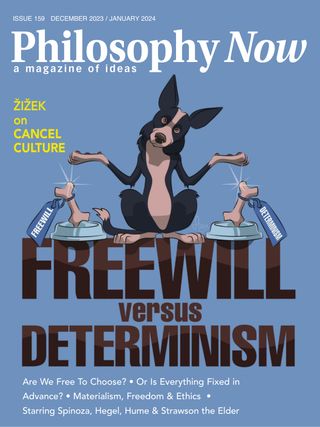

Diese Geschichte stammt aus der December 2023 / January 2024-Ausgabe von Philosophy Now.
Abonnieren Sie Magzter GOLD, um auf Tausende kuratierter Premium-Geschichten und über 9.000 Zeitschriften und Zeitungen zuzugreifen.
Sie sind bereits Abonnent? Anmelden
WEITERE GESCHICHTEN VON Philosophy Now

Philosophy Now
The Possibility- Bearing Animal
Raymond Tallis explores a twilight zone.

7 mins
February/March 2026

Philosophy Now
Amazing Times at the Pub Agora
John Douglas Mullen is a philosophical bar fly on the wall.
8 mins
February/March 2026
Philosophy Now
Friedrich Nietzsche (1844-1900)
Hilarius Bogbinder considers the all too human life of the notorious iconoclast.
11 mins
February/March 2026

Philosophy Now
Heisenberg's Philosophy of Quantum Mechanics
Kanan Purkayastha explains how Werner Heisenberg's 1925 paper turned the quantum theory of the early 1900s into the quantum mechanics of today.
10 mins
February/March 2026
Philosophy Now
Cicero & the Ideal of Virtue
Abdullah Shaikh explores Cicero's ideas about the core Roman principle of virtus.
13 mins
February/March 2026

Philosophy Now
ROPE
Les Jones has a Nietzschean take on a Hitchcock thriller.
6 mins
February/March 2026
Philosophy Now
What Have the Romans Ever Done For Us?
Salve! This issue's theme is Roman Philosophy. But as the rebels in Monty Python's Life of Brian asked, what have the Romans ever done for us? The question seems relevant here; we are philosophers, not archaeologists.
2 mins
February/March 2026
Philosophy Now
Paul Guyer
Paul Guyer is an American philosopher and a leading scholar of both Immanuel Kant and aesthetics. AmirAli Maleki interviews him about Kant's political and moral vision.
9 mins
February/March 2026
Philosophy Now
Identity in the Age of Connectivity
Sara Asran explores the dynamics of identity online.
6 mins
February/March 2026
Philosophy Now
A Very Short History of Critical Thinking
Luc de Brabandere summarises a long history through key figures of thought.
7 mins
February/March 2026
Translate
Change font size