Versuchen GOLD - Frei
Stephen Fry
Philosophy Now
|June/July 2025
Perhaps unshockingly for someone who is an actor, broadcaster, comedian, director, narrator and writer, Stephen Fry has a deep interest in words and how we use them. After hearing him lecture on that subject, Marcel Steinbauer-Lewis asked him about Artificial Intelligence and how it connects with the extraordinary lure of language.
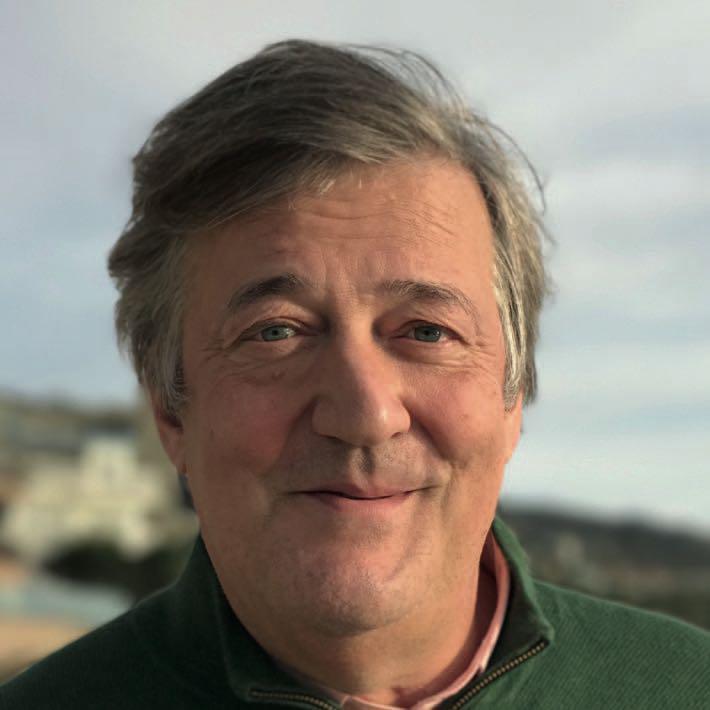
Recently at Oxford University's Sheldonian Theatre you gave a lecture called: 'Words, Words, Words: The Lure of Language'. Where did your interest in the sound of words come from?
Well, I answer that very question in the lecture! Indeed most of it is taken up with telling the story of the time I happened on a line that hit me over the head like a sandbag when I was 11 or 12. A line from Oscar Wilde's The Importance of Being Earnest. This love of language was reinforced by reading and rereading my WWW of early literary heroes: Wilde, Wodehouse and Waugh.
Your lecture was a great showcase of its subject and, leaving, there was real excitement about using language. Clearly, it's something we can all appreciate. Nonetheless, even in academic studies of literature, we have to approximate, use technical terms to discuss particular instances, and can never seem to address the thing itself; what do you think makes 'the lure of language' so difficult to pin down or talk about?
I feel it's because we take language for granted and consider it somehow pretentious to dive deep into it. But words can be like jewels, like living creatures – words can repay the closest study. They contain the wisdom of our ancestors. Take a word that can seem dull, abstract and obvious – education, for example. We think we know what it means, but it can tell us more if you take it apart. It has a Latin root ... educere. Ducere means to lead, to draw in the sense of pull, as in a horse drawn carriage; e or ex in front of a verb gives a sense of 'out'. So educere is to draw out, to lead out. Education is not a putting in, it's not stuffing a head, it's drawing out from a student what is already in them. Encouraging, enabling .... If only (some) educators were more aware of that!

Diese Geschichte stammt aus der June/July 2025-Ausgabe von Philosophy Now.
Abonnieren Sie Magzter GOLD, um auf Tausende kuratierter Premium-Geschichten und über 9.000 Zeitschriften und Zeitungen zuzugreifen.
Sie sind bereits Abonnent? Anmelden
WEITERE GESCHICHTEN VON Philosophy Now
Philosophy Now
Bilbo Theorizes About Wellbeing
Eric Comerford overhears Bilbo and Gandalf discussing happiness.

9 mins
December 2025 / January 2026

Philosophy Now
What Women?
Marcia Yudkin remembers almost choking at Cornell
11 mins
December 2025 / January 2026
Philosophy Now
Islamic Philosophers On Tyranny
Amir Ali Maleki looks at tyranny from an Islamic perspective.
4 mins
December 2025 / January 2026

Philosophy Now
Peter Singer
The controversial Australian philosopher defends the right to choose to die on utilitarian grounds
5 mins
December 2025 / January 2026

Philosophy Now
Another Conversation with Martin Heidegger?
Raymond Tallis talks about communication problems.
7 mins
December 2025 / January 2026

Philosophy Now
Letters
When inspiration strikes, don't bottle it up. Email me at rick.lewis@philosophynow.org Keep them short and keep them coming!
17 mins
December 2025 / January 2026
Philosophy Now
The Philosophy of William Blake
Mark Vernon looks at the imaginative thinking of an imaginative artist.
9 mins
December 2025 / January 2026
Philosophy Now
Philosophical Haiku
Peering through life’s lens God in nature is deduced: The joy of being.
1 mins
December 2025 / January 2026

Philosophy Now
Philosophy Shorts
More songs about Buildings and Food' was the title of a 1978 album by the rock band Talking Heads. It was about all the things rock stars normally don't sing about. Pop songs are usually about variations on the theme of love; tracks like Rose Royce's 1976 hit 'Car Wash' are the exception. Philosophers, likewise, tend to have a narrow focus on epistemology, metaphysics and trifles like the meaning of life. But occasionally great minds stray from their turf and write about other matters, for example buildings (Martin Heidegger), food (Hobbes), tomato juice (Robert Nozick), and the weather (Lucretius and Aristotle). This series of Shorts is about these unfamiliar themes; about the things philosophers also write about.
2 mins
December 2025 / January 2026
Philosophy Now
Hedonic Treadmills in the Vale of Tears
Michael Gracey looks at how philosophers have pursued happiness.
8 mins
December 2025 / January 2026
Listen
Translate
Change font size