Versuchen GOLD - Frei
Is VR Meaningful Escapism?
Philosophy Now
|June/July 2025
Amir Haj-Bolouri enquires into possible meaning through technology.
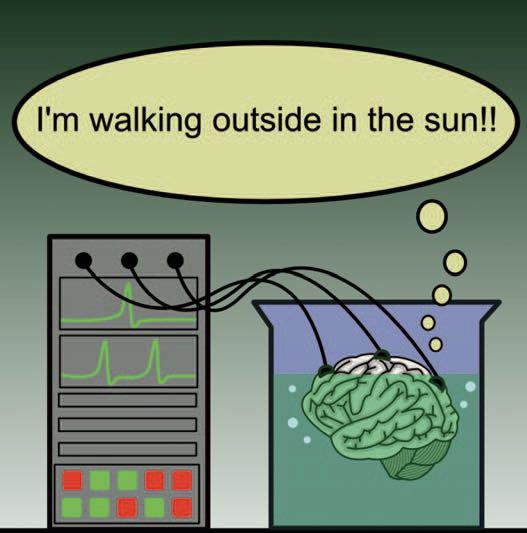
Immersive Virtual Reality (IVR) is considered the perfect technology for extending the experiences we have in the physical world. Through it, we can represent and simulate the past, the present and the future. And through the rapid development of Artificial Intelligence, modern VR experiences are not only realistically convincing, but also smart. As such, IVR experiences can increasingly be a creative product of human imagination. Moreover, the IVR experience is 'immersive' in the way that it turns the user into a 'being-in-the-virtual-world' - that is, an embodied avatar, dynamically present, and capable of accomplishing 'magic' - teleportation across virtual worlds, walking through walls, hiding inside furniture, or generally, exercising the god-like power of being able to define the (virtual) reality around us. The immersive effect is arguably dependent on the sensory configuration of IVR technology, in that it provides an enclosed visual field for the user, headphones that cancel out the sound of the outside world, and haptic devices that can provide sensory feedback loops of touch, pain, heat or cold.
However, with the possibilities that IVR increasingly affords us also come existential questions, and thoughts about the distinction between what's real and what is a layer of illusion. One might wonder where reality begins and ends, especially when IVR experiences will begin to extend the world we engage with on a daily basis. David Chalmers argues in Reality+ (2022) that virtual reality is genuine reality because we can live meaningful lives there; and increasingly, we will. Subsequently, Chalmers invokes questions such as: What is reality, anyway? How can we live a meaningful life? And how do we know there is an external world independent of human experience?
Of course, through the ages, philosophers have questioned our conceptions of reality. One famous example is provided by Hilary Putnam in


Diese Geschichte stammt aus der June/July 2025-Ausgabe von Philosophy Now.
Abonnieren Sie Magzter GOLD, um auf Tausende kuratierter Premium-Geschichten und über 9.000 Zeitschriften und Zeitungen zuzugreifen.
Sie sind bereits Abonnent? Anmelden
WEITERE GESCHICHTEN VON Philosophy Now

Philosophy Now
Bilbo Theorizes About Wellbeing
Eric Comerford overhears Bilbo and Gandalf discussing happiness.

9 mins
December 2025 / January 2026

Philosophy Now
What Women?
Marcia Yudkin remembers almost choking at Cornell
11 mins
December 2025 / January 2026

Philosophy Now
Islamic Philosophers On Tyranny
Amir Ali Maleki looks at tyranny from an Islamic perspective.
4 mins
December 2025 / January 2026

Philosophy Now
Peter Singer
The controversial Australian philosopher defends the right to choose to die on utilitarian grounds
5 mins
December 2025 / January 2026

Philosophy Now
Another Conversation with Martin Heidegger?
Raymond Tallis talks about communication problems.
7 mins
December 2025 / January 2026

Philosophy Now
Letters
When inspiration strikes, don't bottle it up. Email me at rick.lewis@philosophynow.org Keep them short and keep them coming!
17 mins
December 2025 / January 2026
Philosophy Now
The Philosophy of William Blake
Mark Vernon looks at the imaginative thinking of an imaginative artist.
9 mins
December 2025 / January 2026

Philosophy Now
Philosophical Haiku
Peering through life’s lens God in nature is deduced: The joy of being.
1 mins
December 2025 / January 2026

Philosophy Now
Philosophy Shorts
More songs about Buildings and Food' was the title of a 1978 album by the rock band Talking Heads. It was about all the things rock stars normally don't sing about. Pop songs are usually about variations on the theme of love; tracks like Rose Royce's 1976 hit 'Car Wash' are the exception. Philosophers, likewise, tend to have a narrow focus on epistemology, metaphysics and trifles like the meaning of life. But occasionally great minds stray from their turf and write about other matters, for example buildings (Martin Heidegger), food (Hobbes), tomato juice (Robert Nozick), and the weather (Lucretius and Aristotle). This series of Shorts is about these unfamiliar themes; about the things philosophers also write about.
2 mins
December 2025 / January 2026

Philosophy Now
Hedonic Treadmills in the Vale of Tears
Michael Gracey looks at how philosophers have pursued happiness.
8 mins
December 2025 / January 2026
Listen
Translate
Change font size