Versuchen GOLD - Frei
Horseplay in Hibernia
Philosophy Now
|February/March 2024
Seán Moran explores equine escapades in Eire and elsewhere.

‘Hibernia’ is the Latin for Ireland. The Romans didn’t use the word much though, because (unlike our neighbour, Britannia) they never invaded Ireland. Perhaps they were scared of the dancing girls with their long curly wigs, kitsch Celtic dresses, and ferociously competitive mammies. In any case, they had a cheek naming our country Hibernia, which literally means ‘Land of Winter’. They seem to have mixed us up with Narnia. We actually have four seasons – admittedly sometimes on the same day.
When present-day Romans visit for a summer holiday, they soon discover that Ireland loves horses. This national characteristic runs across all socio-economic classes. When Queen Elizabeth came to Ireland, she made a pilgrimage to my home county of Tipperary, to admire the thoroughbred racehorses in the paddocks and stables of stud farms. Horses are also found in impoverished Dublin housing estates, and in Traveller encampments around the country. The young charioteers in my photograph are members of the Irish Traveller community. A similar image of a charioteer struggling to control recalcitrant horses appears in Plato’s dialogue Phaedrus – though in Ireland we call a chariot a ‘sulky’, and the minor drama depicted in my photo took place in a cloudy Tipperary town, not under the blazing sun of Athens.
In Plato’s allegory, the chariot of the soul (psyche) is pulled by two horses, one mortal, one immortal. Both horses have wings, but the mortal one is a “crooked lumbering animal… hardly yielding to whip and spur” (Phaedrus, 253). This steed represents our desires or appetites (
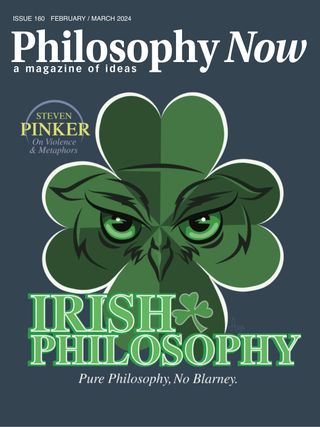

Diese Geschichte stammt aus der February/March 2024-Ausgabe von Philosophy Now.
Abonnieren Sie Magzter GOLD, um auf Tausende kuratierter Premium-Geschichten und über 9.000 Zeitschriften und Zeitungen zuzugreifen.
Sie sind bereits Abonnent? Anmelden
WEITERE GESCHICHTEN VON Philosophy Now
Philosophy Now
Bilbo Theorizes About Wellbeing
Eric Comerford overhears Bilbo and Gandalf discussing happiness.

9 mins
December 2025 / January 2026

Philosophy Now
What Women?
Marcia Yudkin remembers almost choking at Cornell
11 mins
December 2025 / January 2026

Philosophy Now
Islamic Philosophers On Tyranny
Amir Ali Maleki looks at tyranny from an Islamic perspective.
4 mins
December 2025 / January 2026

Philosophy Now
Peter Singer
The controversial Australian philosopher defends the right to choose to die on utilitarian grounds
5 mins
December 2025 / January 2026

Philosophy Now
Another Conversation with Martin Heidegger?
Raymond Tallis talks about communication problems.
7 mins
December 2025 / January 2026

Philosophy Now
Letters
When inspiration strikes, don't bottle it up. Email me at rick.lewis@philosophynow.org Keep them short and keep them coming!
17 mins
December 2025 / January 2026
Philosophy Now
The Philosophy of William Blake
Mark Vernon looks at the imaginative thinking of an imaginative artist.
9 mins
December 2025 / January 2026

Philosophy Now
Philosophical Haiku
Peering through life’s lens God in nature is deduced: The joy of being.
1 mins
December 2025 / January 2026

Philosophy Now
Philosophy Shorts
More songs about Buildings and Food' was the title of a 1978 album by the rock band Talking Heads. It was about all the things rock stars normally don't sing about. Pop songs are usually about variations on the theme of love; tracks like Rose Royce's 1976 hit 'Car Wash' are the exception. Philosophers, likewise, tend to have a narrow focus on epistemology, metaphysics and trifles like the meaning of life. But occasionally great minds stray from their turf and write about other matters, for example buildings (Martin Heidegger), food (Hobbes), tomato juice (Robert Nozick), and the weather (Lucretius and Aristotle). This series of Shorts is about these unfamiliar themes; about the things philosophers also write about.
2 mins
December 2025 / January 2026

Philosophy Now
Hedonic Treadmills in the Vale of Tears
Michael Gracey looks at how philosophers have pursued happiness.
8 mins
December 2025 / January 2026
Listen
Translate
Change font size