Versuchen GOLD - Frei
Affirmative Action for Androids
Philosophy Now
|June/July 2025
Jimmy Alfonso Licon asks, when should we prioritise android rights?
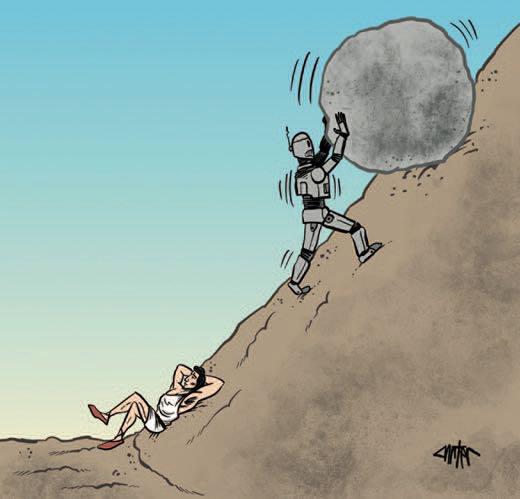
We should begin examining the question of whether there should be affirmative action for androids by first answering a couple of prior questions. Would androids count morally anyway? And what conditions, if any, would justify affirmative action for androids?
It’s easy to dismiss the possibility that androids, being machines, would deserve any greater moral consideration than a cellphone; but in any future world where androids have become self-aware, capable of suffering, and have projects and values which matter to them, to not give them moral rights would mean that the androids would be second-class citizens at best, and slaves at worst. Such an arrangement wouldn’t survive: many humans would feel bad for the androids, and the androids would resist.
So what are we to think morally about androids?
Do Androids Count Morally?
For something to qualify as the subject of fairness considerations, it must first have moral standing. As the philosopher Christopher Morris explains:
“[The] metaphor of the moral community is an interesting one. It makes possession of moral standing analogous to the political status of citizenship. Like membership in the political community, membership in ‘the moral community’ gives one a particular status that non-members lack, in particular a set of rights. [Something] has moral standing if it is owed duties. This understanding of moral standing connects it with the notion of legal standing; both are conceptions of a status that entitles the holder to something.”
(The Oxford Handbook of Animal Ethics, edited by Tom Beauchamp and R.G. Frey, p.262, 2011)
To put the point simply: to have moral standing is to deserve moral consideration for one’s own sake.


Diese Geschichte stammt aus der June/July 2025-Ausgabe von Philosophy Now.
Abonnieren Sie Magzter GOLD, um auf Tausende kuratierter Premium-Geschichten und über 9.000 Zeitschriften und Zeitungen zuzugreifen.
Sie sind bereits Abonnent? Anmelden
WEITERE GESCHICHTEN VON Philosophy Now

Philosophy Now
Star Trek: Enterprise
Sofia Villaweaver asks, what kind of future do we want — Gene Roddenberry's, or Friedrich Nietzsche's?

7 mins
June/July 2026

Philosophy Now
The Delphic Injunctions
Massimo Pigliucci philosophises about prophetic principles.
4 mins
June/July 2026

Philosophy Now
What’s the Value of Mountaineering?
Suleyman Moollan wonders why people climb mountains.
8 mins
June/July 2026

Philosophy Now
Death as Life’s Picture Frame
Joshua Clements puts us in the picture.
10 mins
June/July 2026
Philosophy Now
Philosophers on Butterflies
Summer is upon those of us in the northern hemisphere. That invites reflection.
2 mins
June/July 2026

Philosophy Now
Margalit & Limits to Political Compromise
Laure Gillot-Assayag reflects on the political philosophy of Avishai Margalit.
12 mins
June/July 2026

Philosophy Now
Making Omelettes & A Future Like Ours
Jimmy Alfonso Licon wonders what's wrong with killing — first chickens, then humans.
5 mins
June/July 2026

Philosophy Now
Breakfast with Habermas
Matt Qvortrup recalls chat over coffee and scrambled eggs with a champion of reasoned debate.
5 mins
June/July 2026

Philosophy Now
Who Wants to Live Forever?
Dan Pollen weighs up the pros and cons of indefinitely extended life.
10 mins
June/July 2026

Philosophy Now
Carl Schmitt (1888-1985)
Marco Pandolfini on the ideas of a highly contentious legal theorist.
9 mins
June/July 2026
Listen
Translate
Change font size