Versuchen GOLD - Frei
Human, All Too Human
New York magazine
|June 30 – July 13, 2025
An unkillable zombie franchise wants to talk about civilization now.
-
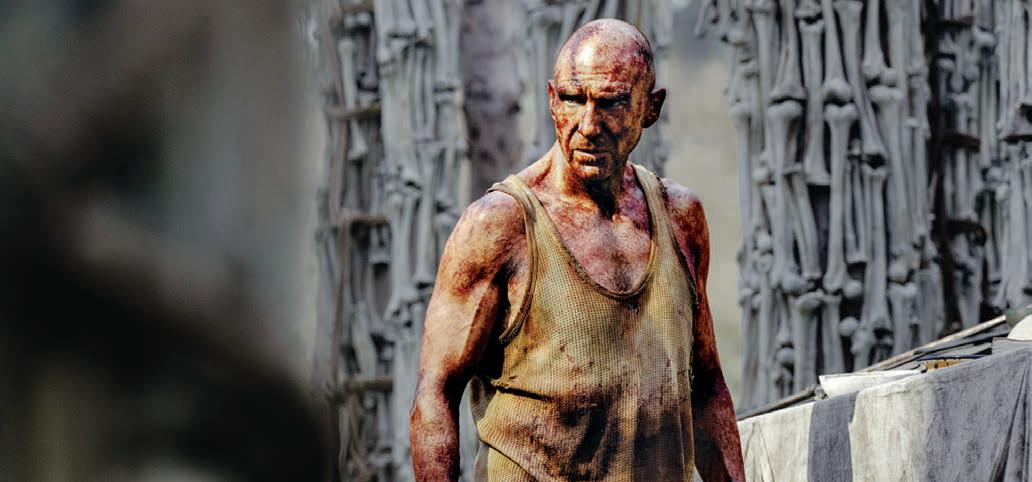
AT THE HEART OF Danny Boyle's 28 Years Later stands an eerie monument: a tower of skulls serving as a memorial to the dead. It’s a grim sight but one designed to stir up compassion as well. “There are so many dead, infected and uninfected alike—because they are alike,” says its caretaker, Dr. Ian Kelson (Ralph Fiennes), who in the years following Britain’ transformation into a zombie-filled hellscape became a gruff, buff, and somewhat daffy hermit single-handedly holding off armies of monsters with weapons, guile, and medical know-how. When someone dies, Kelson burns off their skin, polishes their skull, and places it on the tower. This memorial speaks to the constant presence of death, but it also asks us to consider the immense loss these humans have endured. “Every skull is a set of thoughts,” Kelson says. “These sockets saw, and these jaws swallowed.” People think he’s a lunatic, but maybe you have to be a bit mad to hold on to your humanity in a world like this.
One could say the same for the world beyond the screen. Those lusting for cool monster action and genre thrills would do well to remember that the original 28 Days Later, directed by Boyle and written by Alex Garland, wasn't that much of a zombie flick to begin with. Those infected by the “rage virus” lurked in the shadows and popped up to set in motion the extremes of behavior that were that film’s true focus. Boyle and Garland had little interest in face-eating monsters chasing people; they wanted to depict how the remnants of humanity reacted to the devastation around them. Shot on relatively inexpensive digital video cameras and released in 2002 to audiences still reeling from the aftermath of September 11, the film was a masterpiece, but maybe the scariest thing about it was the title: 28 days had been all it took for society to fall apart. The slightly more genre-suited sequel from 2007,

Diese Geschichte stammt aus der June 30 – July 13, 2025-Ausgabe von New York magazine.
Abonnieren Sie Magzter GOLD, um auf Tausende kuratierter Premium-Geschichten und über 9.000 Zeitschriften und Zeitungen zuzugreifen.
Sie sind bereits Abonnent? Anmelden
WEITERE GESCHICHTEN VON New York magazine
New York magazine
To Do
Twenty-five things to see, hear, watch, and read.

6 mins
June 29–July 12, 2026

New York magazine
JALEN BRUNSON'S VICTORY LAP TAGGING ALONG WITH THE MVP AS KNICKS FANS EXHALE AND THE CITY ERUPTS.
FATIGUE HAD CAUGHT up to Jalen Brunson.
18 mins
June 29–July 12, 2026

New York magazine
Finally, Some Fire
House of the Dragon's third season is the series at its best.
5 mins
June 29–July 12, 2026

New York magazine
Construction School
On a recent weekday, apprentices and longtime union Local 79 members took certification classes at the Mason Tenders training center in Long Island City.
1 mins
June 29–July 12, 2026

New York magazine
Olivia Rodrigo Finds Balance
She remains a razor-sharp storyteller, even with a slightly softer sound.
5 mins
June 29–July 12, 2026

New York magazine
‘I’m Six Months Out From Bankruptcy at Any Moment’
The unglamorous financial realities of making an indie film right now.
8 mins
June 29–July 12, 2026

New York magazine
Olivia Wilde Had to Disappear
Her last movie was panned, and her life dissected: “I don’t think you know what you’re made of until you fall apart.”
8 mins
June 29–July 12, 2026

New York magazine
What We Wear to Swim Summer After Summer
The one-pieces and bikinis we put on for beach days and lounging by the pool.
1 mins
June 29–July 12, 2026

New York magazine
The Best FOOD of 2026 (So Far)
Our critics take a midyear look at the city’s most interesting new dishes.
7 mins
June 29–July 12, 2026

New York magazine
FASHION That Makes Us Want Again
The industry, deep in a funk, has forgotten how to create things people desire—with three standout exceptions.
15 mins
June 29–July 12, 2026
Listen
Translate
Change font size