
Mit Magzter GOLD unbegrenztes Potenzial nutzen
Erhalten Sie unbegrenzten Zugriff auf über 9.000 Zeitschriften, Zeitungen und Premium-Artikel für nur
FOR THE Love OF Sand! Become a Psammophile!
Rock&Gem Magazine
|May 2023
While rock and mineral collectors often seek the biggest crystal ever, true wonders exist at the microscopic level.

A single teaspoon of sand from a beach, riverbed or desert dune can hold a world you never imagined when viewed through the lens of a microscope. A whole community of fellow enthusiasts exists for exchanging these tiny bits of amazing nature from around the world. You can join that community. But beware. Once you start, it's all too easy to get hooked!
SAND COLLECTORS DEFINED
People who are fascinated by and who collect sand wherever they can are called psammophiles, or arenophiles. The term psammophile is derived from the Greek words psammo (sand) and phile (lover of). If you prefer Latin over Greek, you would be an arenophile.
True-blue sand lovers not only carry ziplock baggies to scoop up samples, they dump out shoes after a walk across a beach or desert dune to see what treasures they may have gathered.
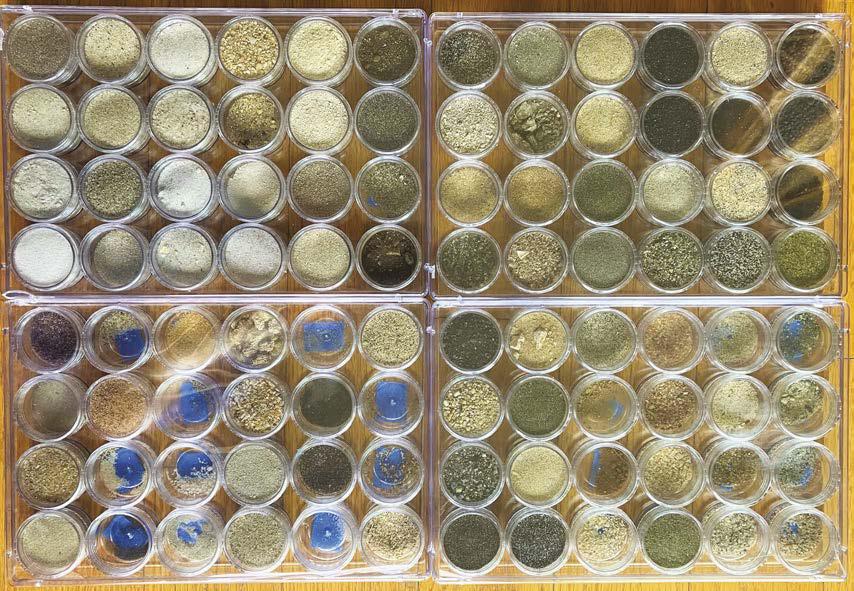
WHAT IS SAND?
A heap of sand is a collection of microminerals and/or microfossils with a grain size residing between silt and gravel. Precisely, "very fine" sand has a grain size of 0.0625 to 0.125 mm, and "very coarse" sand has a grain size of up to 2+ mm.
Sand often starts from rocks that weather and decompose. Sand is generally divided into three basic types derived from different sources.
- Hard Mineral Grains These include quartz and feldspar weathered and eroded from igneous rocks such as granites or from metamorphic rocks like quartzite (which is ultimately derived from sedimentary sandstone formed from sand).
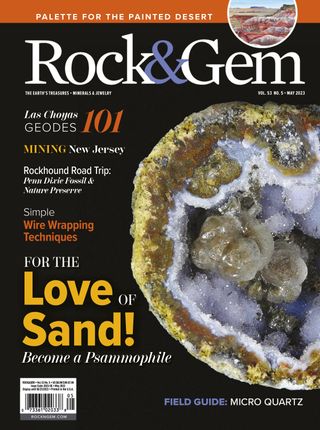

Diese Geschichte stammt aus der May 2023-Ausgabe von Rock&Gem Magazine.
Abonnieren Sie Magzter GOLD, um auf Tausende kuratierter Premium-Geschichten und über 9.000 Zeitschriften und Zeitungen zuzugreifen.
Sie sind bereits Abonnent? Anmelden
WEITERE GESCHICHTEN VON Rock&Gem Magazine
Rock&Gem Magazine
A New Amber Locality Fills a Gap
A sandstone quarry in central Ecuador has yielded the first significant deposit of Mesozoic amber from South America.

1 min
January / February 2026
Rock&Gem Magazine
Did "Left-Handed" Fish Leave Water Earlier than Thought?
Fossil evidence suggests that fish (or \"fishapods\") dragged themselves onto land during the middle Devonian Period.
1 min
January / February 2026

Rock&Gem Magazine
"Lab Quakes” Produce Surprising Results
When faults let loose and earthquakes result, the main effect we mortals experience is the violent shaking.
1 min
January / February 2026
Rock&Gem Magazine
This Egg is No Spring Chicken
How to date a dino egg
1 min
January / February 2026
Rock&Gem Magazine
Have we Already Mined the Critical Minerals We Need
Then why are we throwing them away?!
1 min
January / February 2026
Rock&Gem Magazine
One Toxic Worm
A critter that creates & tolerates orpiment!
1 min
January / February 2026
Rock&Gem Magazine
ROCK & GEM FIELD GUIDE: Silver
Silver (Ag) is a native element and one of Earth's most prized precious metals.
2 mins
January / February 2026
Rock&Gem Magazine
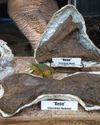
DINOSAURS OF THE HELL CREEK MUSEUM
In the Badlands of South Dakota, just outside the small town of Belle Fourche—pronounced “Bell Foosh”—a new attraction has taken shape that every dinosaur enthusiast should see. The Dinosaurs of the Hell Creek Museum is part hands-on exhibit, part science center and part active research lab.
3 mins
January / February 2026
Rock&Gem Magazine
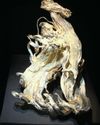
The Lost Twins of Kongsberg
A Silver Story Resurfaced
3 mins
January / February 2026
Rock&Gem Magazine
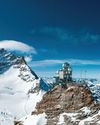
Switzerland's ICE PALACE
Walk Inside a Glacier at The Top of Europe
7 mins
January / February 2026
Translate
Change font size