Versuchen GOLD - Frei
Beating melanoma
WellBeing
|Issue 208
Every six hours an Australian dies of melanoma. Every challenge offers a gift, and our battle with this deadly form of skin cancer has shaped Australia into a world leader in melanoma research and treatment. Here's how to beat our national cancer.

Every 30 minutes, roughly the time it will take you to read this article, someone in Australia is diagnosed with melanoma, says Professor Richard Scolyer, co-medical director of the Melanoma Institute Australia. "It's a big deal in our country." Australians are more likely to develop the deadly form of skin cancer than anywhere else in the world. About 1300 of us die from it each year - it's our third leading cancer battle. New Zealanders suffer from similar rates of the disease.
Everyone should protect against the sun
At the heart of most melanoma and other skin cancers is ultraviolet radiation from the sun. While central to life, this ancient blazing ball of hot gases unleashes deadly electromagnetic radiation on a daily basis. Most of the harmful stuff is absorbed by Earth's atmosphere. What makes it through are mostly infrared wavelengths, which provide the heat, visible light, which enables sight, and ultraviolet (UV) light, invisible to our senses.
UVA's longer wavelengths can sink into the deeper layers of the skin, as well as penetrate glass, causing wrinkles and photo ageing. UVB's shorter wavelengths only infiltrate the top layer, where it's involved in vitamin D synthesis - which can't occur through glass BTW! Too much UVB is the main cause of sunburn and cataracts. Both UVA and UVB can contribute to skin cancers. UVC, the most damaging, is absorbed by the ozone layer, as is most of UVB.

Evolution has provided us with a defence: melanin in the skin. You can blame our melanoma epidemic largely on colonial migration. People with fairer-skinned ancestors have less melanin: they simply haven't evolved to live in the high-UV light conditions that exist in our part of the world, Scolyer explains.
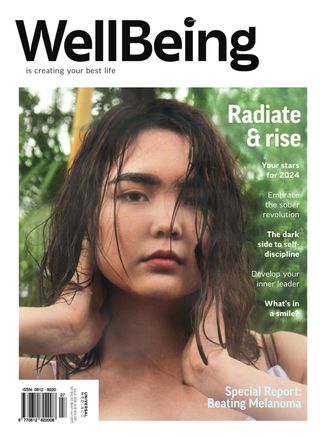

Diese Geschichte stammt aus der Issue 208-Ausgabe von WellBeing.
Abonnieren Sie Magzter GOLD, um auf Tausende kuratierter Premium-Geschichten und über 9.000 Zeitschriften und Zeitungen zuzugreifen.
Sie sind bereits Abonnent? Anmelden
WEITERE GESCHICHTEN VON WellBeing
WellBeing
In Season
These are the fruit and vegetables that are currently in season and so will be the freshest.

1 min
Issue 218

WellBeing
Navigating complementary medicines
For practitioners, quality and evidence matter more than ever. SFI Health is raising the bar with gold-standard formulations that don't compromise on clinical integrity.
5 mins
Issue 218
WellBeing
Too much of a good thing
Even well- intentioned health choices can sometimes contribute to unexpected problems.
3 mins
Issue 218
WellBeing
What we've been up to
WellBeing's editor Dana has been soaking up slow moments of warmth this winter.
1 min
Issue 218

WellBeing
Could creatine have a dark side?
Creatine is a multitalented wonder potion we all need to protect us against the ravages of ageing.
3 mins
Issue 218

WellBeing
ACS Distance Education
The secret to a successful career.
3 mins
Issue 218

WellBeing
Yoga for Energy Vampires
In yoga, prana is our life force and acts as a bridge between universal consciousness and matter.
8 mins
Issue 218
WellBeing
Chinese medicine dietary therapy
Food therapy may augment TCM herbal therapy or sustain improvements after herbal treatments have ceased. It may also be used in prevention, to nourish health and prolong life.
3 mins
Issue 218
WellBeing
AcuEnergetics®
AcuEnergetics received widespread attention in the media when founder Kevin Niv Farrow treated the captain of the NSW State of Origin team Boyd Cordner for a calf injury. Since then, the unique treatment modality has continued to capture the attention of other high-profile sports stars.
1 mins
Issue 218
WellBeing
Honouring a legacy in aromatherapy
Our oils are extracted with precision and care to ensure the active plant compounds remain intact, preserving the therapeutic benefits from field to bottle.
3 mins
Issue 218
Translate
Change font size