
Mit Magzter GOLD unbegrenztes Potenzial nutzen
Erhalten Sie unbegrenzten Zugriff auf über 9.000 Zeitschriften, Zeitungen und Premium-Artikel für nur
Versuchen GOLD - Frei
Understanding Mesh Circuits How to Use and Calculate Them
Circuit Cellar
|October 2024
Microcontrollers and other digital systems concern mostly ones and zeros but when connections to the real word are needed it can get messy. Stuart writes about mesh analysis and how mesh circuits can be calculated and applied in practical scenarios.

When working with microcontrollers and other digital systems, we don't usually have to be concerned about anything but ones and zeros, right? But sometimes our MCU has to connect to the real world, and that can be messy. Sometimes we have to use that algebra that we couldn't see the need for in high school to make sure that we get the inputs or outputs we want and do it without damaging anything in the process. And in some cases, mesh analysis is how we handle that. I want to show you a few simple mesh circuits, and how they may be calculated and applied in practical scenarios. If you went to EE school, you probably saw this material in a fundamentals of electrical engineering course.
SIMPLE MESH CIRCUIT
Figure 1 shows a simple mesh circuit of three resistors. For a review of resistors, see my article "Getting Started with Resistors" in Circuit Cellar issue 382. Let's say that we need to calculate the voltage across the 2K resistor R2. This is fairly simple to do using series/parallel resistor calculations. R2 is 2K, R3 is 3K, so the value of R2 and R3 in parallel is 1.2K.
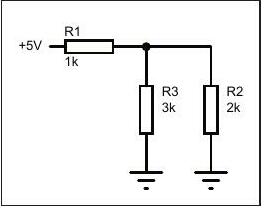 The current through R1 plus the parallel combination of R2 and R3 is:
The voltage across the parallel combination of R2 and R3 is:
2.27ma x 1.2K = 2.73 v
So the current through R2 is 2.73V/2K = 1.36 ma.
This simple example illustrates some general principles of mesh circuits:
•The sum of the currents into a node (connection) is zero. The current flowing into the junction of R1, R2, and R3 has to equal the current flowing out. So the 2.27ma flowing in through R1 has to equal the two currents flowing out through R2 and R3. Note that in doing the calculations, you can (and usually do) assume that all currents are positive, flowing into the circuit. When you do the math, at least one will turn negative.


Diese Geschichte stammt aus der October 2024-Ausgabe von Circuit Cellar.
Abonnieren Sie Magzter GOLD, um auf Tausende kuratierter Premium-Geschichten und über 9.000 Zeitschriften und Zeitungen zuzugreifen.
Sie sind bereits Abonnent? Anmelden
WEITERE GESCHICHTEN VON Circuit Cellar
Circuit Cellar
Combining Nostalgic Design with Embedded Programming
In this article, Maxwell and Noah, two Cornell University undergrads, describe the design and implementation of a retro-inspired, side-scroller game, modeled after Super Mario Bros.

9 mins
May 2026
Circuit Cellar
TI Unveils High-Performance Isolated Power Modules to Advance Power Density in Data Centers and EVs
Texas Instruments (TI) unveiled new isolated power modules, helping enable increased power density, efficiency, and safety in applications ranging from data centers to electric vehicles (EVs).
1 mins
May 2026

Circuit Cellar
Using MapleLink for IoT Device Scanning
A Simple Tool for Probing On-Board Data
10 mins
May 2026

Circuit Cellar
Edge Intelligence
Artificial Intelligence's Next Frontier
11 mins
May 2026

Circuit Cellar
Bringing the World to SBCs
Sensor Shields Bring the Real World to Microcontrollers
7 mins
May 2026

Circuit Cellar
1200V QSiC Dual3 Modules Enable Power Converters with Industry-Leading Conversion Efficiency and Power Density
SemiQ, Inc, a designer, developer, and global supplier of superior silicon carbide (SiC) solutions for ultra-efficient, high-performance, and high-voltage applications, has launched the QSiC Dual3, a family of 1200V half-bridge MOSFET modules for motor drives in data center cooling systems, grid converters in energy storage systems, and industrial drivers.
1 min
May 2026
Circuit Cellar
Marvell Launches Industry's First 260-Lane PCIe 6.0 Switch for AI Data Center Scale-Up Infrastructure
Marvell Technology, Inc., a leader in data infrastructure semiconductor solutions, announced Marvell Structera S 60260, the industry's first 260-lane PCIe 6.0 switch.
1 mins
May 2026
Circuit Cellar
Saelig Introduces Advanced Aim-TTi ADM1055
Saelig Co., Inc., has introduced the Aim-TTi ADM1055 DMM, a next-generation 5½-digit bench digital multimeter engineered to deliver the measurement accuracy, flexible functionality, and seamless integration needed for development labs, production test environments, and educational establishments.
1 mins
May 2026

Circuit Cellar
Granite 4 AI by IBM: Disrupting Traditional Approaches to Embedded Programming
What If Your Edge Device Could Read Its Own Instruction Manual?
9 mins
May 2026

Circuit Cellar
Embedding Ergonomics Into Electronic Design
Tactile Sensing Can Provide Comfort and Fit to Electronics Users
3 mins
May 2026
Listen
Translate
Change font size