Versuchen GOLD - Frei
Thin Film Transistor LED Displays - Visual I/O
Circuit Cellar
|September 2024
To add a resistive touchscreen on top of a TFT display, Jeff explores the technology offerings and libraries needed to accomplish his task. Calibrating the touchscreen's computed coordinates with the actual pixel coordinates of the display proved difficult with a modular framework but separating functions allows easy expansion.
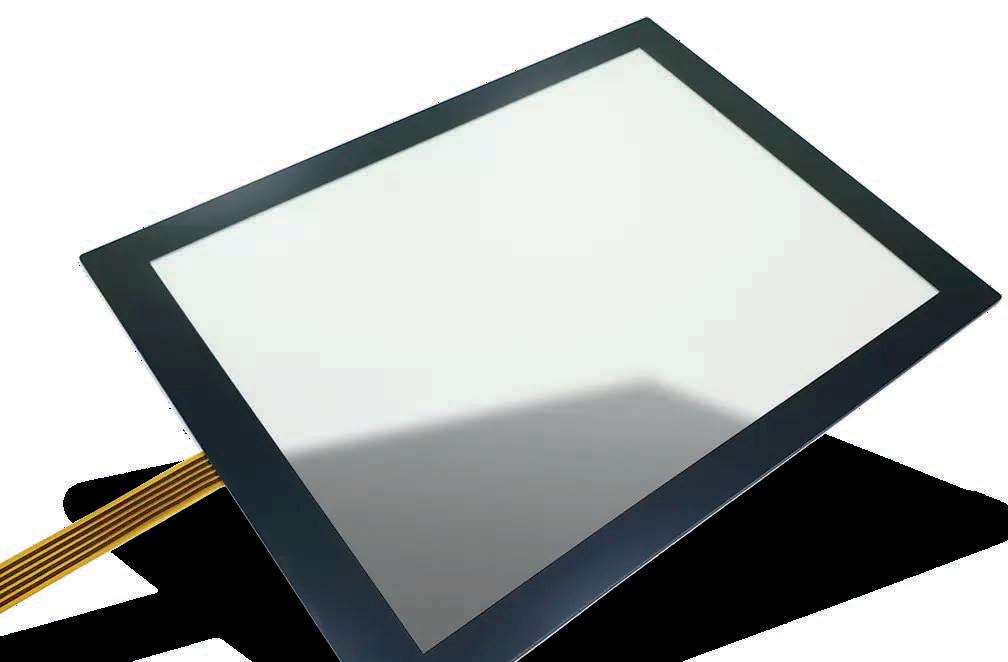
Last month I chose to use a TFT display, based on the simple fact that it was compatible with Arduino UNO shield (Circuit Cellar #409, August, 2024 [1]). That means the display mounts atop an UNO and requires no wiring whatsoever to operate. My micro of choice nowadays is an ESP32. Officially there is no UNO-format ESP32 from Arduino. They do make a NANO format ESP32, but that lacks the Arduino expansion format. Third-party companies such as Wemos offer one, but it's hardly a standard. Using an UNO or MEGA format board with a shield-compatible display board made a lot of sense.
Despite its advantages, a TFT screen cannot emit light on its own, and needs a backlight to generate an image. In this month's column, I add a resistive touchscreen on top of the TFT display
 HOW TFTS AND TOUCHSCREENS WORK
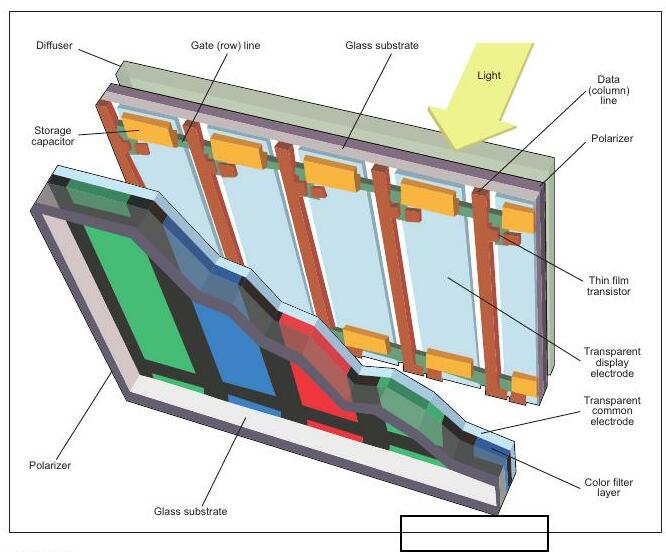
 TFT display: A TFT or "thin-film-transistor" technology display has a sandwich-like structure with liquid crystal material between two glass plates. Referring to Figure 1, you can see the two polarizing and RGB (Red/Green/Blue) color filters, which, combined with two alignment layers, determine the amount of light allowed to pass. An uncharged pixel allows the vertically polarized light to pass unaffected, then it gets blocked by the second horizontal polarizer. When charged, the liquid crystals bend the vertically polarized light 90°, allowing it to pass through the second polarizer. Each pixel in the active RGB matrix is paired with transistors that includes a capacitor to give each sub-pixel the ability to retain its charge. Thus, the TFT layer controls the amount of light allowed to flow through its color filter. The TFT screen, itself, however, can't emit light like an OLED display; it must have a backlight to generate the picture.

Diese Geschichte stammt aus der September 2024-Ausgabe von Circuit Cellar.
Abonnieren Sie Magzter GOLD, um auf Tausende kuratierter Premium-Geschichten und über 9.000 Zeitschriften und Zeitungen zuzugreifen.
Sie sind bereits Abonnent? Anmelden
WEITERE GESCHICHTEN VON Circuit Cellar

Circuit Cellar
Bosch Sensortec Launches BMI423 Inertial Measurement Unit
Smart wearables are always on the move-and so is their sensing technology. Bosch Sensortec introduced the BMI423, a new-generation Inertial Measurement Unit (IMU) that combines extended measurement range with low power consumption.

1 mins
February 2026

Circuit Cellar
Renesas Releases its First Wi-Fi 6 and Wi-Fi/Bluetooth LE Combo MCUs for IoT and Connected Home Applications
Renesas Electronics Corp., a premier supplier of advanced semiconductor solutions, has introduced the RA6W1 dual-band Wi-Fi 6 wireless microcontroller (MCU), along with the RA6W2 MCU that integrates both Wi-Fi 6 and Bluetooth Low Energy (LE) technologies.
1 mins
February 2026

Circuit Cellar
Airborne Embedded Software: Simplifying Safety and Security
With modern airborne systems no longer isolated computing environments, any vulnerabilities introduced into these increasingly connected devices can quickly become much more than just a cybersecurity issue, but a safety risk no one can afford.
4 mins
February 2026

Circuit Cellar
Wearable LIDAR Spatial Audio Navigator for Visually-Impaired Individuals
Built with a Raspberry Pi Pico, a TF-Luna LiDAR Sensor, and a Hand-Held Potentiometer
13 mins
February 2026

Circuit Cellar
ADRs: The Missing Memory in Embedded Projects
Remembering and communicating why design decisions were made and the reasons behind their particular implementations can be critical when it comes to developing software as a team and maintaing that software in the future. This time Jacob shares his thoughts on and experience with one of the most valuable tools to extend the reach of software development memories.
9 mins
February 2026

Circuit Cellar
Sensors: From Canned Tuna to Caviar
In the first installment of a new Circuit Cellar column on sensors, Brian Chee looks at how sensors figure into larger application packages and when \"just enough sensors\" can be the perfect solution.
10 mins
February 2026
Circuit Cellar
Embedded DSP with the RT1010 MCU
Part 2: Delay, Flanger, IIR, and Overdrive
15 mins
February 2026
Circuit Cellar
Omnion Power Provides Modular, Scalable DC Power System Monitoring and Control with New Pulsar 200 Controller
Omnion Power is helping to redefine the role of the DC power system controller with its next-generation Pulsar 200 platform.
1 mins
February 2026

Circuit Cellar
Robot Operating System 2 (ROS 2): Core Concepts, Architecture, and Real-World Capabilities
The Robot Operating System 2 (ROS 2) is an open-source, middleware framework that addresses the communication and coordination challenges inherent in modern, distributed robotic systems. In this article, Pedro details how ROS 2's architectural foundations successfully address the core limitations of its predecessor, ROS 1, using real-world scenarios, and steps for setting up the ROS 2 Foxy environment on Ubuntu Linux distro, and cross-platform communication between a host PC and a Raspberry Pi module.
14 mins
February 2026

Circuit Cellar
Ambiq Unveils Atomiq, the World's First Ultra-Low Power NPU SoC Built on SPOT
Ambiq Micro, Inc., a recognized leader in ultra-low-power semiconductor solutions for edge AI, announced Atomiq, the highly anticipated system-on-chip (SoC) integrating a Neural Processing Unit (NPU) designed to enable real-time, always-on artificial intelligence at the edge.
1 mins
February 2026
Listen
Translate
Change font size