
Mit Magzter GOLD unbegrenztes Potenzial nutzen
Erhalten Sie unbegrenzten Zugriff auf über 9.000 Zeitschriften, Zeitungen und Premium-Artikel für nur
Bringing Cost-Effective, On-Device AI to Home Appliances - Sparse Weights and Interactions Negate GPUs and Cloud Computing
Circuit Cellar
|September 2024
GPU silicon and cloud computing infrastructure are too costly for mass markets devices like refrigerators and washers. By deploying compute resources only to the necessary parts of AI inference, Sparse AI allows product designers to practically incorporate new AI features like natural voice interfaces into their consumer offerings without breaking the bank or electric bill surprises.

Artificial Intelligence (AI) is changing every aspect of consumer product design. Manufacturers are discovering new ways to deploy AI into their products to differentiate in the market with new capabilities, improved efficiency, and reduced operating costs. However, the extreme processing requirements of AI have led manufacturers to implement AI either on-device using a high-cost, AI-capable chip, with a connection to cloud-based AI infrastructure, or both.
These approaches incur design and operating costs that have priced AI out of all but the highest-end products in markets such as white goods/home appliances and other consumer electronics applications. To make AI accessible to cost-sensitive mass markets, we need to bring costs down. This is where sparse AI technology can help. By optimizing AI inference processing by up to 100 times, sparse AI enables developers to implement complex, deep-learning-based AI models using low-cost AI MCU silicon without adversely impacting speed, efficiency, memory footprint, or performance. This article will explore sparse AI and how manufacturers can optimize AI inferencing to reduce cloudbased dependency and infrastructure or even implement powerful AI-based capabilities completely on-device.
SPARSE AI
AI models can be complex and require extensive processing resources and memory. In high-end AI systems, a specialized (and expensive) processor like a GPU runs AI model inferencing on-device. Alternatively, many systems take a cloud-based approach where data is collected on-device and sent to a server for processing.
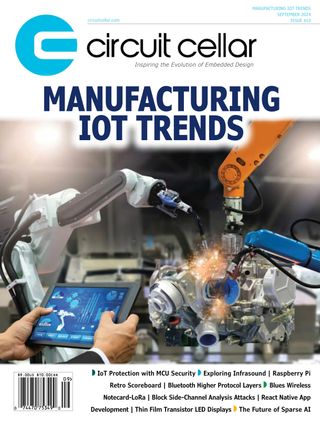

Diese Geschichte stammt aus der September 2024-Ausgabe von Circuit Cellar.
Abonnieren Sie Magzter GOLD, um auf Tausende kuratierter Premium-Geschichten und über 9.000 Zeitschriften und Zeitungen zuzugreifen.
Sie sind bereits Abonnent? Anmelden
WEITERE GESCHICHTEN VON Circuit Cellar
Circuit Cellar
Saelig Introduces Economical AIM-TTI ATG1005 5MHz Function Generator
Saelig Co., Inc. announces the AIM-TTI ATG1005 Touchscreen Function Generator, which uses advanced Direct Digital Synthesis (DDS) technology to deliver high-quality, low-distortion Sine, Square, and Pulse waveforms to 5MHz, and triangle waveforms to 500kHz.

1 mins
January 2026
Circuit Cellar
The Future of Edge AI Ultra-Low Power Edge AI
The Case for Intelligence at the Source
3 mins
January 2026

Circuit Cellar
IR Images Come to Your Cellphone
In this article Brian uses a Melexis MLX90640 IR camera module coupled to an ESP32 controller. He streams the image data to a web browser running on a cell phone, tablet, or computer, eliminating the need for a dedicated color LCD. Together, this makes for a very low-price IR camera.
20 mins
January 2026

Circuit Cellar
STMicroelectronics' Intelligent Power Switch Automatically Adjusts to Handle Inrush Current
STMicroelectronics' IPS1050LQ low-side switch IC provides flexible overcurrent protection, including a static mode with fixed, programmable current limit and a dynamic mode that safely handles high inrush current.
1 min
January 2026

Circuit Cellar
Nordic Semiconductor Unveils nRF54LV10A - Breakthrough Low-Voltage Bluetooth LE SOC for Next-Gen Healthcare Wearables
Nordic Semiconductor, a global leader in low-power wireless connectivity solutions, launches the nRF54LV10A SoC, setting a new benchmark for integration, performance, and battery life in the smallest medical devices.
2 mins
January 2026

Circuit Cellar
SemiQ Expands 1200V Gen3 SiC MOSFET Line with Launch of 7.4, 14.5, and 34m2 SOT-227 Modules
SemiQ Inc, a designer, developer, and global supplier of superior silicon carbide (SiC) solutions for ultra-efficient, high- performance, and high-voltage applications, has expanded its family of 1200V Gen3 SiC MOSFETs, launching five SOT- 227 modules that offer RDSon values of 7.4, 14.5, and 34mΩ.
1 min
January 2026

Circuit Cellar
Datasheet: Power Quality Monitoring Watching the Peaks and Valleys
Systems for Monitoring Power Quality for Homes and Industry
2 mins
January 2026

Circuit Cellar
Build a Miniature Greenhouse for Hydroponic and Potted Plants
Automated Monitoring with a Raspberry Pi 4B
10 mins
January 2026

Circuit Cellar
The Pulse of Innovation 600
The Rise of Wearable Technology
18 mins
January 2026

Circuit Cellar
Build a Smart Energy Meter to Track Home Power Use
Using an ESP32 Dev Kit and PZEM-004T Energy Sensor Module
12 mins
January 2026
Listen
Translate
Change font size