Versuchen GOLD - Frei
THE RACE TO DECIPHER ANCIENT EGYPT, SACRED SCRIPT
BBC History UK
|October 2022
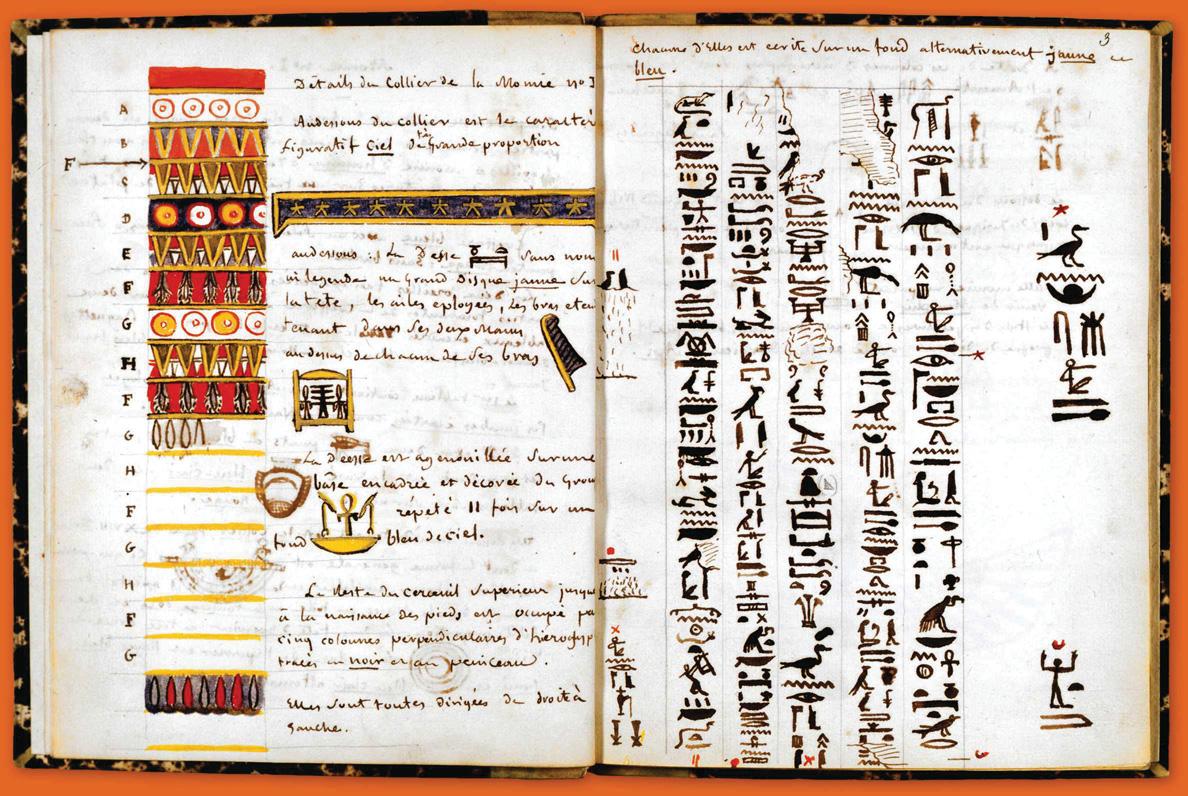
The discovery of the Rosetta Stone in 1799 breathed life into a quest long deemed impossible: the reading of Egyptian hieroglyphics. Toby Wilkinson tells the tale of the two rivals who raced to be first to crack the code

For more than 40 generations, no living soul was able to read an ancient Egyptian text. Even before the last-known hieroglyphic inscription was carved (in August AD 394), detailed understanding of the script had all but died out in the Nile Valley, save for a few members of the elite. As those with the specialist knowledge also dwindled, speculation took over and fanciful theories sprang up about the meaning of the mysterious signs seen adorning Egyptian monuments.
As early as the first century BC, the Greek historian Diodorus Siculus had averred that the script was “not built up from syllables to express the underlying meaning, but from the appearance of the things drawn and by their metaphorical meaning learned by heart”. In other words, it was believed hieroglyphics did not form an alphabet, nor were they phonetic (signs representing sounds). Instead, they were logograms, pictures with symbolic meaning.
This was a fundamental misconception, and deflected scholars from decipherment for the following 19 centuries. The European Enlightenment’s ablest philologists (those who study the history and development of languages) deemed the task to be impossible. English antiquarian William Stukeley said in the early 18th century: “The characters cut on the Egyptian monuments are purely symbolical… The perfect knowledge of ’em is irrecoverable.” Five decades later, French orientalist Antoine Isaac Silvestre de Sacy dismissed the work of deciphering the writing as “too complicated, scientifically insoluble”.

Diese Geschichte stammt aus der October 2022-Ausgabe von BBC History UK.
Abonnieren Sie Magzter GOLD, um auf Tausende kuratierter Premium-Geschichten und über 9.000 Zeitschriften und Zeitungen zuzugreifen.
Sie sind bereits Abonnent? Anmelden
WEITERE GESCHICHTEN VON BBC History UK

BBC History UK
On the skids
Richard Rodgers and Oscar Hammerstein II's smash musical Oklahoma! opened on Broadway on 31 March 1943.

1 min
Christmas 2025

BBC History UK
Small pleasures
Memory is imperfect, but what if you could get a professional model maker to recreate a moment from the past?
1 min
Christmas 2025

BBC History UK
Bath in five places
In the Georgian era, Bath became arguably Britain's most fashionable destination. KIRSTEN ELLIOTT promenades five historic highlights
3 mins
Christmas 2025
BBC History UK
End times
Why do civilisations that dominated their epoch fail? In an era of autocracy, climate change, the rise of Al and a first-hand understanding of how deadly pandemics can be, it's a question that seems pertinent.
1 min
Christmas 2025
BBC History UK
What are the origins of the Yule Lads?
To learn about the Jólasveinar (Yule Lads), we must start with their mother, the terrifying ogress Grýla. Her name appeared in Icelandic texts as early as the 13th century, although it wasn’t until later that those 13 mischievous lads became associated with her. Folk tales and poems tell how she descends from the mountains with an empty sack to stuff full of children. Grýla owns the monstrous Jólaköttur (Yule Cat), which roams the countryside on Christmas Eve, searching for children to gobble up if they're not wearing new clothes.
1 mins
Christmas 2025

BBC History UK
Santa Claus v Father Christmas
The true identity of the white-bearded, red-robed figure who fills children's stockings at Christmas has long been debated. Thomas Ruys Smith sizes up the merry contenders
8 mins
Christmas 2025

BBC History UK
Frontier friction
Set in Washington Territory in 1854, The Abandons is a Western that's unusual for having two matriarchs, women whose lives become entangled, at its centre.
1 min
Christmas 2025

BBC History UK
The Last Days of Pompeii: The Immersive Experience
Delve into the culture of daily Roman life, witness the momentous eruption of Mount Vesuvius, and follow its fallout in Immerse LDN's new exhibition. In a blend of cutting-edge technology and vivid storytelling, this exhibition launches visitors into Pompeii's rich history with recreations of the ancient city's beautiful pre-eruption landscape, a 360-degree virtual reality Roman amphitheatre experience, and a digital metaverse recreating Pompeii's 'Villa of Mysteries'.
1 min
Christmas 2025

BBC History UK
Elizabeth Marsh The corsair's captive
Taken hostage by a Barbary ship's captain in the 18th century, a young Englishwoman found herself fighting for her freedom in Marrakech. ADAM NICHOLS introduces a brave captive who later wrote a book about her dramatic experiences
6 mins
Christmas 2025

BBC History UK
29 DECEMBER 1170: Thomas Becket is murdered in Canterbury
Knights loyal to Henry II rid him of the “low-born cleric”
2 mins
Christmas 2025
Translate
Change font size