
Mit Magzter GOLD unbegrenztes Potenzial nutzen
Erhalten Sie unbegrenzten Zugriff auf über 9.000 Zeitschriften, Zeitungen und Premium-Artikel für nur
Versuchen GOLD - Frei
POSTCARD FROM KENT
Best of British
|November 2024
Bob Barton investigates a network of caves, takes a ride on a thriving heritage railway, and marvels at the beauty of the garden of England
-

Though I was born 10 years after the end of World War Two, I have an enduring childhood memory of clambering around a disused air raid shelter. It was reached, after negotiating clumps of stinging nettles, in an area we called the dump, near where we lived. Inside, it was pitch black and cavernous, with several underground chambers. My intrepid pals and I would explore without the benefit of a light - not even a match.
These days, it would be securely cordoned off, but not then.
Those memories came flooding back when I took a tour of one of the largest public wartime shelters in the country. I'm not referring to a bunker in a city centre but a network of caves in deepest Kent. Chislehurst Caves (020 8467 3264, chislehurst-caves. co.uk) were quickly (and unofficially) used as a shelter when the bombing of London started in 1940. Soon, people thronged there by the thousands each evening. The caverns grew into an underground city of sorts.
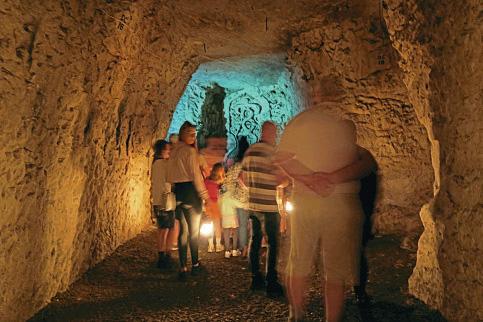 I joined one of the regular guided tours. Our small group was shown bunk beds of the sort used by sheltering families. Areas set up as a chapel, canteen, first aid station, lavatories - even a bank, post office and dentist surgery - were pointed out by our guide, Darren. Most of the vast labyrinth is unlit, so we were handed paraffin-burning hurricane lamps. Their flickering flames cast strange shadows on the walls, some of which are decorated with elaborate carvings.
The caves aren't a natural feature but entirely man-made. Technically, they are mines as they were hacked out of the ground by Romans, Saxons and their successors. Men dug for chalk and flint. During World War One, the space provided a ready-made ammunition depot.

Diese Geschichte stammt aus der November 2024-Ausgabe von Best of British.
Abonnieren Sie Magzter GOLD, um auf Tausende kuratierter Premium-Geschichten und über 9.000 Zeitschriften und Zeitungen zuzugreifen.
Sie sind bereits Abonnent? Anmelden
WEITERE GESCHICHTEN VON Best of British
Best of British
The Medway Queen Club
Richard Halton recalls a little ship of Dunkirk's time as a nightclub

6 mins
May 2026

Best of British
Red Giant
Chris Hallam pays tribute to a co-creator of Red Dwarf
5 mins
May 2026
Best of British
Freddie in the Overworld
Philip and David Williams investigate Freddie Garrity's life beyond the Dreamers
5 mins
May 2026
Best of British
Looking Back (in Anger)
Colin Mayo celebrates the 70th anniversary of John Osborne's groundbreaking play
5 mins
May 2026

Best of British
BACK INSIDE THE TARDIS
Oliver Crocker travels back in time to explore the 1996 Doctor Who TV movie
12 mins
May 2026
Best of British
Spymaster
Chris Hallam pays tribute to spy writer and cookery expert Len Deighton
5 mins
May 2026
Best of British
BACK IN TIME WITH COLIN BAKER
BoB's very own Time Lord recalls corpsing in front of an audience of one, and how his return to Doctor Who on TV was a heartening experience
2 mins
May 2026

Best of British
RAINING CHAMPIONS
The nearest I get to watching the Eurovision Song Contest these days is pointing the remote control at the screen to change channels the moment I hear the opening notes of Te Deum.
1 mins
May 2026
Best of British
Better Than the Captain's Table
Simon Stabler visits a pair of Brighton dining favourites
2 mins
May 2026
Best of British
The Great Exhibition
Michael Montagu celebrates the beginning of the Crystal Palace and draws on his family's accounts of its destruction
9 mins
May 2026
Listen
Translate
Change font size