Versuchen GOLD - Frei
Life Between the Tides
Muse Science Magazine for Kids
|July/August 2022
SURVIVING THE INTERTIDAL ZONE ALONG CATALINA ISLAND

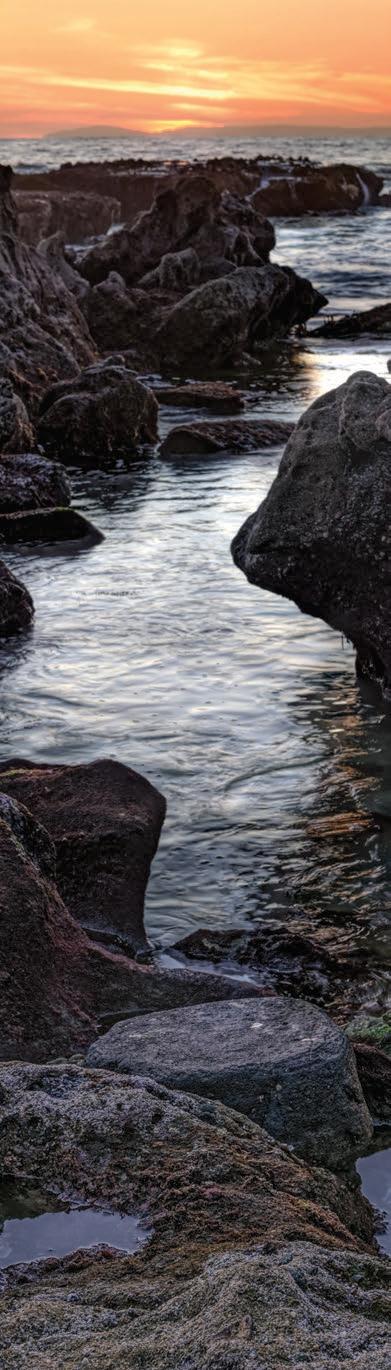
At first glance, the tumbled rocks at the edge of the ocean cove where I once lived look lifeless-too rugged a place for animals to make their home. But explore these boulders, and you'll meet a fascinating community of creatures that survive in the harsh intertidal zone.
The intertidal zone lies along the ocean's edge. In this unique habitat, the water level changes with the Moon-driven tides. At high tide, seawater covers shoreline that might be several feet, or a few meters, above water at low tide.
Catalina Island's Intertidal Zone
On Catalina Island, 20 miles (32 km) off the coast of Southern California, much of the intertidal habitat is rocky and rough. I worked as a teacher at Catalina Island Marine Institute, an outdoor marine science school that students from fourth grade to twelfth grade visit to learn about the ocean. I loved taking my classes to investigate our constantly changing intertidal zone.
Let's explore this wondrous environment between the tides!
First, listen to the constant rhythm of the intertidal world: a whoosh as blue-green water pours into cracks around the rocks, a gargle as the frothy water is sucked back out.

If we watched one patch of intertidal rock all day, we'd see water swirl over it at high tide, the Sun bake it at low tide, and waves pound on it in between. In California and most places on Earth, there are two high tides and two low tides each lunar day. (A lunar day is the time it takes the Moon to orbit Earth, which is about 24 hours and 50 minutes.)
It's almost low tide now, the perfect time to find intertidal creatures out of the water. Let's go-be careful on the slippery rocks!

Diese Geschichte stammt aus der July/August 2022-Ausgabe von Muse Science Magazine for Kids.
Abonnieren Sie Magzter GOLD, um auf Tausende kuratierter Premium-Geschichten und über 9.000 Zeitschriften und Zeitungen zuzugreifen.
Sie sind bereits Abonnent? Anmelden
WEITERE GESCHICHTEN VON Muse Science Magazine for Kids

Muse Science Magazine for Kids
ANIMAL FIREFIGHTER TO THE RESCUE
Can animals help manage the risks of deadly wildfires?

3 mins
Muse July 2025: The Story Behind Wildfires

Muse Science Magazine for Kids
FIRE DANGER
WHY THE RISK OF WILDFIRES KEEPS GROWING
4 mins
Muse July 2025: The Story Behind Wildfires
Muse Science Magazine for Kids
The Miller NEW Normal
WHAT TODAY’S WILDFIRES TELL US ABOUT OUR FUTURE
8 mins
Muse July 2025: The Story Behind Wildfires

Muse Science Magazine for Kids
WOMEN AND FIREFIGHTING: A GOOD FIT
Jessica Gardetto is a firefighter. Her father was, too. “I grew up with my dad coming home smelling like wildfire and covered in soot,” she says.
1 min
Muse July 2025: The Story Behind Wildfires

Muse Science Magazine for Kids
What is happening on your fingertips when they get all wrinkly in a hot tub?
—Felix G., age 10, Montana
1 mins
Muse July 2025: The Story Behind Wildfires

Muse Science Magazine for Kids
WHEN the SMOKE CLEARS
THE LINGERING EFFECTS OF THE RECENT PACIFIC PALISADES AND ALTADENA EATON FIRES
6 mins
Muse July 2025: The Story Behind Wildfires

Muse Science Magazine for Kids
PICKING TEAMS
Keep it fair with a strategy that relies on geometry.
2 mins
Muse July 2025: The Story Behind Wildfires

Muse Science Magazine for Kids
SHAN CAMMACK
WILDLIFE BIOLOGIST AND FIRE SAFETY OFFICER
3 mins
Muse July 2025: The Story Behind Wildfires
Muse Science Magazine for Kids
Scientists Create Mice With Woolly Mammoth-Like Fur
RESEARCHERS AT A COMPANY IN TEXAS ARE WORKING TO CREATE A LIVING ANIMAL THAT RESEMBLES THE EXTINCT WOOLLY MAMMOTH. Recently, they produced mice with traits of the large mammal. The mice all have coats with mammoth-like fur, and some of the small mammals also have genes that help them store fat. Both features would help the animals survive in the cold Arctic, where the woolly mammoth once lived.
1 min
Muse July 2025: The Story Behind Wildfires

Muse Science Magazine for Kids
Cool Sunshade Added to the Nancy Roman Space Telescope
THE NANCY ROMAN SPACE TELESCOPE IS A NEW TELESCOPE THAT NASA IS BUILDING AND WILL LAUNCH INTO SPACE, LIKELY IN EARLY 2027.
1 min
Muse July 2025: The Story Behind Wildfires
Translate
Change font size