Versuchen GOLD - Frei
COSO'S ENTERPRISE RISK MANAGEMENT FRAMEWORK
THE INSURANCE TIMES
|September 2022
The Committee of Sponsoring Organisations of the Treadway Commission (COSO) was established in the mid-1980s, initially to sponsor research into the causes of fraudulent financial reporting. Its current mission is to: 'help organizations improve performance by developing thought leadership that enhances internal control, risk management, governance and fraud deterrence.'
-

COSO
Although COSO's guidance is non-mandatory, it has been influential because it provides frameworks against which risk management and internal control systems can be assessed and improved. Corporate scandals, arising in companies where risk management and internal control were deficient, and attempts to regulate corporate behaviour as a result of these scandals have resulted in an environment where guidance on best practice in risk management and internal control has been particularly welcome.
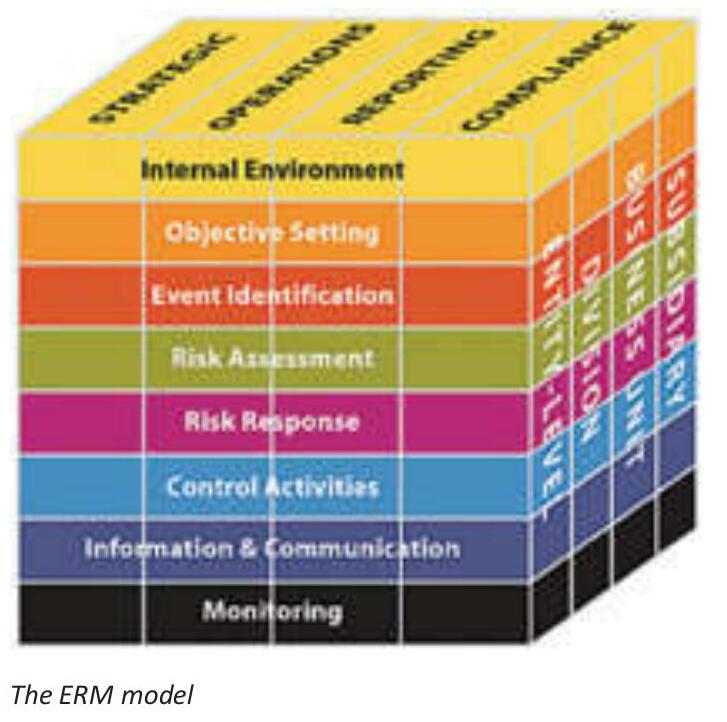
The ERM model
COSO originally created an enterprise risk management (ERM) model in 1992 which was shaped like a pyramid and focused on the evaluation of existing controls. This was updated in 2013 to the COSO cube, which focused on the design and implementation of a risk management framework. The COSO cube became a widely-accepted framework for organisations to use and it became established as a model that could be used in different environments worldwide.
COSO intended the cube to illustrate the links between objectives that are shown on the top and the eight components shown on the front, which represent what is needed to achieve the objectives. The third dimension represents the organisation's units, which portrays the model's ability to focus on parts of the organisation as well as the whole.
There are a number of issues under each of the eight components listed on the front of the cube that organisations have had to tackle - issues which can be featured in exam questions for the Strategic Business Leader (SBL) exam.
Internal environment
The internal environment establishes the tone of the organisation, influencing risk appetite, attitudes towards risk management and ethical values.

Diese Geschichte stammt aus der September 2022-Ausgabe von THE INSURANCE TIMES.
Abonnieren Sie Magzter GOLD, um auf Tausende kuratierter Premium-Geschichten und über 9.000 Zeitschriften und Zeitungen zuzugreifen.
Sie sind bereits Abonnent? Anmelden
WEITERE GESCHICHTEN VON THE INSURANCE TIMES

THE INSURANCE TIMES
Claims, Complaints, and the Limits of Technology in Indian Insurance
India's insurance sector has made meaningful progress over the past decade. Digital onboarding, video KYC, instant policy issuance, and app-led servicing have significantly reduced friction at the point of sale. Yet one part of the value chain continues to attract disproportionate dissatisfaction claims.

4 mins
January 2026
THE INSURANCE TIMES
Age & Term Insurance
Age & Term Insurance: Large, Larger & Unwind
3 mins
January 2026

THE INSURANCE TIMES
Insurance Reforms and the Reality Check: Beyond the Promise of 100% FDI
The recent amendments to India’s insurance laws, including the decision to permit 100 per cent foreign direct investment (FDI), have been widely described as transformational.
2 mins
January 2026

THE INSURANCE TIMES
International News
Global reinsurance major Munich Re has unveiled its long-term strategic roadmap titled Ambition 2030, outlining a clear focus on sustained profitability, disciplined growth and capital efficiency over the rest of the decade.
4 mins
January 2026

THE INSURANCE TIMES
Sabka Bima Sabki Raksha (Amendment of Insurance Laws) 2025 - Strategic Significance
The recent amendment to India's insurance laws marks one of the most consequential regulatory reforms in the sector since liberalisation. This article examines the key provisions of the amendments, the rationale behind them, and their likely impact on insurers, intermediaries, investors, and consumers.
5 mins
January 2026

THE INSURANCE TIMES
A Place Called Safety
Through our patented insurance innovation, we are manufacturing articles of utility from insured salvage. An 'article of utility' can best be described as any piece of article which we use in our daily lives. They are the articles of regular use. These articles are manufactured from insurance salvage.
9 mins
January 2026
THE INSURANCE TIMES
The POS Model in the Insurance Industry - Expanding Reach through Simplified Distribution
The Point of Sales Person (POSP) model has emerged as a transformative distribution channel in the insurance industry, particularly in markets like India where insurance penetration remains relatively low.
4 mins
January 2026
THE INSURANCE TIMES
New Product Launches
Tata AIA Life Insurance has unveiled its latest product, Shubh Family Protect, a first-of-its-kind term insurance solution designed to cover multiple family members under a single plan.
2 mins
January 2026

THE INSURANCE TIMES
Insurance Technology & Digital Transformation
Artificial intelligence (AI) and machine learning (ML) are at the forefront of insurance digitalization. Al-driven underwriting tools have been adopted by 60% of insurers, enhancing accuracy and efficiency in risk assessment through predictive analytics.
4 mins
January 2026
THE INSURANCE TIMES
IRDAI Corner
Permitting insurers' investments in AT1 bonds and Tier 2 Capital of RBI regulated All India Financial Institutions (AIFIs)
3 mins
January 2026
Translate
Change font size