
Mit Magzter GOLD unbegrenztes Potenzial nutzen
Erhalten Sie unbegrenzten Zugriff auf über 9.000 Zeitschriften, Zeitungen und Premium-Artikel für nur
Versuchen GOLD - Frei
Shearer training for improved performance
Stockfarm
|February 2026
Lungani Maqakalana has sheep shearing in his blood. Both his father and uncle were shearers, and from a young age he aspired to follow in their footsteps.
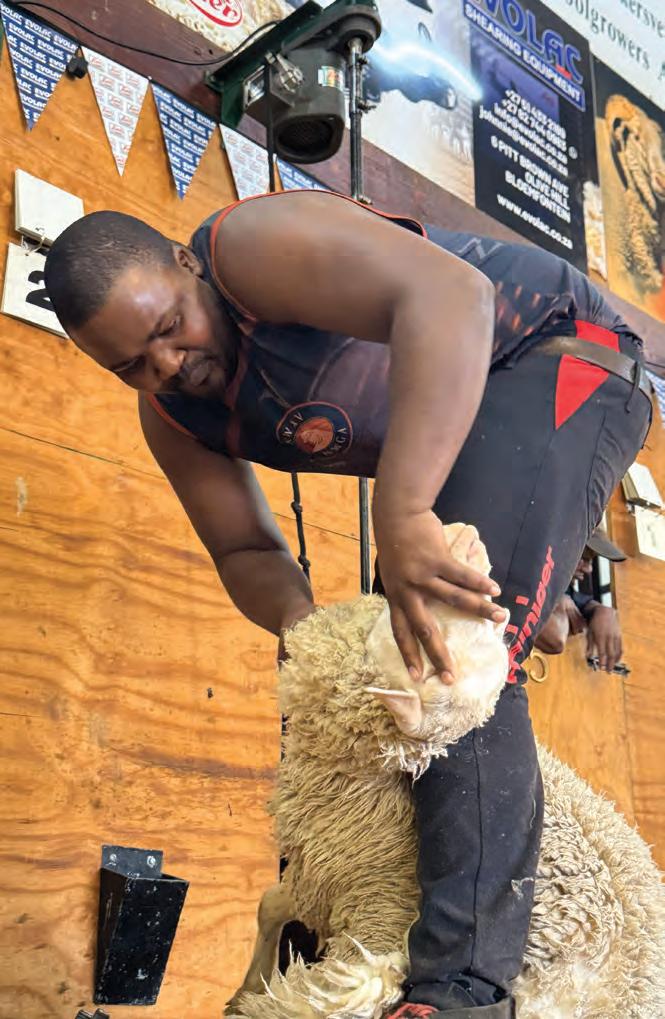
Originally from Sterkspruit in the Eastern Cape close to the Lesotho border, Maqakalana began shearing while still in Grade 10. "When we slaughtered sheep, I first had to shear them. That's how it started," he recalls. "My father and uncle were very good teachers." After finishing school in 2015, he decided to pursue shearing full time and joined a shearing team called Japtrap, where his uncle served as foreman. He started out as a wool worker and, in 2016, progressed to become a machine shearer.
From competitor to trainer
"From the beginning, I was eager to test my skills in competitions. My very first competition was in Philippolis in 2017, and I made the finals. From that day on, I fell in love with competing and entered every competition I could."
It was during this period that he caught the attention of the National Wool Growers' Association (NWGA). DG Snyman of DG Snyman Shearing Services approached him and encouraged him to further develop his skills. "He told me I was still young, but that I had the potential to become a great shearer," Maqakalana recalls.
In 2020, he was contacted by Izak Klopper, head of shearer training at the NWGA, inviting him to join the association's shearer training team.
"To be a good shearing instructor, you need to speak several languages so that you can communicate clearly with shearers and farmers," Maqakalana explains.
"Farmers must understand exactly what your role is, while shearers need clear, technical guidance on how to improve their technique." He speaks Xhosa, Sesotho, Afrikaans, and English.

Diese Geschichte stammt aus der February 2026-Ausgabe von Stockfarm.
Abonnieren Sie Magzter GOLD, um auf Tausende kuratierter Premium-Geschichten und über 9.000 Zeitschriften und Zeitungen zuzugreifen.
Sie sind bereits Abonnent? Anmelden
WEITERE GESCHICHTEN VON Stockfarm
Stockfarm
Tackle mastitis in dairy COWS
Mastitis is one of the most significant challenges in the dairy industry, reducing milk yield and overall profitability.

5 mins
February 2026
Stockfarm
Ewe nutrition for a healthy lamb crop
Producers widely acknowledge that the success of any sheep enterprise depends heavily on the potential and management of the farm’s female animals.
4 mins
February 2026
Stockfarm
Does chop length really matter?
Chop length is a critical factor in producing successful silage. Mistakes made during this initial stage can have lasting, irreparable effects.
2 mins
February 2026
Stockfarm
Place these ticks on your autumn watch list
Heavy tick infestations and an increase in the incidence of tickborne diseases such as redwater, gallsickness, and heartwater remain a serious challenge for livestock producers in South Africa, particularly when environmental conditions favour these parasites. Effective control strategies and sound management practices are therefore essential.
2 mins
February 2026
Stockfarm
The grazing paradox: Towards better data
Producers are often under pressure to reassess their grazing strategies and consider dramatic management changes aimed at sustainability.
5 mins
February 2026

Stockfarm
Shearer training for improved performance
Lungani Maqakalana has sheep shearing in his blood. Both his father and uncle were shearers, and from a young age he aspired to follow in their footsteps.
4 mins
February 2026
Stockfarm
Misuse of an employer's property
An employer's property is an integral part of the business infrastructure. Any loss, damage, accidental misuse, intentional misuse, or waste of this property constitutes serious misconduct, placing unnecessary strain on the employer to repair or replace it.
2 mins
February 2026
Stockfarm
The dynamics of the South African lucerne hay industry: Grading and quality
In the January issue of Stockfarm, part one of this series explored the role of lucerne hay in South Africa's animal feed industry.
5 mins
February 2026
Stockfarm
Functional efficiency in small stock
Functional efficiency, the combination of structural soundness, adaptability, mobility, mothering ability, and reproductive capability, is as important as genetic merit for economically important, measurable traits.
3 mins
February 2026
Stockfarm
Managing breeding stock and unsold weaner calves
Persistent outbreaks of foot-and-mouth disease (FMD) have dealt a severe blow to the South African cattle industry.
1 mins
February 2026
Listen
Translate
Change font size