Circular agriculture in practice: A regenerative and profitable model
Stockfarm
|January 2026
On their family farm in Himeville, KwaZulu-Natal, the Eustaces have developed a system that balances profitability with regeneration and sustainability, giving outputs a second life and adding value wherever possible.
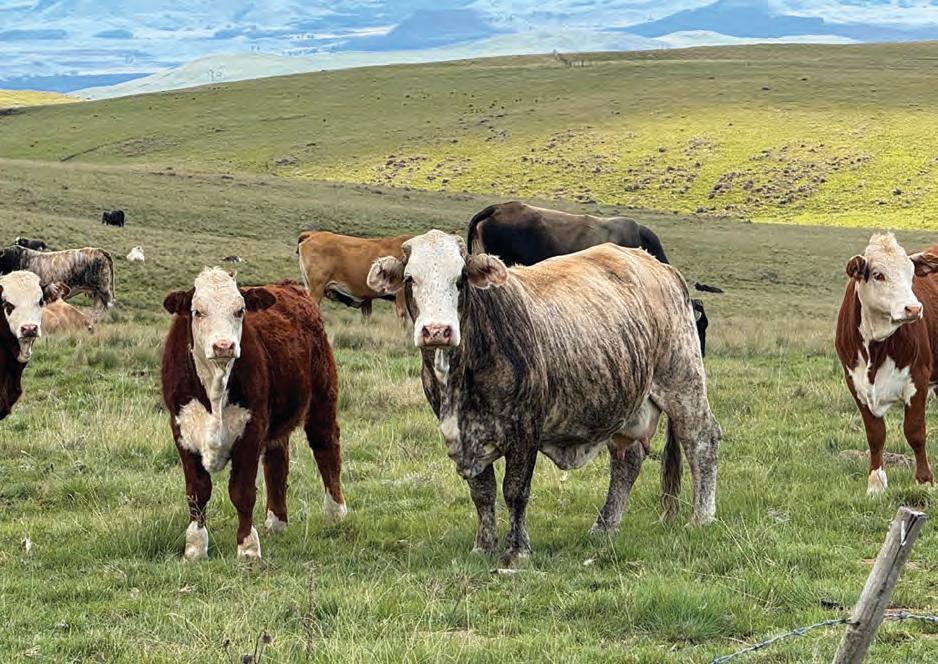
Their approach exemplifies the circular economy by transforming agricultural waste into resources, enhancing ecosystem health, and reducing dependence on external inputs.
Pat's father, Charles, bought the farm in 1936 when he moved to the area as a wool advisor for the Farmers’ Cooperative Union (FCU). Pat joined him after finishing school in 1964, and John followed in 1997. The Eustaces are committed to efficiency and effectiveness, running a mixed farming system that combines extensive livestock farming with intensive cropping.
They employ techniques such as genetic technology, precision planting, biostimulants, water monitoring, and no-till mechanisation in their cropping system. In terms of their livestock division, they focus on breeding naturally hardy and strong animals with minimal medical intervention, good conception and birth statistics, and efficient feed conversion.
Himeville lies in a high rainfall (850mm) sourveld area, with a high carrying capacity in summer but very low-quality grazing in winter. On its own, beef cattle require about 2,5ha/LSU (large-stock unit). By integrating sheep into the system, the Eustaces have reduced this figure and improved the productivity of the land without degrading it.
Employing circular practices
Rather than reshaping the land to fit industrial production, they work in harmony with the local environment (rainfall patterns, grazing capacity, and mountainous terrain). The farm has been in their family for 90 years, with each generation contributing knowledge and sustainable practices instead of merely extracting more from the land. “Circularity begins with respecting what the land can provide, not demanding more than it can give,” explains John.

Diese Geschichte stammt aus der January 2026-Ausgabe von Stockfarm.
Abonnieren Sie Magzter GOLD, um auf Tausende kuratierter Premium-Geschichten und über 9.000 Zeitschriften und Zeitungen zuzugreifen.
Sie sind bereits Abonnent? Anmelden
WEITERE GESCHICHTEN VON Stockfarm

Stockfarm
World School Milk Day: A national celebration of dairy
The Department of Basic Education (DBE), in partnership with Milk SA's Consumer Education Project (CEP), marked the national celebration of World School Milk Day (WSMD) at Mandlomsobo Primary School in Bronkhorstspruit on 26 September.

2 mins
January 2026
Stockfarm
A breed that you like will work with you
Data can't fix what selection broke, and your grandpa knew it.
4 mins
January 2026
Stockfarm
2025 Santam Agriculture Silage Competition: Wet conditions, winning silage
Plaas Media's twelfth Santam Agriculture National Silage Competition once again showcased impressive expertise among its participants.
4 mins
January 2026
Stockfarm
Unravelling the regulations for dairy and imitation dairy products
Regulation R1510 of 22 November 2019, which governs dairy and imitation dairy products, recently took centre stage during a webinar hosted by the Dairy Standard Agency (DSA). Thabang Rampa, manager of regulatory affairs at the DSA, provided a technical interpretation of key sections of the regulation, aimed at improving industry's understanding of the prescribed minimum compositional and labelling requirements.
3 mins
January 2026

Stockfarm
2025 ARC National Master Dairyman Awards: Top dairy farmers honoured
The Agricultural Research Council (ARC) announced the winners of its 2025 National Master Dairyman Awards during a ceremony held in November at Lanzerac Estate in Stellenbosch.
2 mins
January 2026
Stockfarm
Abattoirs: The hidden pulse of meat safety
In conversations regarding the meat supply chain, the first and final links tend to take prominence, while the work performed by the middlemen often goes unnoticed. Yet every link plays a vital role. The real question is: Do we truly understand the value each link adds? Or has ‘value addition’ become shorthand for 'price addition, leaving producers and consumers feeling the financial strain?
5 mins
January 2026
Stockfarm
Silage equipment you can't do without
Silage is an invaluable resource on many livestock farms but producing it is not always simple or cheap.
3 mins
January 2026
Stockfarm
The value of a vaccination programme for cattle
Vaccination is essential for any cattle operation, especially given the increasing risk of disease outbreaks. According to Dr Paul Reynolds, a veterinarian at the Warden and Vrede Animal Hospitals, vaccines are never developed arbitrarily. Each exists because a specific disease threat warranted it.
4 mins
January 2026
Stockfarm
Silage competition winners: Key success factors
The Santam Agriculture National Silage Competition once again delivered impressive results, maintaining its high standards and enthusiastic participation. This year’s judging spanned six key categories: nutrient composition, fermentation quality, aerobic stability, top-layer losses, compaction or density, and visual assessment.
2 mins
January 2026
Stockfarm
Why use a silage inoculant?
Producing high-quality silage is critical for any livestock operation, especially in regions where seasonal forage shortages are common. One of the most effective ways to improve silage fermentation and preservation is with a silage inoculant.
2 mins
January 2026
Listen
Translate
Change font size