
Mit Magzter GOLD unbegrenztes Potenzial nutzen
Erhalten Sie unbegrenzten Zugriff auf über 9.000 Zeitschriften, Zeitungen und Premium-Artikel für nur
Versuchen GOLD - Frei
MIL MI-8: THE MOST PRODUCED HELICOPTER IN HISTORY
SP’s Aviation
|Issue 7, 2025
When the Mi-8 was first displayed at the 1965 Paris Air Show, it created a sensation. Western analysts had long considered Soviet technology inferior to that of the West, but the comments about the Mi-8 were mainly positive.
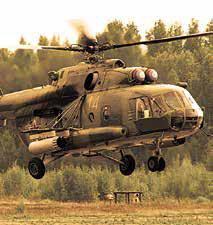
THE MIL MI-8 IS A VERSATILE, MEDIUM-LIFT, TWIN-TURBINE helicopter, in widespread use in both military and civilian roles, particularly as a transport helicopter. It holds the distinction of being the most produced helicopter ever. The design of this iconic machine was drawn up in the 1950s by the Mil Design Bureau, headed by Mikhail Mil. Mil believed that gas turbine engines would revolutionise helicopter construction and make a breakthrough both in flight performance and economic efficiency. During over six decades of production, perhaps 17,000 Mi-8s have been delivered to around 80 countries worldwide. 'Eights', as they are colloquially called, are still being built, and continue in service all over the world. Both Russia and Ukraine utilise them in their ongoing conflict.
The Mi-8 story began with Soviet Prime Minister Nikita Khrushchev who, on a visit to the USA in September 1959, was taken on a trip aboard the US presidential helicopter. This was the age of intense superpower rivalry, when the refrain was, "Anything you can do, I can do better!" Khrushchev wanted something to impress the US president on his reciprocal visit to the Soviet Union. In the meantime, the Soviet military, was also planning a new and better machine to replace the existing Mi-4. Consequently, a team of developers soon got to work on the proposed helicopter.

Diese Geschichte stammt aus der Issue 7, 2025-Ausgabe von SP’s Aviation.
Abonnieren Sie Magzter GOLD, um auf Tausende kuratierter Premium-Geschichten und über 9.000 Zeitschriften und Zeitungen zuzugreifen.
Sie sind bereits Abonnent? Anmelden
WEITERE GESCHICHTEN VON SP’s Aviation

SP’s Aviation
AVIATION'S NEW FUEL DIVIDE
Differential fuel pricing emerges for the first time, raising questions on cost allocation and the future of business aviation

3 mins
Issue 4, 2026

SP’s Aviation
LESSONS FROM THE IRAN WAR
How Air Power Shaped the USA/Israel-Iran War and Strategic Lessons from the Conflict
7 mins
Issue 4, 2026

SP’s Aviation
ACCELERATING MARKET MOMENTUM
With Record participation, AERO Friedrichshafen 2026, Europe's Leading General Aviation Show, Delivers a Landmark Edition
5 mins
Issue 4, 2026
SP’s Aviation
MAJOR IAF BOOST WITH RAFALE, MTA AND AEW&C DEALS
The scale of acquisitions signals a shift from incremental upgrades to preparing for high-intensity, technology-led warfare. If executed well, they could rebuild IAF squadron strength, boost readiness, and strengthen deterrence.
3 mins
Issue 4, 2026

SP’s Aviation
TRANSFORMING THE FUTURE OF HUMAN SPACE EXPLORATION
After a 10-day journey that took humanity farther from Earth than ever before, the four astronauts of Artemis II splashed down on Earth, completing a mission that validated NASA's entire deep- space architecture, paving the way for the next generation of human space exploration
7 mins
Issue 4, 2026

SP’s Aviation
COUNTING CRORES – INDIA'S BUSINESS JET MARKET IS ABOUT TO BOOM
India's business aviation market holds strong untapped potential, with expectations of significant fleet expansion and broader market development by 2030
3 mins
Issue 4, 2026

SP’s Aviation
TRANSFORMING INDIA'S HELICOPTER LANDSCAPE
In a major push to developing India's Helicopter Ecosystem, Adani and Leonardo have announced a MoU to build a Helicopter Manufacturing Hub
2 mins
Issue 4, 2026

SP’s Aviation
FALCON 10X UNVEILED
Dassault Aviation Redefines the Ultra-Long-Range Business Jet Segment
4 mins
Issue 4, 2026

SP’s Aviation
AIRCRAFT MANAGEMENT: THE CASE FOR DECOUPLING
Why India Needs Specialised Aircraft Management Companies for its Business Aviation Sector
3 mins
Issue 4, 2026

SP’s Aviation
DEVELOPING A SUSTAINABLE DOMESTIC MRO ECOSYSTEM
India is expanding its civil aviation MRO infrastructure, but without deeper component repair capability, regulatory alignment and supply-chain control, it risks creating capacity without sovereignty and continued reliance on foreign maintenance ecosystems
8 mins
Issue 1, 2026
Listen
Translate
Change font size