Versuchen GOLD - Frei
Reptile Radar
Forbes Africa
|February - March 2026
REVERED BY SOME, FEARED BY MANY, SNAKES HAVE A COMPLICATED HISTORY IN AFRICA. THEIR ENVIRONMENTAL IMPACT IS OFTEN OVERLOOKED, REPRESENTING ONLY A FRAGMENT OF ECOLOGICAL STUDIES. THIS SEEMS TO BE CHANGING AND THEY ARE SLOWLY CREEPING INTO THE SPOTLIGHT.
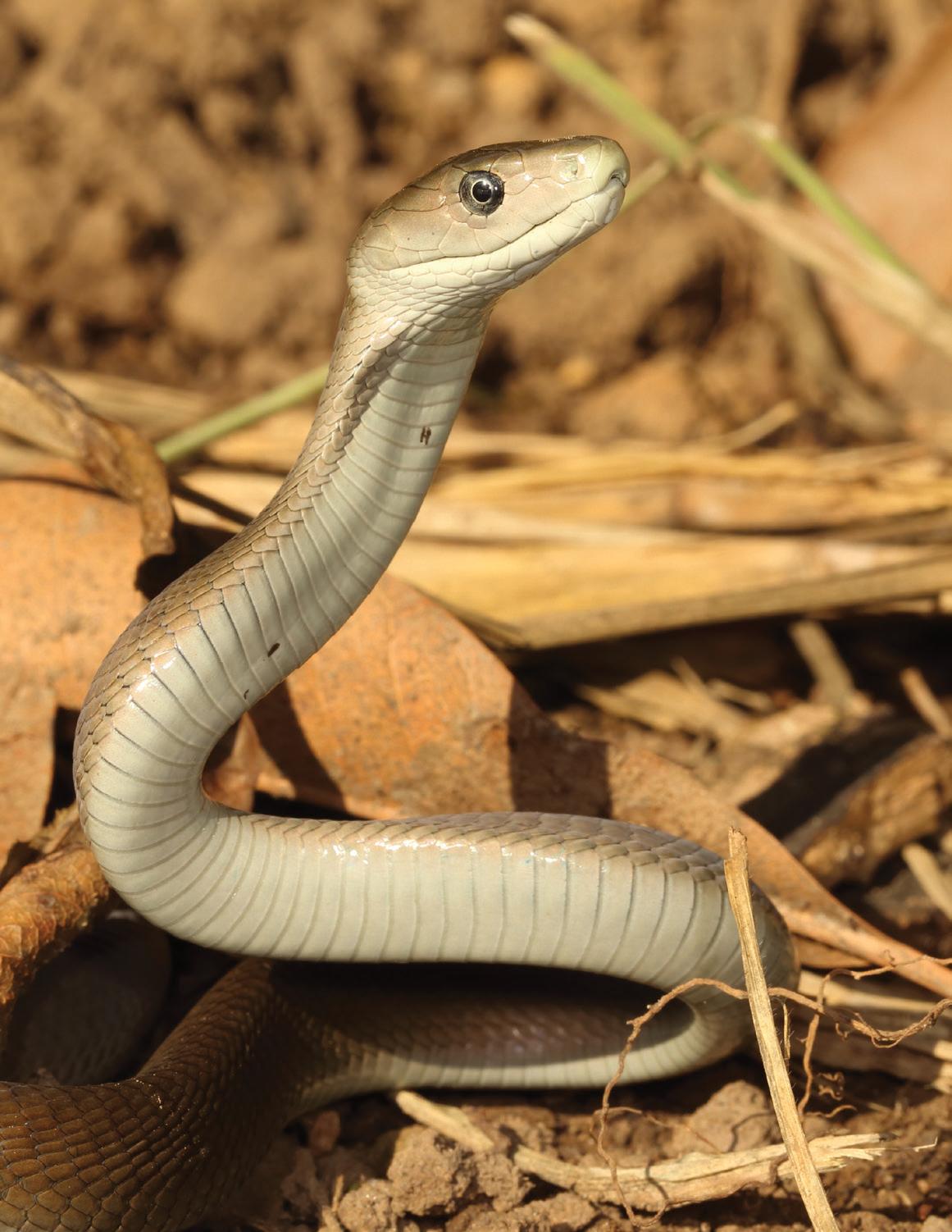
Across sub-Saharan Africa's (SSA) plains, an unexpected hero slithers in the grass: the puffadder.
These reptiles are responsible for some of the highest fatality rates on the continent. They're also one of the most abundant, found throughout the continent-from Senegal to South Africa.
Typically injecting prey with around 80-240mg of cytotoxic venom—the lethal dose for a human is 100mg—puff adders are now emerging as effective environmental stabilizers, able to control rodent populations at a remarkable rate.
When rodents, such as mice and rats, are presented with the right conditions, these highly adaptable survivors breed at speed. A single female can produce hundreds of offspring a year.
“Rodent blooms (increase in numbers) are often related to rainfall, and because they've got such short growth periods, their populations can explode in a very short period of time,” says Graham Alexander, Professor of Herpetology at the University of the Witwatersrand in Johannesburg, to FORBES AFRICA.
Africa’s rapid urbanization, poor housing infrastructure, and inadequate waste management systems make it a highly suitable region for rodents to thrive, posing a plethora of potential concerns for human health and economic activity.
Rats are a common headache for farmers, often found chewing through storage bags or feeding on seeds, roots, and crops, leaving entire regions vulnerable to food scarcity.
In Western Kenya, a 2016 Gadisa et al. report revealed how ravaging rodents can be, reporting 34% loss in grain, and 20% damage in maize crops, while Ethiopia experienced between 9-48% loss in coffee, 21-60% in cotton, and 15-40% in pulses and oil seeds.
During peak activity, nests of mice feed continuously, their high metabolism demanding several meals a day. It’s an endless cycle that makes farmlands a desirable destination.


Diese Geschichte stammt aus der February - March 2026-Ausgabe von Forbes Africa.
Abonnieren Sie Magzter GOLD, um auf Tausende kuratierter Premium-Geschichten und über 9.000 Zeitschriften und Zeitungen zuzugreifen.
Sie sind bereits Abonnent? Anmelden
WEITERE GESCHICHTEN VON Forbes Africa

Forbes Africa
Power-ful CURRENCY
AS AFRICA'S DIGITAL TRANSFORMATION ACCELERATES, GREEN ENERGY IS BECOMING A MARKER OF ECONOMIC STRENGTH. WITH VAST UNTAPPED RENEWABLE RESOURCES, AFRICA HOLDS A STRATEGIC ADVANTAGE, BUT HIGH FINANCING COSTS AND FRAGMENTED INFRASTRUCTURE THREATEN TO SLOW ITS MOMENTUM.

3 mins
February - March 2026

Forbes Africa
POD POWER
MADAGASCAR'S CALLING CARD TO THE WORLD MAY BE VANILLA, BUT TAOLAGNARO, ON ITS SOUTHEASTERN TIP, DRAWS IN VISITORS WITH ITS UNASSUMING CHARM AND STARTLINGLY BEAUTIFUL SEA.
3 mins
February - March 2026

Forbes Africa
TRAILBLAZER!
BENJAMIN ROSMAN'S RESEARCH IS POWERING AFRICA'S GEOPATRIATED AI FUTURE.
3 mins
February - March 2026

Forbes Africa
THE MIRACLE OF OMAHA
AFTER ESCAPING AN IMPOVERISHED CHILDHOOD AND SURVIVING A GUNSHOT WOUND AT 20, TERENCE CRAWFORD EARNED MORE THAN $100 MILLION IN HIS CAREER AS A BOXER. WITH WARREN BUFFETT IN HIS CORNER, THE 38-YEAR-OLD CHAMPION IS NOW STARING DOWN THE ULTIMATE OPPONENT-FATHER TIME.
4 mins
February - March 2026

Forbes Africa
THE NEW BOARD-ROOM PRIORITY
WHO GOVERNS THE CLOUD? AI HAS MADE DATA POWERFUL, BUT SOVEREIGNTY DECIDES WHO GETS TO USE IT, STORE IT AND PROTECT IT.
3 mins
February - March 2026

Forbes Africa
THINKING A-HEAD
INTERFACES ARE AN INEVITABLE STEP IN HUMAN EVOLUTION. WITH THE TECHNOLOGY MOVING INSIDE OF OUR HEADS, THE QUESTION IS NO LONGER IF WE'LL MERGE WITH IT, BUT WHEN. HEAR FROM THOSE WHO HAVE HAD A HEAD START.
3 mins
February - March 2026

Forbes Africa
VOICES FROM THE LAB
FROM CLEAN WATER INNOVATION TO CANCER RESEARCH, THESE SOUTH AFRICAN SCIENTISTS REVEAL HOW MENTORSHIP, INCLUSIVE FUNDING AND SUPPORTIVE ECOSYSTEMS CAN ENABLE WOMEN TO PARTICIPATE IN STEM SECTORS AND RESHAPE AFRICA'S SCIENTIFIC LANDSCAPE.
3 mins
February - March 2026

Forbes Africa
ALPINE AMBITIONS
THE SOUTH AFRICAN SKI-RACER TAKING THE SPORT TO NEWER HEIGHTS.
2 mins
February - March 2026

Forbes Africa
ONE MIC, MANY STORIES
FROM ACCRA TO CAPE TOWN, IS PECHAKUCHA BECOMING THE PERFECT STAGE FOR AFRICAN IDEAS AND STORYTELLING?
4 mins
February - March 2026
Forbes Africa
MICRO-SHIFTING AND CLOCKING OUT OF THE NINE-TO-FIVE
For years, the nine-to-five day ruled working lives. It was predictable, easy to follow and very rarely questioned. This neat and tidy arrangement, however, is starting to get a little messed up. That's because people are increasingly shaping their days around life rather than watching the clock. The shift even has a name. It is called micro-shifting. It's not for everyone, but for those who enjoy it, it works something like this. Instead of sitting through eight straight hours or work, some people break the day up and work in shorter bursts when it suits them.
2 mins
February - March 2026
Listen
Translate
Change font size