
Mit Magzter GOLD unbegrenztes Potenzial nutzen
Erhalten Sie unbegrenzten Zugriff auf über 9.000 Zeitschriften, Zeitungen und Premium-Artikel für nur
Versuchen GOLD - Frei
Optimising cherry production and quality
Farmer's Weekly
|November 29, 2024
Growing cherries in a suboptimal climate requires manipulating trees and temperatures. But with a considerable market advantage, it is worth the effort. Lindi Botha visited ZZ2's Toscana farm, which for four weeks of the year takes prime position in the cherry market.
-

South Africa doesn’t have an ideal climate for growing cherries. Herein lies a considerable challenge for those taking on this notoriously finicky crop.
But the rewards are worth it for those who succeed, providing a lucrative export market.
For ZZ2, growing cherries in Lanseria, Gauteng, provides an even greater benefit – they are one of only a handful of cherry growers in the global market for four weeks of the year.
“This is a massive advantage,” says Piet van Zyl, general production manager at ZZ2. “As our cherries enter the market, the Canadian supply has dried up. The next region to enter the market is the Western Cape, followed by Chile in South America, but only six weeks after the last of the Canadian crop.”
Identifying such a niche microclimate like that of the farm Toscana in Lanseria is part of ZZ2’s strategy to ensure the business can grow and position its crops in the market to gain the maximum advantage. While Toscana is far from being an ideal climate for cherries, production is possible with the right management.
“Cherries originated from the highlands of Tibet – you can imagine how cold it gets there,” says Van Zyl. “While temperatures on Toscana can dip to -8°C in winter, they can go up to 34°C in summer. So much of our time is spent on keeping the orchards cool, and manipulating the tree into mimicking behaviour in colder climates.”
THE RIGHT CLIMATE
ZZ2 planted a trial block of cherries on Toscana in 2015. While the results were not as promising as they had hoped, they forged ahead and expanded. Today the farm cultivates 17,4ha consisting of several licensed varieties from Zaiger Genetics – Minnie Royal, Royal Tioga, Royal Letty, Royal Lynn, Royal Alida and Royal Lee – which require fewer cold units than the open varieties.
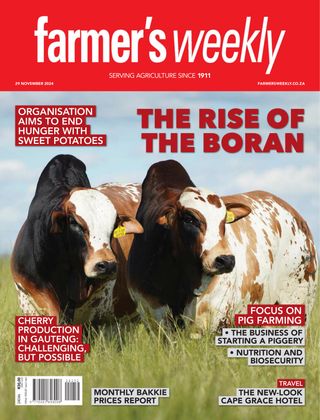

Diese Geschichte stammt aus der November 29, 2024-Ausgabe von Farmer's Weekly.
Abonnieren Sie Magzter GOLD, um auf Tausende kuratierter Premium-Geschichten und über 9.000 Zeitschriften und Zeitungen zuzugreifen.
Sie sind bereits Abonnent? Anmelden
WEITERE GESCHICHTEN VON Farmer's Weekly
Farmer's Weekly
Cash flow budgets: keeping farmers in control of liquidity, risk, and their survival
Profit doesn't guarantee a farm's survival - cash does. Cobus du Plessis explains why cash flow budgets are one of the most important yet underused financial tools on South African farms.

5 mins
February 27 - March 06, 2026

Farmer's Weekly
The toast of the Navy
The incredible story of the World War II-era Great Dane dog Nuisance being enlisted in the Royal Navy is well documented. Graham Jooste shared some entertaining anecdotes involving the canine shipmate.
6 mins
February 27 - March 06, 2026
Farmer's Weekly
Healthier soils deter destructive locusts
Locust swarms remain a serious global threat, capable of devastating crops, livelihoods and local economies across vast regions.
1 min
February 27 - March 06, 2026
Farmer's Weekly
Wheat crisis dominates Grain SA regional meetings
As the ongoing wheat crisis continues to erode producers' margins, emotions ran high at Grain SA's regional meeting in Moorreesburg in the Western Cape.
2 mins
February 27 - March 06, 2026

Farmer's Weekly
A FARMER'S EXPERIENCE
Street Wallet has been a game-changer for Mario Athanasopoulos, hydroponic production consultant and owner of Green City Farms.
1 mins
February 27 - March 06, 2026
Farmer's Weekly
Kesieberg Merino Stud Production Sale
The Kesieberg Merino Stud Production Sale was held on the farm Leeuwfontein on 4 February on behalf of Willie and Herman Henning.
1 min
February 27 - March 06, 2026

Farmer's Weekly
Not cheaper, just different: what you should know about farming in Mozambique
Although Mozambique is often viewed as a cheaper, easier farming location than South Africa, cost comparisons tell a more complex story. But while cross-border production presents real challenges, it also offers opportunities for complementary trade, diversification and regional food security, particularly when it comes to subtropical crops such as bananas.
10 mins
February 27 - March 06, 2026

Farmer's Weekly
The all-rounder anchoring South Africa's beef value chain
Louis Steyl, CEO of the Bonsmara Cattle Breeders' Society of South Africa, spoke to Octavia Avesca Spandiel about how the versatile Bonsmara breed anchors the country's beef value chain, delivering balanced performance, reproductive and feed efficiency, and carcass traits across extensive and intensive systems.
6 mins
February 27 - March 06, 2026

Farmer's Weekly
THE HITCHING POST
I'm a 60-year-old white woman who loves camping, animals, the outdoors, and watching sport.
2 mins
February 27 - March 06, 2026
Farmer's Weekly
Foot-and-mouth disease in pigs
Recently, the radio news mentioned an outbreak of foot-and-mouth disease (FMD) in pigs in South Africa.
2 mins
February 27 - March 06, 2026
Listen
Translate
Change font size