
Mit Magzter GOLD unbegrenztes Potenzial nutzen
Erhalten Sie unbegrenzten Zugriff auf über 9.000 Zeitschriften, Zeitungen und Premium-Artikel für nur
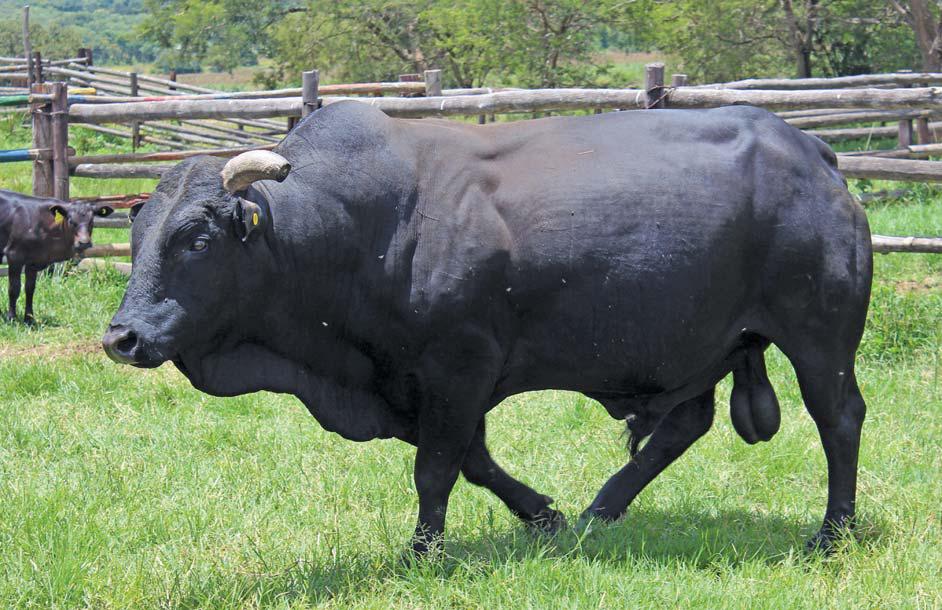
Mashona: small in stature, big in value
Farmer's Weekly
|Farmer's Weekly 10 March 2023
Zimbabwe's indigenous Mashona cattle are renowned for their outstanding productivity and ability to survive under even the most extreme conditions. Maree Osborne, chairperson of the Mashona Cattle Society of Zimbabwe, spoke to Annelie Coleman about this remarkable breed of beef cattle.
-

Zimbabwe’s indigenous Mashona, a Sanga-type cattle breed, has evolved over millennia into a hardy, highly adaptable and economical contender in the African beef production arena, says Maree Osborne, chairperson of the Mashona Cattle Society of Zimbabwe.
Following the decimation of the Shona people’s cattle herds as a result of rinderpest in the late 1890s and East Coast fever in the early 1900s, Angoni cows were mated with Mashona bulls, resulting in the Mashona breed as it is known today. A herd book was established in 1954, after a decade of selection for beef production. Mashona are usually either black or red, and most are now polled.

“Working with Mashona cattle has given me a huge amount of pleasure over the years. The breed’s small stature plays a crucial role in its survivability, fertility and production efficiency under extensive farming conditions,” explains Osborne. In its breed-evaluation research trial from 1974 to 1900, the largest and longest of its kind in Africa, Zimbabwe’s Matopos Research Station found that the Mashona far outperformed all other breeds in the country in terms of beef live weight per hectare.
According to Osborne, the Mashona’s docility and relatively small body size facilitate easy handling and management.
An added benefit of the breed is that the females graze in groups, which allows for the more efficient use of bulls during the breeding: season.


Diese Geschichte stammt aus der Farmer's Weekly 10 March 2023-Ausgabe von Farmer's Weekly.
Abonnieren Sie Magzter GOLD, um auf Tausende kuratierter Premium-Geschichten und über 9.000 Zeitschriften und Zeitungen zuzugreifen.
Sie sind bereits Abonnent? Anmelden
WEITERE GESCHICHTEN VON Farmer's Weekly

Farmer's Weekly
Christmas books to charm and delight
During the holiday season, one usually takes a well-earned break from the daily rutt, and there is no better time to catch up on some reading. Patricia McCracken has selected a wide spectrum of titles to tuck into.

4 mins
December 19-26, 2025

Farmer's Weekly
From chance to choice: a women's rise to farming success
Many raisin producers assume that retiring without a son to take over the farm means the end of the family business. Alcois Blaauw, this year's winner of the Raisins SA Female Producer Award, proves that assumption to be wrong. Glenneis Kriel reports.
4 mins
December 19-26, 2025

Farmer's Weekly
Grandparents below, and kids upstairs!
Dear Jonno,My wife and I want to escape to the countryside.
1 min
December 19-26, 2025

Farmer's Weekly
The Unseen Protector
The belief in the Unseen Protector or Unseen Shepherd endured for around 600 years, from the 13th century up until the 19th century. The farmer or his wife would provide a bowl of fresh cream and gruel to appease a spirit, whose blessing was imperative for a good summer harvest and animal health and fertility.
2 mins
December 19-26, 2025
Farmer's Weekly
THE HITCHING POST
I am a 67-year-old farmer residing on a farm near Harding in KwaZulu-Natal.
1 mins
December 19-26, 2025
Farmer's Weekly
Pet-friendly family accommodation in the Waterberg
With travel time of only a little over three hours from Johannesburg and 30 minutes from Vaalwater, guests will find Waterberg Cottages in Limpopo. Guests can plan a family-friendly holiday or weekend with plenty of activities to keep everyone occupied on this peaceful 2 500ha private game reserve.
4 mins
December 19-26, 2025
Farmer's Weekly
The Shuman legacy continues under the watchful eye of a fifth-generation farmer
Ken Shuman, co-owner of Hilson Shuman Farming, is committed to carrying on his father's towering legacy through innovation and adaptation.
9 mins
December 19-26, 2025

Farmer's Weekly
History's most famous musket
The Brown Bess musket was the standard issue firearm for British forces from 1722 to 1838. As Mike Burgess writes, this much-loved weapon contributed significantly to the consolidation of the British Empire that by 1922 was in control of a quarter of the earth's surface.
4 mins
December 19-26, 2025

Farmer's Weekly
Muddy soil can cause lameness due to footrot
It is important to clean legs and hooves and check for lameness in horses on a daily basis, especially when there is heavy rain
2 mins
December 19-26, 2025

Farmer's Weekly
The role of family farmers in sub- Saharan Africa
As part of the United Nations' recognition of family farming as a vital component of the global agricultural landscape, the decade between 2019 to 1928 was declared the Decade for Family Farming globally. Annelie Coleman compiled this report.
6 mins
December 19-26, 2025
Translate
Change font size