Versuchen GOLD - Frei
An award-winning miniature horse stud in the Eastern Cape
Farmer's Weekly
|5+12 April 2024
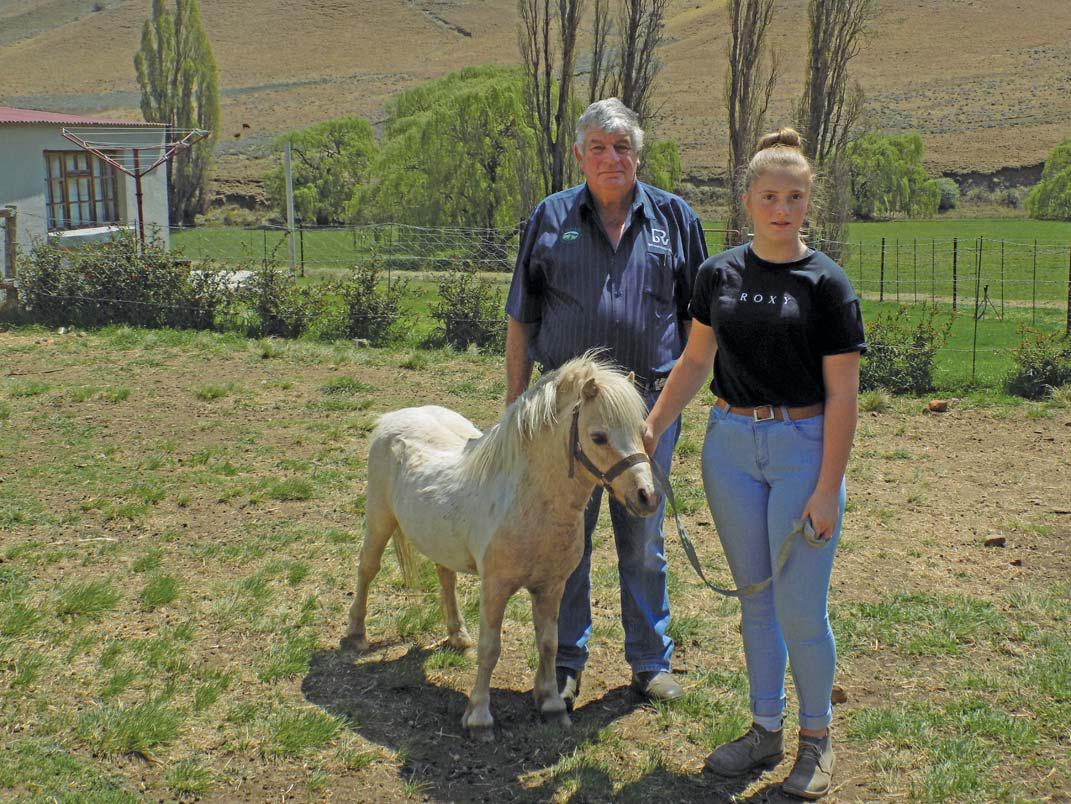
Don't be mistaken: the South African Miniature Horse is not a toy breed but a well-balanced, hardy animal, and if all reference to size were eliminated, would have the same conformational proportions than other full-sized light breeds. Annelie Coleman spoke to the Naudés, who run the Eduan Miniature Horse Stud.

Gawie Naudé runs the Eduan Miniature Horse Stud in partnership with his son Willem near Rhodes in the Eastern Cape.
The Naudés farm on Buttermead, about 5km outside Rhodes, in the Eastern Cape Highlands near the escarpment at the southernmost end of the Drakensberg mountain range in the Barkly East district. The farm is 1 832m above sea level.
The Buttermead horses are kept on the veld and they thrive on the mountainous mixed sourveld. According to Gawie, miniature horses have been purposefully bred in Europe since the 1600s from a variety of other horse and pony breeds, including the Shetland pony.
MINES AND PETS
“Apart from being used as pets in England and the US, the miniatures were used in mines after child labour was outlawed. The first miniature horse arrived in the US in 1861. Although they were initially used in mines, show events took hold in the US, resulting in the miniature horse we know today,” Gawie explains.
In South Africa, miniature horse breeding was pioneered from 1945 onwards by Wynand de Wet from Lindley in the Free State, who practised selective breeding Shetland stock.
Willem points out that the modern local miniature horse has subsequently developed into a well-adjusted animal, regardless of size, and it is well-balanced, strong, agile and alert. The Eduan miniature breed is known to be outstandingly nimble and powerful.
IMPROVED LOOKS AND MOVEMENT

Diese Geschichte stammt aus der 5+12 April 2024-Ausgabe von Farmer's Weekly.
Abonnieren Sie Magzter GOLD, um auf Tausende kuratierter Premium-Geschichten und über 9.000 Zeitschriften und Zeitungen zuzugreifen.
Sie sind bereits Abonnent? Anmelden
WEITERE GESCHICHTEN VON Farmer's Weekly

Farmer's Weekly
More about growing vegetable seedlings in trays
By considering various factors and tailoring care to specific vegetable needs, you can produce healthy, robust seedlings ready for transplanting into the garden, writes Shane Brody.

2 mins
March 27 - April 3, 2026

Farmer's Weekly
Prodigy of agriculture and land is now a presidential envoy
Wandile Sihlobo will be armed by state powers to accelerate any decision-making that the Presidency deems crucial to grow the sectors of agriculture and land
2 mins
March 27 - April 3, 2026

Farmer's Weekly
Notes from the Western Cape agricultural roadshow
We spent time last week engaging with agribusinesses and farmers in the Western Cape. The primary agricultural focus of the province is various fruits, citrus, table grapes, wine, wheat, barley, livestock, and aquaculture, among many value chains.
3 mins
March 27 - April 3, 2026

Farmer's Weekly
AGOA's promise fades under new US tariffs
Although the African Growth and Opportunity Act has been extended for another year, new US reciprocal tariffs have largely erased its duty-free benefits. Recent modelling shows sharp declines in African exports to the US, particularly in apparel-dependent economies such as Lesotho and Madagascar.
4 mins
March 27 - April 3, 2026

Farmer's Weekly
Egon Zunckel: a lifetime of learning from the soil
The Zunckel name is synonymous with no-till farming in South Africa. Egon Zunckel, a pioneer in the field and a passionate advocate for soil health, shared with Lindi Botha the lessons he has learnt over the years about building resilient soils and sustainable farming systems.
10 mins
March 27 - April 3, 2026
Farmer's Weekly
Researchers explore new tools to combat herbicide resistance
Research by students from Stellenbosch University aimed at combatting herbicide resistance was highlighted during a recent technical trial information day hosted by the Western Cape Department of Agriculture.
6 mins
March 27 - April 3, 2026

Farmer's Weekly
Lepas leaps into South Africa as the latest Chery-owned brand
Lepas has become Chinese carmaker Chery's latest local subbrand with the introduction of the L4 compact SUV. The Citizen's Charl Bosch reports.
2 mins
March 27 - April 3, 2026

Farmer's Weekly
La Rhone Limousins: a small mixed herd turned renowned stud
The Western Cape is not typically known for cattle farming, particularly in its fruit-growing regions. Yet nestled among the orchards below the mountains of Tulbagh is a Limousin stud that has made a name for itself. AJ du Toit of La Rhone Limousins spoke to Henning Naudé about producing high-quality genetics now found on farms in all nine provinces.
6 mins
March 27 - April 3, 2026
Farmer's Weekly
Nitrogen: no easy fix
Products that claim to herald a nitrogen revolution that will boost global food production are nothing more than snake oil, say scientists.
4 mins
March 27 - April 3, 2026

Farmer's Weekly
Potato soup
Rich, creamy, and indulgent, this soup is the ultimate in comfort food.
1 mins
March 27 - April 3, 2026
Listen
Translate
Change font size