
Mit Magzter GOLD unbegrenztes Potenzial nutzen
Erhalten Sie unbegrenzten Zugriff auf über 9.000 Zeitschriften, Zeitungen und Premium-Artikel für nur
Versuchen GOLD - Frei
Ending the Monetary Easing Cycle
BUSINESS ECONOMICS
|December 1 - 31, 2025
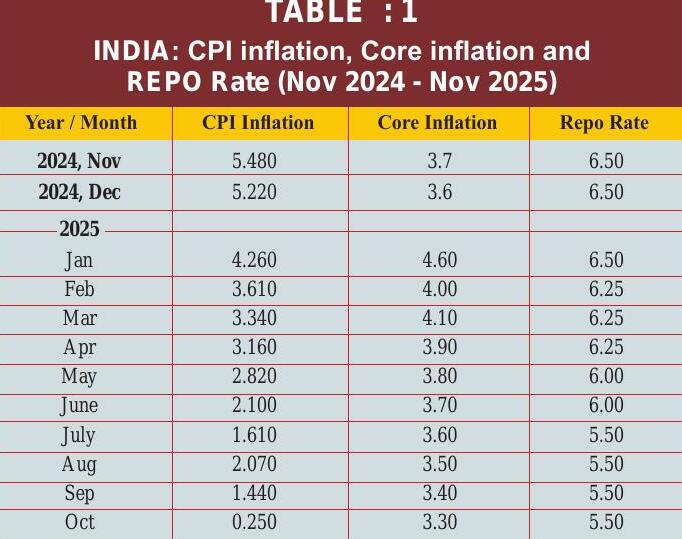
India's Consumer Price Index (CPI)-based year-on-year inflation—commonly known as headline or retail inflation—has shown a consistent downward trend over the past nine months.
The October reading, at just 0.25%, is the lowest in a decade since the CPI series began, effectively amounting to near-zero inflation. This raises an immediate question for savers, who are planning asset purchases as well as for investors: Will the Reserve Bank of India’s (RBI) Monetary Policy Committee (MPC) cut the repo rate during its bimonthly meeting scheduled for December 3–5?
Background
After India recovered around mid-2021 from the global Covid-19 pandemic, the economy faced a prolonged inflationary phase that lasted far longer than the pandemic itself. Retail inflation remained above the RBI’s target of 4% for nearly 30 consecutive months, from May 2021 to mid-2023.
While the Covid-19 recovery—driven by pent-up demand and the use of appropriate fiscal and monetary policies—was relatively smooth, the supply-chain disruptions caused by the pandemic had severe and lasting effects. Restrictions impeded the movement of food grains, vegetables and fruits. Given that food and energy constitute 55% of India’s consumption basket, even modest supply shocks produced disproportionately large inflationary effects.
Inflation first climbed to 6.3% in May 2021, breaching the RBI's upper tolerance band of 6%. The Russia-Ukraine war, which escalated in early 2022, further raised global commodity prices—crude oil, natural gas, wheat, and edible oils. India, being a net importer of energy, saw sharp surges in food (vegetables, cereals, pulses) and fuel inflation. Retail inflation averaged 6.7% in 2022.


Diese Geschichte stammt aus der December 1 - 31, 2025-Ausgabe von BUSINESS ECONOMICS.
Abonnieren Sie Magzter GOLD, um auf Tausende kuratierter Premium-Geschichten und über 9.000 Zeitschriften und Zeitungen zuzugreifen.
Sie sind bereits Abonnent? Anmelden
WEITERE GESCHICHTEN VON BUSINESS ECONOMICS

BUSINESS ECONOMICS
The global damage to 'Make in India'
The AI Impact Summit, 2026 held in Delhi was a huge opportunity for India to project country's technical skills globally.

2 mins
March 1-31, 2026

BUSINESS ECONOMICS
UNION BUDGET 2026-27
FM stakes on infra sector to sustain growth momentum
7 mins
March 1-31, 2026

BUSINESS ECONOMICS
Rani Rashmoni: A life of spiritual awakening-humanity and compassionate service
At the dawn of the Bengal Renaissance, when reformers such as Raja Rammohan Roy, Dwarkanath Tagore, and Ishwar Chandra Vidyasagar were reshaping society, a remarkable woman emerged from within the rigid confines of tradition.
3 mins
March 1-31, 2026

BUSINESS ECONOMICS
WB Budget 2026-27 and the 16th Finance Commission's Financial Devolution to States
West Bengal’s Finance Minister Chandrima Bhattacharya presented the State Budget for 2026-27 on 12 February 2026. The total expenditure, or size of the Budget for FY 2026-27, has been pegged at ₹3.89 lakh crore. This is about 14% higher than the revised estimate for 2024-25.
3 mins
March 1-31, 2026

BUSINESS ECONOMICS
Tamil Nadu's Interim Budget 2026-27 An Analysis
On 17 February 2026, Finance Minister Thangam Thennarasu presented the Tamil Nadu Interim Budget for 2026-27.
2 mins
March 1-31, 2026

BUSINESS ECONOMICS
Why Even Good Intentions Are Failing Global Policy
Across the world, leaders are acting under the pressure of constant crisis.
6 mins
March 1-31, 2026

BUSINESS ECONOMICS
Manufacturing: FM's focus is in the right direction but lessons from the past are crucial
Manufacturing has been a major focus of the annual Budget presented on February 1 by Nirmala Sitharaman. India has long aimed to raise manufacturing’s share in GDP to around 25%, from about 16-17% a few years ago.
2 mins
March 1-31, 2026

BUSINESS ECONOMICS
India's Orange Economy : Creativity as the Next Growth Engine
In India's economic lexicon, a vibrant new term is capturing the imagination of policymakers, entrepreneurs, creators and investors alike - The Orange Economy.
3 mins
March 1-31, 2026
BUSINESS ECONOMICS
Sixteenth World Confluence of Humanity, Power & Spirituality – My Understanding of 'Spiritual Intelligence
In the light of Spiritual Intelligence, the 16th World Confluence of Humanity, Power and Spirituality brought together participants from diverse spiritual, religious, and cultural backgrounds.
5 mins
March 1-31, 2026

BUSINESS ECONOMICS
Budget proposals on Agriculture: Emphasis on high-value products and technology
The Union Budget 2026-27 places significant emphasis on high-value agricultural products and the adoption of advanced technology.
3 mins
March 1-31, 2026
Listen
Translate
Change font size