Versuchen GOLD - Frei
The Story Of Indian Dairy Industry: From Scratch To Success
Food & Beverages Processing
|May 2021
Introduction The livestock sector of India is one of the largest in the world. It has emerged as one of the major engines of agricultural growth in our country. As a matter of fact, the livestock sector contributes more than 25% of total agricultural GVA and 4.5% of total GVA. Among the various livestock products, milk has always held a higher rank than the other products viz. meat, eggs, wool, hide, etc. Since times immemorial milk is considered an essential component of the human diet providing various nutrients owing to its high nutritive value and also offers a wide range of health benefits. Milk is defined as the whole, fresh, clean, lacteal secretion obtained by the complete milking of the udder of one or more healthy milch animals, excluding that obtained within 15 days before or 5 days after calving or such periods as may be necessary to render the milk practically colostrum free and containing the minimum prescribed percentages of milk fat and milk solids not fat (SNF). The dairy industry of India today stands tall with the global milk production of 176.3 MT (19% of world milk production), which has reached a mark of 187.7 MT for 2019 as per the provisional report of DAHD, 2019. We have come a long way from being milk-deficit to surplus producers. The given article is an attempt to help the readers to develop an understanding of the growth of the Indian dairy industry from scratch to success.

In the beginning
The dairy industry was almost completely unorganized in the initial stages. Although a beginning to organized milk handling was made in India with the establishment of Military Dairy Farms (oldest; Allahabad, 1889), a number of other steps in the post-independence era were undertaken to establish an organized system of milk collection, processing, distribution, and storage. They included handling of milk in co-operative Milk Unions established all over the country on a small scale in the early stages, long-distance refrigerated rail transport of milk from Anand to Bombay since 1945, pasteurization and bottling of milk on a large scale for organized distribution at Aarey (1950), Worli (1961), Calcutta Haringhata, 1959), Delhi (1959), Madras (1963), etc.
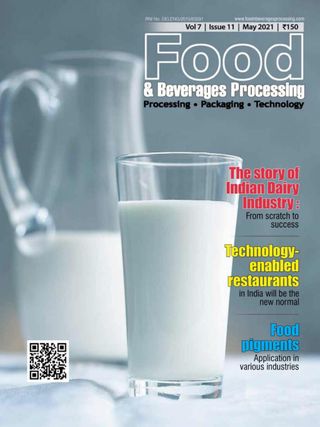

Diese Geschichte stammt aus der May 2021-Ausgabe von Food & Beverages Processing.
Abonnieren Sie Magzter GOLD, um auf Tausende kuratierter Premium-Geschichten und über 9.000 Zeitschriften und Zeitungen zuzugreifen.
Sie sind bereits Abonnent? Anmelden
WEITERE GESCHICHTEN VON Food & Beverages Processing
Food & Beverages Processing
Food and Beverage Powder Producers Gain Scale-Up
Advantage with Tetra Pak's New Product Development Centre in France

2 mins
December 2025

Food & Beverages Processing
Eco-friendly Food Packaging Market Set to Surge Amid Growing Demand for Sustainable Solutions
The global eco-friendly food packaging market is poised for significant growth, driven by rising environmental awareness, stricter regulatory frameworks, and increasing consumer demand for sustainable packaging solutions.
2 mins
December 2025
Food & Beverages Processing
Functional Food Ingredients Market to Reach USD 232.40 Billion by 2034
The global functional food ingredients market is experiencing dynamic expansion as consumers increasingly prioritize nutrition, preventive health, and overall well-being.
3 mins
December 2025
Food & Beverages Processing
Digitizing Sustainability: A Path to Preventing Food Waste in the Supply Chain
Food waste is a pervasive issue that spans the entire journey of our meals, from the fields to our homes.
4 mins
December 2025

Food & Beverages Processing
Powerhouse Ranveer Singh unveils RANGEELA Vodka
ABD Maestro Pvt. Ltd., the super-premium and luxury spirits subsidiary of Allied Blenders and Distillers Limited (ABD), today announced launch of its homegrown RANGEELA Contemporary Indian Vodka.
1 mins
December 2025

Food & Beverages Processing
Kaatil Launches Hot Barbeque Sauce
Kaatil, one of India's leading hot condiments brands, has announced the expansion of its product portfolio with the launch of Hot Barbeque Sauce No. 9.
1 mins
December 2025

Food & Beverages Processing
Markem-Imaje Helps Catering Giant Elior Implement A Robust Rfid Solution to Reduce Food Waste and Gain Efficiency
Markem-Imaje, the global provider of end-to-end supply chain solutions and industrial marking and coding systems, has provided a printing and data management solution for catering expert Elior to reduce food waste and improve production efficiency.
2 mins
December 2025

Food & Beverages Processing
Driving Efficiency & Sustainability through Advanced Power Transmission Systems
In today’s industrial landscape, efficiency and sustainability are no longer optional; they're essential.
2 mins
December 2025

Food & Beverages Processing
CavinKare Strengthens its Beverages Portfolio With Nostalgia-Inspired Milkshakes for Children's Day
CavinKare, under its beverage division, has strengthened its Cavin's portfolio with the addition of Orange Cream Biscuit Milkshake and Premium Malt Milkshake variants.
1 mins
December 2025
Food & Beverages Processing
Tetra Pak launches Integrated Heat Pump system to electrify pasteurization and cut energy use by up to 77%
New Tetra Pak® Integrated Heat Pump system delivers combined heating and cooling to pasteurization, enabling up to 77% energy savings while reducing CO₂ emissions and operating costs1 Markem-Imaje, the global provider of end-to-end supply chain solutions and industrial marking and coding systems, has provided a printing and data management solution for catering expert Elior to reduce food waste and improve production efficiency. Elior is a very well-established business in Italy with a long history of foresight, strategy and innovation, which was born in the Genoa shipyards in 1954, and has today ten thousand collaborators, two thousand restaurants and over 106 million customers every year. Part of their strategy to approach new markets is through the Division called SMB (Small-Medium-Business), offering innovative and modular solutions for small and medium-sized food outlets. The SMB Division of the company has identified four formats which focus on the line of products in a protective atmosphere without the addition of chemical preservatives, which offers - among the first, main courses and side dishes - over two hundred recipes prepared by Elior nutritionists and chefs. The gastronomic offer varies according to seasonality and ranges from traditional Italian dishes such as lasagna Bolognese, to light and genuine dishes, such as sliced chicken and steamed spinach, all the way to vegan, or vegetarian dishes. Elior thus offers different distribution modules to accommodate different needs and environments. Urban 360, for example, involves the installation of a smart fridge, which allows the distribution of ready meals 24/7 without the obligation to book. The intelligent locker opens when you make a payment through an application or by approaching a debit card or ticket card. The display case, equipped with RFID technology, recognizes the user and the identification number of the dish. The Market, on the other hand, is an open space with a display fridge, where you can choose dishes on the spot, a real “mini market” where the employee can select their lunch menu at their convenience, always supported by the availability of the staff at the cash register. All this information and data management is today managed automatically in a production hub in Zola Predosa with the help of Markem-Imaje's CoLOS® software. “We needed a partner to help us to connect the product digitally and, in Markem-Imaje, we identified the skills and products necessary to move in this direction. What convinced us was the possibility of having a single implementor for all technological areas, with efficient Print & Apply labellers, software with proven stability and robustness, RFID Technology, and knowledge of IT industrial environments,” says Luca Lomolino, IT Application Manager at Elior Italy. “The Elior project immediately thrilled us because it includes some of the core values of the Markem-Imaje philosophy, such as the fight against food waste. Thanks to this project, Elior can automatically establish which dishes need to be replenished and send only what is consumed, as well as manage deadlines in a predictive manner,” explains Gianluca Angelici, Solutions Architect at Markem-Imaje Italy. “Thanks to our knowledge of industrial IT environments and the versatility of the CoLOS® software, we were able to communicate directly with Elior's ERP, managing production in real time, coding the human-readable information on the label, storing other data on the RFID antenna and marking the lot on the edge of the tray.” Additionally, two 2200 Series Print & Apply systems have been installed on the production lines. These systems ensure the precise application of labels that include both human-readable information and data encoded on RFID tags, significantly improving product traceability, and ensuring compliance with European regulations. “We are deeply proud to be an integral part of the innovative food-to-consumer solution developed by Elior,” Angelici adds. through smarter heat recovery and reuse. The new Tetra Pak® Integrated Heat Pump system builds on the company's existing pasteurization technology by introducing a high-efficiency electric heat pump that recovers and reuses heat from the pasteurization process. For every 1 kWh of electricity used, the system can recover up to 2 kWh of otherwise wasted heat – making it up to three times more efficient than a traditional boiler2. By combining heating and cooling in one integrated solution, the system also optimises energy use across the pasteurization process. It upgrades low-temperature waste heat to higher temperatures and generates ice water for cooling. This dual function helps lower total energy consumption and operating costs1, while supporting producers in reducing reliance on fossil fuels and exposure to volatile energy prices2. F&B producers operating large scale pasteurization processes, such as fruit juice, chilled milk, cheese and ambient milk pre-treatment pasteurization, stand to achieve substantial savings. A typical dairy production line, for example, could reduce energy consumption for pasteurization by up to 77%, making operating expense (OPEX) savings of up to €230,000/year and reducing CO2 emissions by up to 650 tonnes/year.3 Nicole Uvenbeck, Director Factory Sustainable Solutions and OEM Components at Tetra Pak, comments: \"Food and beverage producers need smarter ways to reduce energy use without compromising performance. The new heat pump system delivers up to three times the efficiency of conventional boilers, recovering 2 kWh of heat for every 1 kWh of electricity4. By combining deep processing expertise with a global network, we work closely with customers to select the right solution and ensure seamless integration into their operations, supporting their shift toward more resilient, energy-efficient production.\" Fiona Liebehenz, Vice President Key Components, Plant Solutions and Channel Management at Tetra Pak, comments: \"We're proud that our longstanding experience in developing processing solutions for the food and beverage industry, together with a strong focus on innovation, has led to another important step forward. By blending advanced technology with a deep understanding of the daily challenges F&B producers face, we've developed a solution designed to make one of the most energy-intensive stages of food production more efficient.\"
2 mins
December 2025
Translate
Change font size