Versuchen GOLD - Frei
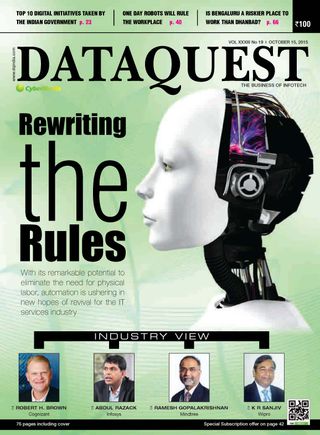
Robots To Rule The Workplace
DataQuest
|October 15, 2015
The prospect of robots taking up jobs might sound scary, but it's an impending reality already started happening in some pockets. Though with displacement also comes new job opportunities.

Sounds like science fiction or a figment of imagination but very much a possibility. As one looks at the annual results of the major IT services providers in India, most of them are deepening their competencies in automation to achieve the twin goal of improved productivity and reduction in lead times. But will it also have an impact on the workforce—will it lead to large-scale reduction in headcount?
While that is a possibility in IT services, but at the same time a recent Forrester report states that ‘Robots won’t steal our jobs; automation to create 13.6 mn jobs over next decade; 7% net job loss by 2025’. According to Forrester, the data in the market on anticipated job loss— thanks to automation is quite dire—the most popular study claiming nearly 50% of the jobs will be impacted. But these studies have so far ignored an important factor of automation which is jobs creation.
Analysts at Forrester say, “Yes, there will be jobs lost in the coming years thanks to robots, driver-less cars, and cognitive computing. We predict 16% job loss rate between 2015 and 2025. On the other hand, automation will create 13.6 mn jobs over the next decade, equivalent to 9% of the workforce, to yield a net job loss of 7% in the US by 2025.”
Not to be overlooked, according to the study, the third category is jobs transformation. By 2019, Forrester expects robots to change 25% or more of every job category across every industry. The medical clinician is a great example, as cognitive computing increasingly transforms how doctors diagnose and prescribe treatments.

Diese Geschichte stammt aus der October 15, 2015-Ausgabe von DataQuest.
Abonnieren Sie Magzter GOLD, um auf Tausende kuratierter Premium-Geschichten und über 9.000 Zeitschriften und Zeitungen zuzugreifen.
Sie sind bereits Abonnent? Anmelden
WEITERE GESCHICHTEN VON DataQuest

DataQuest
Engineering India's Al-First Data Centres at Hyperscale
Rohan Sheth explains how AI and HPC are reshaping India's data centres, from density and cooling to power economics, sustainability, and hyperscale decision criteria.

4 mins
February 2026

DataQuest
From copilots to colleagues: Why agentic AI is forcing enterprises to rethink control, trust, and culture
As AI agents shift from assisting to acting, enterprises must redesign governance, data controls, and security guardrails so autonomy stays auditable, reversible, and trusted.
2 mins
February 2026

DataQuest
Reclaiming Control in the AI Era: A Conversation with Kalyan Kumar, CPO, HCLSoftware
Enterprises are reassessing cloud-first strategies as AI becomes core to operations. HCLSoftware's Kalyan Kumar explains why sovereignty, choice and control now shape decisions.
5 mins
February 2026

DataQuest
When infrastructure learns: The rise of the Al-native core
AI-native infrastructure is moving from concept to operational reality, reshaping how organisations build, govern, and scale intelligence across their digital core.
6 mins
February 2026

DataQuest
Bridging the gap between connectivity and compute at scale
As AI scales in India, data centres are evolving into high-density, low-latency platforms that unify connectivity, compute, and sustainability at national scale.
4 mins
February 2026

DataQuest
PUE is not a grapefruit metric, anymore
So what are the new high-hanging fruits for data centre strategists today? And are players going after them?
4 mins
February 2026

DataQuest
Even if Al demand fades, India need not worry - about data centres
For every megawatt (MW) of installed colocation capacity, users here generate approximately 13.2 PB of data monthly- compared to 0.3 PB for Australia and just 0.01 PB for Singapore. India's data centre growth is not dependent on one tech lever. Plus, it is phased and modular and not kneejerk. Manoj Paul explains these contours in detail.
7 mins
February 2026

DataQuest
AI infrastructure and systemic risk
What has been the biggest change in data centre industry-specially after AI workloads? Is Al-bubble a big risk for data centre infra- how much will it affect data centres if something cracks?
1 min
February 2026

DataQuest
Inside the Shift to High-Density, Al-Ready Data Centres
CtrlS' Vipin Jain discusses what it truly takes to build AI-ready data centres in India, balancing high density, liquid-ready cooling, resilience, and ESG accountability.
4 mins
February 2026

DataQuest
Sustainability is now the headline, not a footnote
Sanjay Agrawal, Head Presales and CTO at Hitachi Vantara India and SAARC opines that the conversation is moving beyond headline metrics like PUE toward a broader view of how data lifecycle management and infrastructure efficiency reduce the overall environmental footprint. Let's see why and how- while also touching upon adjacent (or not-so-adjacent) factors like redundancies, availability and AI-readiness
3 mins
February 2026
Translate
Change font size