
Mit Magzter GOLD unbegrenztes Potenzial nutzen
Erhalten Sie unbegrenzten Zugriff auf über 9.000 Zeitschriften, Zeitungen und Premium-Artikel für nur
Worshipped And Abandoned
Down To Earth
|January 16, 2019
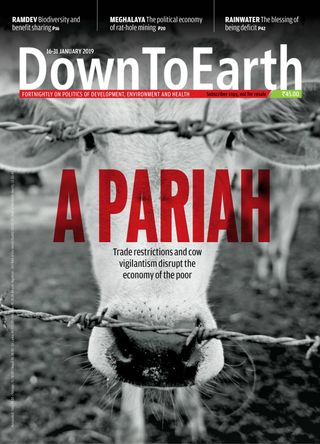
The circular economy of cattle has been ruptured. Restrictions on cattle trade are forcing cattle rearers to abandon the cows, and therefore, their livelihood. Jitendra and photographer Adithyan P C travel across the cow belt in the country and neighbouring Nepal to understand how it has hit the poorest
-

RAHAMDIN KHAN has not slept well for over a year. Resident of Khoabas, a bucolic village of 500 households at the foothills of Aravali mountain range in Rajasthan’s Alwar district, Khan witnessed a cruel turn of fate. Life has undergone a change, and nothing but his traditional white kurta and pyjama remains the same. Goats and buffalos ramble around his house, but cattle, that once dictated his family’s economy, are conspicuously absent. For centuries, villages like Khoabas have depended on cattle for their primary economy and have lived a fairly sustainable livelihood. Food crops here drive the secondary economy.
In 2017, when Khan was on way to a local cattle fare, cow vigilantes thrashed him and took away his two milking cows and two calves. “Between 2014 and 2017, I have been arrested twice,” he says, alleging that 40,000 was extorted from him to be freed. Bruised, battered and humiliated, Khan abandoned his cattle. And with that he gave up what was driving his prime economy. “From being the caregiver, I was branded as the enemy of cows, and called a cow smuggler,” he says staring blankly at the floor. Police raided Khoabas several times, charging dairy farmers like Khan with cruelty against animals and putting them in jail.
“A strange restlessness has gripped me since I abandoned my 65 cattle. It singularly defined the prosperity of my family. I cannot imagine financial growth without it,” he says. Once a prosperous farmer, Khan now lives below poverty line. “I don’t get sleep without my cattle,” he says.
In the backdrop of rising threat of violence over cattle movement and stringent anti-cow trade laws in Rajasthan, many Khoabas residents, like Khan, have started quitting cattle rearing as a profession. Some households keep buffaloes while others either have goats, or both.

Diese Geschichte stammt aus der January 16, 2019-Ausgabe von Down To Earth.
Abonnieren Sie Magzter GOLD, um auf Tausende kuratierter Premium-Geschichten und über 9.000 Zeitschriften und Zeitungen zuzugreifen.
Sie sind bereits Abonnent? Anmelden
WEITERE GESCHICHTEN VON Down To Earth
Down To Earth
KING OF BIRDS
Revered for centuries, western tragopan now needs protection as its forests shrink, human pressures mount

3 mins
December 16, 2025

Down To Earth
WHISKERS ALL AQUIVER
Climate change threatens creatures that have weathered extreme environments for thousands of years
2 mins
December 16, 2025
Down To Earth
GOLDEN SPIRIT
Survival of the shy primate is closely tied to the health of Western Ghats
3 mins
December 16, 2025
Down To Earth
RINGED EYES IN THE CANOPY
Rapid habitat destruction forces arboreal langur to alter habits
2 mins
December 16, 2025
Down To Earth
HANGING BY THE CLIFF
The Himalaya's rarest wild goat is on the brink of local extinction
2 mins
December 16, 2025

Down To Earth
ANGEL OF THE BEAS
Conservation reserves, citizen science, and habitat protection give the Indus River dolphin a fighting chance in India
2 mins
December 16, 2025

Down To Earth
UNDER MOONLIT SCRUB
Survival of this hidden guardian tells us whether our scrublands still breathe
2 mins
December 16, 2025
Down To Earth
SYMBOL OF SILENT VALLEY
Lion-tailed macaque remains vulnerable despite past victories
2 mins
December 16, 2025

Down To Earth
THE APE IN OUR STORIES
India's only non-human ape species is a cultural icon threatened by forest fragmentation
2 mins
December 16, 2025
Down To Earth
SENTINEL OF THE HIGH COLD DESERT
The bird's evocative call may not continue to roll across the cold desert valley for long
3 mins
December 16, 2025
Translate
Change font size