Versuchen GOLD - Frei
Time To Talk
Down To Earth
|August 01, 2019
Gap in communication between India and neighbouring Nepal is an endemic problem that worsens Bihar floods

Over 100 lives lost, 0.1 million displaced and 7.2 million people affected. That’s the human cost of the flood that deluged Bihar for close to two weeks this July. Many lives could have been saved, losses averted, and people and livestock evacuated had the communities known beforehand that heavy rains were also lashing the Terai (lowland) region of the neighboring Himalayan country, Nepal, and that the rivers flowing from across the border were in spate. But weather-related information takes an average 48 hours to travel through the Indian and Nepalese bureaucratic circuit, say, experts. And that’s way too long for a gushing river that can obliterate villages overnight.
Between July 7 and 13, heavy rainfall in Bihar caused flash floods in six districts (see “Knockout spell”, p41). People started picking up their lives as the intensity of rainfall reduced by July 14. But suddenly, the authorities of Koshi Barrage, located on the Kosi river just before it enters India, opened the floodgates. Though heavy rains in the state stopped by July 17, some 12 districts were declared flood-hit.
The delay of information sharing is alarming because every time Nepal has received heavy rains, Bihar has recorded flash floods. “In the recent past, this happened in 2008, 2011, 2013, 2015 and 2017,” says Narayan Gyawali of Lutheran World Relief (LWR) foundation, a non-profit that runs a community-based project in India and Nepal on early flood warning systems. The two countries have a circuitous communication channel that means the information is either critically delayed or unclear and of little use to most riverbank communities in downstream Bihar. This is when the Nepal government has a dedicated Water and Energy Commission Secretariat for transboundary water issues, established way back in 1981. Both the countries have also constituted a Joint Committee on Inundation and Flood Management.
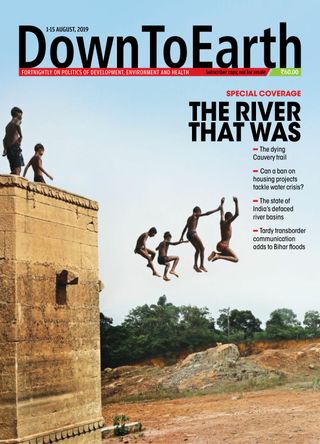

Diese Geschichte stammt aus der August 01, 2019-Ausgabe von Down To Earth.
Abonnieren Sie Magzter GOLD, um auf Tausende kuratierter Premium-Geschichten und über 9.000 Zeitschriften und Zeitungen zuzugreifen.
Sie sind bereits Abonnent? Anmelden
WEITERE GESCHICHTEN VON Down To Earth

Down To Earth
THINK TWICE BEFORE FELLING SAL TREES
Many trees considered to be affected by sal borer in the 1990s are still alive today

1 mins
February 16, 2026

Down To Earth
EDGE OF SURVIVAL
Caste divides deny marginalised communities land, resources and essential aid, leaving them more vulnerable to climate disasters
6 mins
February 16, 2026

Down To Earth
A WISH LIST?
Union Budget for 2026-27 conveys the impression of a roll-call of intentions and ambitious proposals, with little detail on their formulation
6 mins
February 16, 2026
Down To Earth
Break down the gender wall
THE RULING National Democratic Alliance (NDA) government has been heavily invested in the goal to make India a developed economy by 2047.
2 mins
February 16, 2026

Down To Earth
MENSTRUAL HEALTH, NOW A FUNDAMENTAL RIGHT
In a landmark judgement, the Supreme Court has recognised menstrual health and hygiene as a fundamental right under Article 21 of the Constitution of India, which guarantees the right to life and dignity.
8 mins
February 16, 2026

Down To Earth
Of devolution and new disasters
The 16th Finance Commission pushes for changes in view of new fiscal and climatic conditions
11 mins
February 16, 2026
Down To Earth
Rising risks of plastics
NEGATIVE IMPACTS on human health due to emissions linked to the plastic lifecycle could double by 2040, according to a study published in The Lancet Planetary Health in January.
1 min
February 16, 2026

Down To Earth
GAP BETWEEN EPIDEMICS NARROWING
A watershed-based and landscape-level approach is needed to address forest degradation
2 mins
February 16, 2026
Down To Earth
WAITING TO STRIKE
Sal heartwood borer is considered the biggest threat to forestry in India, especially to the sal tree, where it lives and breeds.
11 mins
February 16, 2026

Down To Earth
A SPRING DELIGHT
Mustard flowers are not meant only for the eyes. Invite them to your plate once in a while
3 mins
February 16, 2026
Translate
Change font size