Versuchen GOLD - Frei
Taming The Thar
Down To Earth
|September 01, 2019
What it takes to reclaim the world’s most populated desert

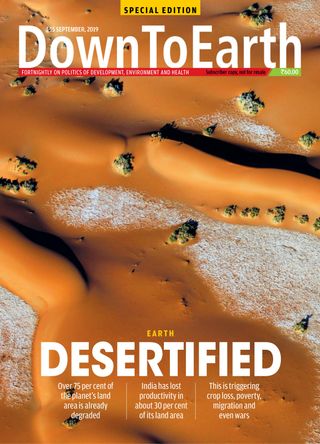
DESERTIFICATION IS severe in hot and arid northwestern India which comprises the Thar desert. Of the 32 million hectares (ha) of hot and arid land in the country, Rajasthan holds the maximum share with 62 percent. The Thar is located between the Aravalli mountain range in the east and the river Indus in the west and both influence the desert’s climate, landform, and hydrology.
The weather here is absolutely inhospitable in summers with low humidity and wind speeds of 40-60 km per hour. The seasonal and annual temperature range is high. It may rise to 50°C in summers and dip to as low as -4°C in winters. The annual average rainfall is very low, varying from 100 mm in the west to 500 mm in the east, but pan evaporation (a measurement that integrates the effects of temperature, humidity, rainfall, and wind) is a high 1,800 mm, making the desert water-scarce.
The sand-covered terrain spreads over 80 percent of the area, a large part of which comprises sand dunes. Census 2011 shows that 28 million people live across western Rajasthan in over 12 districts and four agro-climatic zones that have a dominant agrarian land use.
Desertification has hit nearly 70 percent of the state. Wind erosion, a dominant process of desertification in the state, has affected 44.41 percent area. Vegetation degradation and water erosion also affect desertification.
Wind erosion and deposition causing sand movement and dust storms are the characteristic features of the Thar. Their severity is felt more in summers and is caused due to high wind speed, sandy terrain, sparse vegetation cover, and human activity. About 0.15 million ha, or 72 percent of the area, is affected by wind erosion or deposition, of which 5,800 sq km is very severely degraded, 25,540 sq km is severely affected, 73,740 sq km is moderately affected and 52,690 sq km is slightly affected.

Diese Geschichte stammt aus der September 01, 2019-Ausgabe von Down To Earth.
Abonnieren Sie Magzter GOLD, um auf Tausende kuratierter Premium-Geschichten und über 9.000 Zeitschriften und Zeitungen zuzugreifen.
Sie sind bereits Abonnent? Anmelden
WEITERE GESCHICHTEN VON Down To Earth
Down To Earth
Popular distrust
THE WORLD seems to be going through a period of stasis despite facing an unfathomable polycrisis.

2 mins
February 01, 2026
Down To Earth
CONSERVE OR PERISH
Periyar Tiger Reserve has rewritten Indian conservation by turning poachers into protectors and conflict into coexistence
5 mins
February 01, 2026

Down To Earth
'Rivers need to run free'
From Tibet to West Bengal, the Brahmaputra is the pulse of communities and ecosystems along its course. But what are the risks the river faces through human interventions, particularly dams, discusses journalist, author and filmmaker SANJOY HAZARIKA in his new book, River Traveller.
4 mins
February 01, 2026

Down To Earth
India is facing up to its innovation lag
There are signs now that India is acknowledging the superior strides made by China in a frontier technology like Al
4 mins
February 01, 2026

Down To Earth
Competing concerns
What are the repercussions of the EU-Mercosur pact that have made European farmers protest against the free trade agreement?
4 mins
February 01, 2026

Down To Earth
From fryer to flight
Sustainable fuel made from used cooking oil can play a pivotal role in helping India achieve its aviation emission reduction goals. Measures to collect this oil must be revamped
4 mins
February 01, 2026

Down To Earth
ACCESS OPEN
An amendment to India's nodal forest conservation law opens up forests across India to commercial exploitation by the paper industry
6 mins
February 01, 2026
Down To Earth
DRINK FROM TAP CAN BE A REALITY
As cities across India struggle to supply safe piped water, Odisha offers a success story
2 mins
February 01, 2026
Down To Earth
GREAT DRYING
The Earth is hotter than at any point in the past 100,000 years, with 2023-25 becoming the warmest three-year period on record and also breaching the 1.5°C threshold for the first time. One fallout is dwindling freshwater.
22 mins
February 01, 2026

Down To Earth
Green redemption
Restoration of grasslands of Kerala's Pampadum Shola National Park, once dominated by invasive Australian wattles, see a return of streams and native species
1 mins
February 01, 2026
Translate
Change font size