Versuchen GOLD - Frei
TO TEST OR NOT
Down To Earth
|June 01, 2020
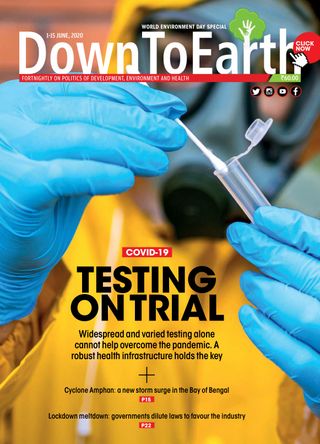
As India begins to relax lockdown rules, there is a growing demand for tests on a mass scale. But it might not help
-

WITH DENSELY packed cities, widespread malnutrition and a rickety health infrastructure, India has little margin for error when it comes to handling the COVID-19 pandemic. But so far, the two things that have helped the country from a tsunami of cases are its past experience and staying nimble, says the Indian Council of Medical Research (ICMR). We learned from the 2009 Swine flu epidemic, it says in a recently released Intelligent Testing Strategy. Then only two institutes—the National Institute of Virology and the National Centre for Disease Control—had the capacity to perform molecular tests essential for pathogen diagnosis. But now, there is a network of virus research and diagnostic laboratories (VRDL), 13 of which were roped in for testing in cities with international airports even before the country reported its first cases.
Imposing nationwide lockdown, dubbed the biggest and stringent, is also part of this testing strategy, ICMR says. This provided time to create adequate facilities to trace, track, test, quarantine, and treat before the disease spread uncontrollably. As on May 28, at least 641 public and private laboratories and those in research and development institutions, universities, and public and private medical colleges have been roped in to ensure that the load of testing does not overwhelm the system at any time. At places where these could not be provided, a system to transport samples to the nearest testing facility has been set up or automated machines like TrueNat have been provided, says the document.

Diese Geschichte stammt aus der June 01, 2020-Ausgabe von Down To Earth.
Abonnieren Sie Magzter GOLD, um auf Tausende kuratierter Premium-Geschichten und über 9.000 Zeitschriften und Zeitungen zuzugreifen.
Sie sind bereits Abonnent? Anmelden
WEITERE GESCHICHTEN VON Down To Earth
Down To Earth
Popular distrust
THE WORLD seems to be going through a period of stasis despite facing an unfathomable polycrisis.

2 mins
February 01, 2026
Down To Earth
CONSERVE OR PERISH
Periyar Tiger Reserve has rewritten Indian conservation by turning poachers into protectors and conflict into coexistence
5 mins
February 01, 2026

Down To Earth
'Rivers need to run free'
From Tibet to West Bengal, the Brahmaputra is the pulse of communities and ecosystems along its course. But what are the risks the river faces through human interventions, particularly dams, discusses journalist, author and filmmaker SANJOY HAZARIKA in his new book, River Traveller.
4 mins
February 01, 2026

Down To Earth
India is facing up to its innovation lag
There are signs now that India is acknowledging the superior strides made by China in a frontier technology like Al
4 mins
February 01, 2026

Down To Earth
Competing concerns
What are the repercussions of the EU-Mercosur pact that have made European farmers protest against the free trade agreement?
4 mins
February 01, 2026

Down To Earth
From fryer to flight
Sustainable fuel made from used cooking oil can play a pivotal role in helping India achieve its aviation emission reduction goals. Measures to collect this oil must be revamped
4 mins
February 01, 2026

Down To Earth
ACCESS OPEN
An amendment to India's nodal forest conservation law opens up forests across India to commercial exploitation by the paper industry
6 mins
February 01, 2026
Down To Earth
DRINK FROM TAP CAN BE A REALITY
As cities across India struggle to supply safe piped water, Odisha offers a success story
2 mins
February 01, 2026

Down To Earth
GREAT DRYING
The Earth is hotter than at any point in the past 100,000 years, with 2023-25 becoming the warmest three-year period on record and also breaching the 1.5°C threshold for the first time. One fallout is dwindling freshwater.
22 mins
February 01, 2026

Down To Earth
Green redemption
Restoration of grasslands of Kerala's Pampadum Shola National Park, once dominated by invasive Australian wattles, see a return of streams and native species
1 mins
February 01, 2026
Translate
Change font size