
Mit Magzter GOLD unbegrenztes Potenzial nutzen
Erhalten Sie unbegrenzten Zugriff auf über 9.000 Zeitschriften, Zeitungen und Premium-Artikel für nur
Versuchen GOLD - Frei
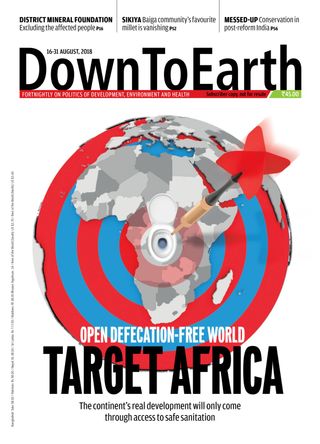
Look Beyond The Loo
Down To Earth
|August 16, 2018
In fast-urbanising Africa, the governments must rework their usual toilet building strategies to ensure safe disposal of waste.

OVER A decade ago, when the world began discussing targets for sanitation the idea seemed simple—build toilets and people will use them. When the UN’s Millennium Development Goals (MDGs) set in 2000 came to an end in 2015, over 2 billion people had gained access to improved sanitation. But nearly 2.6 billion people still had no or poor sanitation facilities—it was the world’s unfinished agenda. The Sustainable Development Goals, which succeeded MDGs, have now set an ambitious global goal to completely get rid of this wicked problem—by 2030 all citizens of the world must have access to clean water and improved sanitation. India (particularly, the laggard states of Odisha, Bihar, Goa, Tripura, Jharkhand and Uttar Pradesh) and Africa hold the key to this transition. So, where are we today?
The past two decades have taught the world some crucial stuff. Firstly, it is clear that toilets do not equal safe sanitation. The faecal matter, if excreted into a poorly made pit in the ground or a latrine connected to an open drain (as is the case in most places) will contaminate the environment and add to the health burden. So, if toilets must lead to the benefits that they are designed to do—reduce waterborne diseases, improve nutrition of children and increase productivity—then sanitation has to be approached differently. The toilet has to be built with provisions for management of human excreta. The toilet must also be built with provision for water. Once again, if people cannot wash hands or clean the toilet then it will add to the health burden. This is the toilet+ strategy.

Diese Geschichte stammt aus der August 16, 2018-Ausgabe von Down To Earth.
Abonnieren Sie Magzter GOLD, um auf Tausende kuratierter Premium-Geschichten und über 9.000 Zeitschriften und Zeitungen zuzugreifen.
Sie sind bereits Abonnent? Anmelden
WEITERE GESCHICHTEN VON Down To Earth

Down To Earth
THINK TWICE BEFORE FELLING SAL TREES
Many trees considered to be affected by sal borer in the 1990s are still alive today

1 mins
February 16, 2026

Down To Earth
EDGE OF SURVIVAL
Caste divides deny marginalised communities land, resources and essential aid, leaving them more vulnerable to climate disasters
6 mins
February 16, 2026

Down To Earth
A WISH LIST?
Union Budget for 2026-27 conveys the impression of a roll-call of intentions and ambitious proposals, with little detail on their formulation
6 mins
February 16, 2026
Down To Earth
Break down the gender wall
THE RULING National Democratic Alliance (NDA) government has been heavily invested in the goal to make India a developed economy by 2047.
2 mins
February 16, 2026

Down To Earth
MENSTRUAL HEALTH, NOW A FUNDAMENTAL RIGHT
In a landmark judgement, the Supreme Court has recognised menstrual health and hygiene as a fundamental right under Article 21 of the Constitution of India, which guarantees the right to life and dignity.
8 mins
February 16, 2026

Down To Earth
Of devolution and new disasters
The 16th Finance Commission pushes for changes in view of new fiscal and climatic conditions
11 mins
February 16, 2026
Down To Earth
Rising risks of plastics
NEGATIVE IMPACTS on human health due to emissions linked to the plastic lifecycle could double by 2040, according to a study published in The Lancet Planetary Health in January.
1 min
February 16, 2026

Down To Earth
GAP BETWEEN EPIDEMICS NARROWING
A watershed-based and landscape-level approach is needed to address forest degradation
2 mins
February 16, 2026
Down To Earth
WAITING TO STRIKE
Sal heartwood borer is considered the biggest threat to forestry in India, especially to the sal tree, where it lives and breeds.
11 mins
February 16, 2026
Down To Earth
A SPRING DELIGHT
Mustard flowers are not meant only for the eyes. Invite them to your plate once in a while
3 mins
February 16, 2026
Translate
Change font size