
Mit Magzter GOLD unbegrenztes Potenzial nutzen
Erhalten Sie unbegrenzten Zugriff auf über 9.000 Zeitschriften, Zeitungen und Premium-Artikel für nur
Versuchen GOLD - Frei
Inconvenient Truth, Retold
Down To Earth
|December 01, 2017
Every issue is contested because it is the contest of ideas and of realities. These exclusive excerpts from Sunita Narain's new book, Conflicts of Interest remind us of the politics behind climate change that threatens our common future

It was the late 1980s. My colleague Anil Agarwal and I were searching for ways to regenerate wasted common lands. We learnt that unless people benefited from these common lands, they would not keep their goats out. The forests would not regenerate. So, cooperation was essential. Cooperation required equitable distribution of the rights and benefits of these lands. We understood goats.
Around the same time, in 1990, a prestigious US research institution, World Resources Institute (WRI), published its annual report. This said, for the first time, that not only did climate change impact everyone, but also that everybody was responsible for emissions that caused climate change. Their data showed that methane, which comes from growing rice or livestock (enteric fermentation or farting) was responsible for the bulk of emissions. They also showed data that developing countries contribute nearly half the emissions that cause climate change.Anil and I were blissfully unaware of these findings or the implications for the ongoing negotiations on a global agreement to combat climate change. But we were pulled into this debate.
We got a call from the rather flummoxed chief minister of Himachal Pradesh, Shanta Kumar, who wanted to know how he should tell his people to stop keeping animals or eating rice. We asked why he wanted to know. He showed us a letter, written by then environment minister Maneka Gandhi. She had just visited Washington DC and, based on her interactions with the WRI, had written to him, asking for restraints on ‘unsustainable’ things like growing rice or keeping animals. ‘How do I do this?’ he asked us. ‘Do the animals of the poor really disrupt the world’s climate system?’
We were equally flummoxed. It seemed absurd. Our work told us that the poor were victims of environmental degradation. Here they were now, complete villains. How?
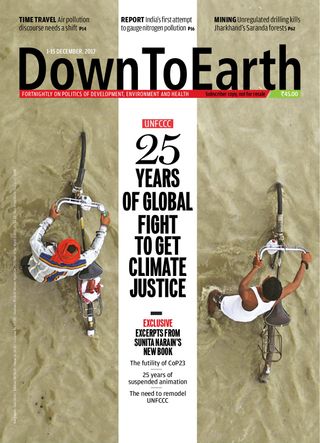

Diese Geschichte stammt aus der December 01, 2017-Ausgabe von Down To Earth.
Abonnieren Sie Magzter GOLD, um auf Tausende kuratierter Premium-Geschichten und über 9.000 Zeitschriften und Zeitungen zuzugreifen.
Sie sind bereits Abonnent? Anmelden
WEITERE GESCHICHTEN VON Down To Earth

Down To Earth
THINK TWICE BEFORE FELLING SAL TREES
Many trees considered to be affected by sal borer in the 1990s are still alive today

1 mins
February 16, 2026

Down To Earth
EDGE OF SURVIVAL
Caste divides deny marginalised communities land, resources and essential aid, leaving them more vulnerable to climate disasters
6 mins
February 16, 2026

Down To Earth
A WISH LIST?
Union Budget for 2026-27 conveys the impression of a roll-call of intentions and ambitious proposals, with little detail on their formulation
6 mins
February 16, 2026
Down To Earth
Break down the gender wall
THE RULING National Democratic Alliance (NDA) government has been heavily invested in the goal to make India a developed economy by 2047.
2 mins
February 16, 2026

Down To Earth
MENSTRUAL HEALTH, NOW A FUNDAMENTAL RIGHT
In a landmark judgement, the Supreme Court has recognised menstrual health and hygiene as a fundamental right under Article 21 of the Constitution of India, which guarantees the right to life and dignity.
8 mins
February 16, 2026

Down To Earth
Of devolution and new disasters
The 16th Finance Commission pushes for changes in view of new fiscal and climatic conditions
11 mins
February 16, 2026
Down To Earth
Rising risks of plastics
NEGATIVE IMPACTS on human health due to emissions linked to the plastic lifecycle could double by 2040, according to a study published in The Lancet Planetary Health in January.
1 min
February 16, 2026

Down To Earth
GAP BETWEEN EPIDEMICS NARROWING
A watershed-based and landscape-level approach is needed to address forest degradation
2 mins
February 16, 2026
Down To Earth
WAITING TO STRIKE
Sal heartwood borer is considered the biggest threat to forestry in India, especially to the sal tree, where it lives and breeds.
11 mins
February 16, 2026

Down To Earth
A SPRING DELIGHT
Mustard flowers are not meant only for the eyes. Invite them to your plate once in a while
3 mins
February 16, 2026
Translate
Change font size