
Mit Magzter GOLD unbegrenztes Potenzial nutzen
Erhalten Sie unbegrenzten Zugriff auf über 9.000 Zeitschriften, Zeitungen und Premium-Artikel für nur
Versuchen GOLD - Frei
Fantastic beasts
Down To Earth
|April 16, 2022
MAO'S BESTIARYIS A REVISIONIST HISTORICAL ACCOUNT OF THE ANIMAL DRUG INDUSTRY IN MAO'S CHINA THAT ALSO GIVES CONTEXT TO THE CURRENT DEBATES ON ZOONOSES AND THE USE OF WILD ANIMALS FOR HEALTH BENEFITS

MAO'S BESTIARY: Medicinal Animals and Modern China by Liz P Y Chee was released in May 2021, while the COVID-19 pandemic was continuing its deadly run worldwide for the second consecutive year. There was palpable anger against China and the Chinese people since the new virus had seemingly emerged from the Huanan seafood market in Wuhan, Hubei, in 2019, where all sorts of fauna were sold.
Chinese medicine has always advocated the use of animal parts. Bencao Gangmu, written by Ming period physician Li Shizhen in the 16th century, lists 400 animals that can be used as “medicine”. But this list of “medicinal animals” grew to 2,341 by 2013, says Chee, quoting the third edition of the state-sanctioned journal Zhongguo yao yong dong wu zhi (Medicinal fauna of China) released that year.
What changed? Well, that is the subject of this book.
Chee focusses on a hitherto a neglected period of China's history, as far as animals in Chinese medicine are concerned. From the start of the Communist government under Mao Zedong in 1949 to the end of the first decade of the country's economic reforms under its foremost leader Deng Xiaoping in 1989, Chinese medicine was pharmaceuticalised. These 40 years led to animals being used on an industrial scale, and the country producing and marketing medicine on an industrial level, within China as well as outside it.
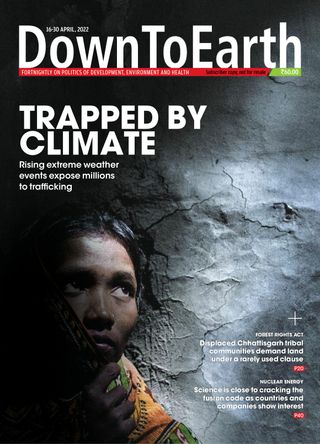

Diese Geschichte stammt aus der April 16, 2022-Ausgabe von Down To Earth.
Abonnieren Sie Magzter GOLD, um auf Tausende kuratierter Premium-Geschichten und über 9.000 Zeitschriften und Zeitungen zuzugreifen.
Sie sind bereits Abonnent? Anmelden
WEITERE GESCHICHTEN VON Down To Earth

Down To Earth
THINK TWICE BEFORE FELLING SAL TREES
Many trees considered to be affected by sal borer in the 1990s are still alive today

1 mins
February 16, 2026

Down To Earth
EDGE OF SURVIVAL
Caste divides deny marginalised communities land, resources and essential aid, leaving them more vulnerable to climate disasters
6 mins
February 16, 2026

Down To Earth
A WISH LIST?
Union Budget for 2026-27 conveys the impression of a roll-call of intentions and ambitious proposals, with little detail on their formulation
6 mins
February 16, 2026
Down To Earth
Break down the gender wall
THE RULING National Democratic Alliance (NDA) government has been heavily invested in the goal to make India a developed economy by 2047.
2 mins
February 16, 2026

Down To Earth
MENSTRUAL HEALTH, NOW A FUNDAMENTAL RIGHT
In a landmark judgement, the Supreme Court has recognised menstrual health and hygiene as a fundamental right under Article 21 of the Constitution of India, which guarantees the right to life and dignity.
8 mins
February 16, 2026

Down To Earth
Of devolution and new disasters
The 16th Finance Commission pushes for changes in view of new fiscal and climatic conditions
11 mins
February 16, 2026
Down To Earth
Rising risks of plastics
NEGATIVE IMPACTS on human health due to emissions linked to the plastic lifecycle could double by 2040, according to a study published in The Lancet Planetary Health in January.
1 min
February 16, 2026

Down To Earth
GAP BETWEEN EPIDEMICS NARROWING
A watershed-based and landscape-level approach is needed to address forest degradation
2 mins
February 16, 2026
Down To Earth
WAITING TO STRIKE
Sal heartwood borer is considered the biggest threat to forestry in India, especially to the sal tree, where it lives and breeds.
11 mins
February 16, 2026
Down To Earth
A SPRING DELIGHT
Mustard flowers are not meant only for the eyes. Invite them to your plate once in a while
3 mins
February 16, 2026
Translate
Change font size