
Mit Magzter GOLD unbegrenztes Potenzial nutzen
Erhalten Sie unbegrenzten Zugriff auf über 9.000 Zeitschriften, Zeitungen und Premium-Artikel für nur
Versuchen GOLD - Frei
Colour Me Indigo
Down To Earth
|April 01, 2017
Rising demand has revived indigo cultivation in India and abroad.

A hundred years ago, indigo symbolised colonial oppression. Now it marks high-end fashion products. Though the natural blue dye never lost its sheen, its production in India under the British saw a tremendous decline after the development of synthetic indigo dye by German chemist Adolf von Baeyer in 1878.
Farming of indigo was at its peak in the late 19th century. India produced nearly 19,000 tonnes of indigo in the 1850s and almost all of it was sent to Europe where the textile industry was experiencing a boom following the industrial revolution. The demand for natural indigo declined after German chemical company Badische Anilin und Sodafabrik started commercially producing synthetic indigo. Unlike natural indigo, whose colour depends on the climate of the area where the plant grows, the synthetic dye gave uniform results which were of benefit to the industry. By 1914, the production of natural indigo had reduced to 1,100 tonnes.
The synthetic indigo still rules the market. But there is now a renewed demand for natural indigo worldwide as people are becoming more healthconscious. This has prompted farmers to once again embrace the blue gold.
Its revival is particularly evident in Tamil Nadu, Andhra Pradesh and Karnataka, where hot and humid climate is conducive to the crop. In fact, during the Colonial period the kurpah (Cuddapah) indigo grown in the Madras region was quite popular in the international market because of its high colour content.
S Kamalnathan from Vellupuram district, Tamil Nadu, is one such farmer who shifted from moringa, a major cash crop, to indigo two years ago. He makes a profit of around R2 lakh per season from his 3.6 ha farmland. “The leaves, which are processed to extract the dye, can be harvested twothree times a year. Besides, it requires less water and inputs,” says Kamalnathan.
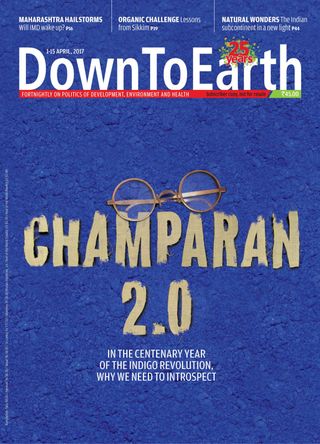

Diese Geschichte stammt aus der April 01, 2017-Ausgabe von Down To Earth.
Abonnieren Sie Magzter GOLD, um auf Tausende kuratierter Premium-Geschichten und über 9.000 Zeitschriften und Zeitungen zuzugreifen.
Sie sind bereits Abonnent? Anmelden
WEITERE GESCHICHTEN VON Down To Earth

Down To Earth
THINK TWICE BEFORE FELLING SAL TREES
Many trees considered to be affected by sal borer in the 1990s are still alive today

1 mins
February 16, 2026

Down To Earth
EDGE OF SURVIVAL
Caste divides deny marginalised communities land, resources and essential aid, leaving them more vulnerable to climate disasters
6 mins
February 16, 2026

Down To Earth
A WISH LIST?
Union Budget for 2026-27 conveys the impression of a roll-call of intentions and ambitious proposals, with little detail on their formulation
6 mins
February 16, 2026
Down To Earth
Break down the gender wall
THE RULING National Democratic Alliance (NDA) government has been heavily invested in the goal to make India a developed economy by 2047.
2 mins
February 16, 2026

Down To Earth
MENSTRUAL HEALTH, NOW A FUNDAMENTAL RIGHT
In a landmark judgement, the Supreme Court has recognised menstrual health and hygiene as a fundamental right under Article 21 of the Constitution of India, which guarantees the right to life and dignity.
8 mins
February 16, 2026

Down To Earth
Of devolution and new disasters
The 16th Finance Commission pushes for changes in view of new fiscal and climatic conditions
11 mins
February 16, 2026
Down To Earth
Rising risks of plastics
NEGATIVE IMPACTS on human health due to emissions linked to the plastic lifecycle could double by 2040, according to a study published in The Lancet Planetary Health in January.
1 min
February 16, 2026

Down To Earth
GAP BETWEEN EPIDEMICS NARROWING
A watershed-based and landscape-level approach is needed to address forest degradation
2 mins
February 16, 2026
Down To Earth
WAITING TO STRIKE
Sal heartwood borer is considered the biggest threat to forestry in India, especially to the sal tree, where it lives and breeds.
11 mins
February 16, 2026
Down To Earth
A SPRING DELIGHT
Mustard flowers are not meant only for the eyes. Invite them to your plate once in a while
3 mins
February 16, 2026
Translate
Change font size