
Mit Magzter GOLD unbegrenztes Potenzial nutzen
Erhalten Sie unbegrenzten Zugriff auf über 9.000 Zeitschriften, Zeitungen und Premium-Artikel für nur
Versuchen GOLD - Frei
₹1,402,680,000,000
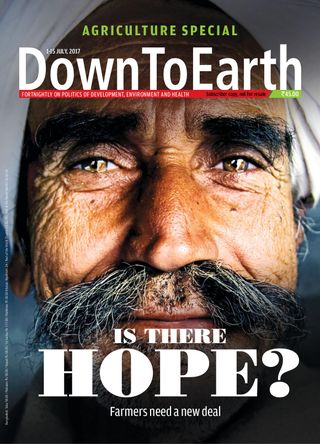
Down To Earth
|July 1, 2017
This is India's agrarian import bill for 2015-16. More than three times of India's annual agriculture budget, this money could have been transferred to Indian farmers who reaped a bumper harvest of crops that we import now


INDIA IS swiftly changing its policy of self-reliance in food production. Despite claiming a bumper production in recent years, the government has encouraged import of agricultural produces. More importantly, it has allowed import of cereals like wheat, maize and non basmati rice. The volume of import of these grains increased by 110 times between 2014 and 2017. Farmers who produce them are at the centre of the current crisis because they are the worst hit by the fall in the prices caused by the import.
The unprecedented situation is result of numerous policy decisions that have made the domestic market less remunerative for farmers. Traders now find it cheaper to import from Australia than to procure local produces. The change in policies has caused a huge spike in India’s agro food import bill. The spending on the import of cereals, which include wheat, maize and non-basmati rice, increased from ₹134 crore in 2014-15 to ₹9,009 crore in 2016-17—a rise of 6,623 per cent. India also imported ₹5,897 crore worth of fruit and vegetables in 2016-17 while the figure in 2014-15 was ₹5,414 crore. On one hand, the government is spending on imports while on the other hand, it has put restrictions on exports. In 2014-15, India’s agrarian exports were to the tune of ₹1.31 lakh crore but fell to ₹1.08 lakh crore in 2015-16.

Diese Geschichte stammt aus der July 1, 2017-Ausgabe von Down To Earth.
Abonnieren Sie Magzter GOLD, um auf Tausende kuratierter Premium-Geschichten und über 9.000 Zeitschriften und Zeitungen zuzugreifen.
Sie sind bereits Abonnent? Anmelden
WEITERE GESCHICHTEN VON Down To Earth

Down To Earth
Bitter pill
THE WEB SERIES PHARMA EXPOSES HARSH TRUTHS OF THE PHARMACEUTICAL INDUSTRY, WHERE PROFIT OFTEN BECOMES MORE IMPORTANT THAN HUMAN HEALTH

3 mins
January 16, 2026
Down To Earth
CHAOS IN-DEFINITION
The Aravallis are perhaps India's most litigated hill range. More than 4,000 court cases have failed to arrest their destruction. The latest dispute concerns a narrow legal definition of this geological antiquity, much of which has been obliterated by mining and urban sprawl. While the Supreme Court has stayed its own judgement accepting that definition, it must see the underlying reality and help reconcile development and national security with conservation.
19 mins
January 16, 2026
Down To Earth
BITS: INDIA
Indore has recorded 16 deaths and more than 1,600 hospitalisations between December 24 and January 6.
1 min
January 16, 2026

Down To Earth
GUARANTEE EXPIRES
India's rural employment guarantee law is replaced with a centrally controlled, budget-capped scheme. Is this an attack on the right to work?
3 mins
January 16, 2026

Down To Earth
BLOOM OR BANE
Surge of vibrant pink water lilies in Kuttanad, Kerala, provides socio-economic benefits, but the plant's ecological impacts must be understood
4 mins
January 16, 2026
Down To Earth
INVISIBLE EMPLOYER
Field and academic evidence shows sharp falls in casual agricultural employment at places where groundwater access declines
3 mins
January 16, 2026

Down To Earth
Schemed for erasure
Does the VB-G RAMG Act address structural weaknesses long observed in MGNREGA's implementation?
10 mins
January 16, 2026

Down To Earth
School of change
An open school in Panagar, Madhya Pradesh, aims to protect children of tribal settlements from falling into the trap of addiction
2 mins
January 16, 2026

Down To Earth
PULSE OF RESILIENCE
As a climate-ready crop, cowpea shows potential for widespread use in India
3 mins
January 16, 2026
Down To Earth
BITS GLOBAL
Britain recorded its hottest and sunniest year ever in 2025, the country's meteorological office said on January 2.
1 min
January 16, 2026
Translate
Change font size