
Mit Magzter GOLD unbegrenztes Potenzial nutzen
Erhalten Sie unbegrenzten Zugriff auf über 9.000 Zeitschriften, Zeitungen und Premium-Artikel für nur
Close up on THE SUN
BBC Sky at Night Magazine
|July 2022
Together, Solar Orbiter and the Parker Solar Probe are giving us our closest ever look at the Sun. With both now in their science phases, Ezzy Pearson updates us on what we've already learned and what's still to come

Although the star at the heart of our Solar System outshines everything else, its very brightness defies attempts to better understand it. Its light blinds any who look at it, while its heat scorches craft that venture too close. Despite this, specialised observatories have allowed solar astronomers to look on from afar over the years.
But now there are two telescopes giving an up-close view of the Sun. On 26 March, the European Space Agency's Solar Orbiter probe sailed past the Sun on its closest approach yet, coming within a third of the Earth-Sun distance to our star. And last year, its observing cousin, NASA's Parker Solar Probe, passed so near to the Sun that it flew through the outer layers of its atmosphere, sniffing out the pristine particles near the solar surface. But despite the pair being closer to the Sun than any other mission, they are looking at the star in two very different ways.
Big plasma bubble
"Solar Orbiter is a mission to explore the Sun and the surrounding heliosphere - the big plasma bubble that the solar wind blows into the interstellar medium," says Daniel Müller, project scientist for Solar Orbiter at the European Space Agency. "The driving rationale for Solar Orbiter is to establish the connections between what our home star does in terms of activity and how that manifests itself in the surrounding heliosphere, including the near-Earth environment. We combine measurements of the plasma at the location of the spacecraft with images of the Sun."
The mission launched on 10 February 2020, and has spent the last two years looping around our star. It spends much of its orbit at a distance to protect itself from the searing heat, only swooping in every five to six months for a close pass known as perihelion. Using flybys of Earth and Venus to pull its orbit close to the Sun, it now passes just 48.3 million km from our star.
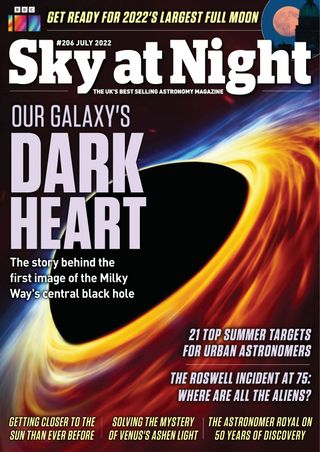

Diese Geschichte stammt aus der July 2022-Ausgabe von BBC Sky at Night Magazine.
Abonnieren Sie Magzter GOLD, um auf Tausende kuratierter Premium-Geschichten und über 9.000 Zeitschriften und Zeitungen zuzugreifen.
Sie sind bereits Abonnent? Anmelden
WEITERE GESCHICHTEN VON BBC Sky at Night Magazine
BBC Sky at Night Magazine
MOONWATCH
January's top lunar feature to observe

2 mins
January 2026
BBC Sky at Night Magazine
Speed up your processing workflow
How to use Photoshop's Actions tool to drastically cut your processing time
3 mins
January 2026
BBC Sky at Night Magazine
Chasing Canada's polar lights
With solar maximum peaking and a new Moon promising dark skies, Jamie Carter travels to Churchill, Manitoba to hunt the Northern Lights - and dodge polar bears – in Canada's far north
7 mins
January 2026
BBC Sky at Night Magazine
Beyond Pluto: The search for the hidden planets
Could one – or even two - undiscovered planets lurk at the edges of our Solar System? Nicky Jenner explores how close we are to finding the elusive 'Planet 9'
6 mins
January 2026
BBC Sky at Night Magazine
Jupiter moon events
Jupiter is a magnificent planet to observe.
2 mins
January 2026

BBC Sky at Night Magazine
What samples from space have taught us
Alastair Gunn explains what scientists have learnt in the 20 years since the first unmanned mission brought materials back from alien worlds
3 mins
January 2026
BBC Sky at Night Magazine
The Milky Way as you've never seen it before
This is the largest low-frequency radio colour image of our Galaxy ever assembled
1 min
January 2026
BBC Sky at Night Magazine
Merger of ‘impossibly' massive black holes explained
Scientists discover how enormous, fast-spinning black holes can exist after all
1 mins
January 2026
BBC Sky at Night Magazine
Lunar occultation of the Pleiades
BEST TIME TO SEE: 27 January from 20:30 UT
1 min
January 2026
BBC Sky at Night Magazine
The Universe's expansion may be slowing down
New study suggests current theories of dark energy could be wrong
1 mins
January 2026
Translate
Change font size