
Mit Magzter GOLD unbegrenztes Potenzial nutzen
Erhalten Sie unbegrenzten Zugriff auf über 9.000 Zeitschriften, Zeitungen und Premium-Artikel für nur
Into The Great Unknown THE ART OF REMOVING AND CREATING HABITS
Heartfulness eMagazine
|November 2021
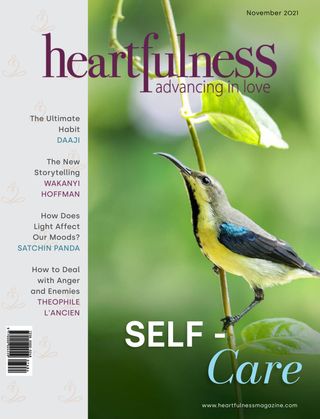
DAAJI continues his series on refining habits, this month sharing his insights on the final Niyama known as Ishwar Pranidhan, which is often translated as “surrender to God.” What does it mean? How can we understand both God and surrender? And why is surrender to God the ultimate habit?

Yoga in action
Let’s start by reminding ourselves of the three Niyamas that make up Kriya Yoga, the Yoga of action – tapas, swadhyaya and the third and final one, Ishwar pranidhan, the most mysterious and puzzling of all. Ishwar pranidhan is generally translated into English as “surrender to God,” or sometimes “God-awareness.” It is puzzling, not the least because God is such an elusive principle to most of us, and also because the idea of surrender often suggests the removal of personal freedom.
Only in this last of the ten Yamas and Niyamas does Patanjali speaks of God – Ishwar. Up till now, the focus has been on self-awareness, self-improvement, behavior, and purifying consciousness. That has all been a preparation. Throughout this preparation, we have moved from self-centeredness and selfishness to selflessness, from “me to we.” Now we take the next step, from “we to Thou.” This is a significant shift in consciousness, a quantum leap into the realm of God where even “we” no longer exists.
God is the great unknown
You may be wondering what God we are talking about here, because God has as many meanings as there are people. In Yoga, God is the great unknown, beyond qualities, beyond comprehension. Everything that is describable or definable has qualities, and while God is also present within the world of qualities, the quality-less state that is beyond definition is really the realm of God. There are other words that are also used for the same divine principle – the Source, the Ultimate, the Absolute.
Remember the state of

Diese Geschichte stammt aus der November 2021-Ausgabe von Heartfulness eMagazine.
Abonnieren Sie Magzter GOLD, um auf Tausende kuratierter Premium-Geschichten und über 9.000 Zeitschriften und Zeitungen zuzugreifen.
Sie sind bereits Abonnent? Anmelden
WEITERE GESCHICHTEN VON Heartfulness eMagazine

Heartfulness eMagazine
A Touch of Heaven
Irish singer and teacher, EILISH BUTLER, combines the mystical chant of Saint Hildegard von Bingen (1098-1176) with the evolutionary path of Uncovering the Voice, satisfying her passion for mystical spirituality and music.

2 mins
November 2025

Heartfulness eMagazine
FROM INNER STILLNESS TO OUTER AGENCY:
How Heartfulness Builds an Internal Locus of Control and Workplace Success
3 mins
November 2025

Heartfulness eMagazine
Virtual Intelligence
Author and cultural commentator CHARLES EISENSTEIN extends last month's argument about virtual substitutes hollowing out reality-this time to Al's imitation of intimacy-and points to what only embodied relationships can restore.
10 mins
November 2025

Heartfulness eMagazine
Grace Is the Creative Spark
Do you sometimes feel that life is blessed and things are unfolding effortlessly, without force or struggle? Some people say it is because of “grace” or “God’s grace.
5 mins
November 2025

Heartfulness eMagazine
Zuri's Guiding Light
A luminous fable from LIAA KUMAR on self-trust, belonging, and inner guidance.
3 mins
November 2025

Heartfulness eMagazine
I AM
In a quiet meditation on desire, stillness, and the witnessing Self, JARNA KHIMANI traces the shift from seeking to being.
3 mins
November 2025

Heartfulness eMagazine
Courage: From Relief to Presence
JASON NUTTING on why relief is temporary-and how courage, rooted in the heart, endures.
3 mins
November 2025

Heartfulness eMagazine
Embracing The Value Within
DR. ROXANNE M. ST. CLAIR on seeing the value in you—and in others—and making it a daily practice.
4 mins
November 2025
Heartfulness eMagazine
Gratitude's Gift
A Creston woman recently recounted her experience in a checkout line.
2 mins
November 2025

Heartfulness eMagazine
HAPPINESS and Gut Health
Q: How does gut health influence mental well-being, and can practices like meditation actively support a healthier digestive system? The gut is often called the second brain because it has over 500 million neurons that constantly talk to the brain through the vagus nerve.
2 mins
November 2025
Translate
Change font size