Versuchen GOLD - Frei
Where Brightness Ends
The Caravan
|June 2017
Bei Dao’s nostalgia for a pre-liberalisation Beijing / LITERATURE.

ON 28 MAY 1989, Lijia Zhang, a twenty-something factory worker, addressed a political rally in the Chinese city of Nanjing. This was unusual for her. A high-school dropout, Lijia had up until then been largely apolitical. But the pro-democracy student demonstrations at Beijing’s Tiananmen Square—going five weeks strong, and days away from massacre—had captured the public imagination. Like many workers, she had followed the events on the radio for weeks. Learning of a nearby demonstration that day, she impulsively decided to attend.
At the rally, Lijia somehow found herself on the podium. Speaking without preparation, through tears, she began modestly enough, expressing solidarity with the students at Tiananmen. The crowd egged her on. Emboldened, she went on to denounce the People’s Republic of China as a “dictatorship,” and even led a chant for democracy. She then ended with these lines by the poet Bei Dao:
Let me tell you, world
I—do—not—believe!
If a thousand challenges lie at your feet,
Count me as number one thousand and one.
The event, recounted in Lijia’s charming memoir Socialism is Great!, is emblematic of the intense and unlikely coming together of poetry and politics during the era of reforms that followed Mao’s death in 1976. It is made unlikelier still by the sort of poet Bei Dao is.
Born in 1949, Bei Dao, whose real name is Zhao Zhenkhai, grew up in a middle-class neighbourhood in Beijing, and studied at an elite boarding school. In 1967, a year into Mao’s Cultural Revolution, he, like millions of other urban youth, was sent to the countryside, where he worked at construction sites and smithies for the next 11 years. By day he mixed cement and cast iron; in the evenings he read and wrote.
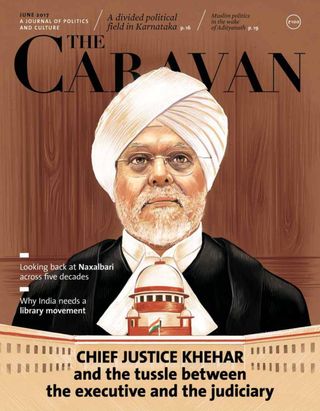

Diese Geschichte stammt aus der June 2017-Ausgabe von The Caravan.
Abonnieren Sie Magzter GOLD, um auf Tausende kuratierter Premium-Geschichten und über 9.000 Zeitschriften und Zeitungen zuzugreifen.
Sie sind bereits Abonnent? Anmelden
WEITERE GESCHICHTEN VON The Caravan

The Caravan
Dim Views
Punjab's new media suffers from old problems

22 mins
February 2026
The Caravan
ON FIRM GROUND
The civic struggle against uranium mining in the West Khasi Hills
6 mins
February 2026

The Caravan
DANGEROUS LIAISON
Why India enabled Israel's genocide in Gaza
44 mins
February 2026

The Caravan
Platform for Change
A women-led union gives voice to India's gig workers
6 mins
February 2026

The Caravan
NARAVANE'S Moment of Truth
An army chief's unpublished memoir exposes how the Modi government spun the China border crisis
44 mins
February 2026
The Caravan
A Brief History of the Slap
How Telugu cinema's heroes turn violence against women into romance
9 mins
February 2026
The Caravan
FACE PALM
Why the Congress keeps losing elections
33 mins
January 2025

The Caravan
The Great Transformation
Challenges facing independent news outlets in the digital age/Media
6 mins
January 2025

The Caravan
The Mob Comes for Film Critics
Dhurandhar and the manufacture of a national consensus
11 mins
January 2025
The Caravan
Memories Are Made of This
FOOD IN DALIT AND ADIVASI WRITING
15 mins
January 2025
Translate
Change font size