Versuchen GOLD - Frei
Swept Away
The Caravan
|March 2020
The liberal jubilation around Kejriwal’s triumph in Delhi is misguided / Politics

In the aftermath of the sweeping electoral triumph of Arvind Kejriwal and his Aam Aadmi Party in Delhi, liberals throughout the country hailed the result. Prominent commentators across the board, whether journalists or celebrities from other spheres such as Bollywood, interpreted it as a rejection of the Bharatiya Janata Party’s hatefilled campaign in the capital. Reacting to exit polls on 8 February, all of which showed a decisive victory for the AAP, Shekhar Gupta, the former editor of the Indian Express, tweeted that the verdict “will be a stunning repudiation of the politics of polarization in Delhi.” Nothing could be further from the truth.
The liberal reaction is part of a familiar pattern. Ever since the AAP appeared on the Indian political landscape, liberals have not just misunderstood the nature of its appeal, but also largely chosen to overlook the party’s many troubling aspects—ones present in its very genealogy, but now ever more evident as it faces ideological challenges from the right.
Examine the nature of its populism. This can be broadly divided into two parts. The first is its emphasis on schools, hospitals and improving civic services, as part of a larger drive to improve routine accountability in government. The second entails widely popular measures such as slashing power and water tariffs and eliminating bus fares for women, all of which serve to bind the city’s working and lower-middle classes to the AAP.
In these approaches, the AAP most closely resembles the left-wing economic populism seen across the world in the last decade, from the two-term presidency of Lula da Silva in Brazil to the electoral insurgency being led by Bernie Sanders in the United States. But economic populism as a party’s sole plank has rarely led to much success in India. The AAP’s upending of that traditional assumption accounts for its novelty in the arena of Indian politics.
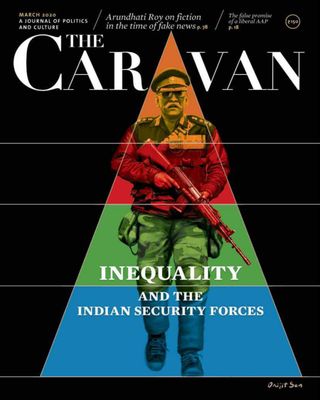

Diese Geschichte stammt aus der March 2020-Ausgabe von The Caravan.
Abonnieren Sie Magzter GOLD, um auf Tausende kuratierter Premium-Geschichten und über 9.000 Zeitschriften und Zeitungen zuzugreifen.
Sie sind bereits Abonnent? Anmelden
WEITERE GESCHICHTEN VON The Caravan
The Caravan
ANY RESEMBLANCE TO ACTUAL EVENTS IS NOT COINCIDENTAL
INTERFAITH ROMANCE FICTION IN THE ERA OF LOVE JIHAD

31 mins
December 2025
The Caravan
Manufacturing Legitimacy
How a Washington Post columnist laundered the Sangh's violent history
7 mins
December 2025

The Caravan
DEATH of REPORTAGE
THE DISMANTLING OF OUTLOOK'S LEGACY
32 mins
December 2025

The Caravan
FOG LIGHT
Samayantar's two-and-half-decade fight against the shrinking of Hindi's world
22 mins
December 2025

The Caravan
THE FINE PRINT
ON 19 MARCH 2005, thousands came out on the streets of Udupi, in coastal Karnataka, to protest a gruesome incident that had shaken the region a week earlier.
23 mins
December 2025

The Caravan
CHARACTER BUILDING
The enduring language of Indian streets
5 mins
December 2025

The Caravan
THE CONVENIENT EVASIONS OF RAJDEEP SARDESAI
DRESSED IN A turban and white kurta pyjama, Narendra Modi sat in the passenger seat of a van crossing the Patan district of Gujarat, in September 2012. Next to him sat Rajdeep Sardesai, the founder-editor of the news channel CNN-IBN.
63 mins
December 2025

The Caravan
Ahmed Kamal Junina: “Every class we hold is a defiant refusal to surrender”
A professor in Gaza on teaching during a genocide / Conflict
11 mins
December 2025

The Caravan
Bangla Pride, Urdu Prejudice
The language wars have primed West Bengal for the RSS
8 mins
November 2025

The Caravan
THE INTERVIEW
\"The people are naked before the government but the government is opaque to them\"
16 mins
November 2025
Translate
Change font size