Versuchen GOLD - Frei
States Of The Union
The Caravan
|May 2019
The pitfalls of India’s fiscal-federalism project

In 1860, Charles Trevelyan, the governor of the Madras Presidency at the time, orchestrated what came to be known as the Madras rebellion. He claimed that the budget of the colonial administration leaned too far towards financial centralisation, and was therefore unfair to the provinces in general, and the Madras Presidency in particular. He questioned the legitimacy of British control of finances, given that there was no representation of tax-paying Indians in the decision-making process.
The colonial administration had centralised power structures for the ease of its own bureaucracy. Trevelyan thought the Madras Presidency, which had not seen much unrest in the revolt of 1857, should not have to pay for the ballooning deficits that were largely caused by the war. While Trevelyan was a complicated man, who is now remembered primarily as being responsible for exacerbating the Irish potato famine, the question he raised during his time in Madras is an important one: how does a country with a large and diverse population, such as India, govern itself?
Independent India has accelerated the accumulation of power at the centre. The periodic demands for political autonomy in varying degrees—in Kashmir, Nagaland, Manipur, Punjab, Tamil Nadu, among others—have been dealt with as problems that need to be subdued, rather than as ones that raise genuine questions about the structure of governance. And over a century and a half after Trevelyan’s revolt, the 2019 general election poses similar questions about India’s management of fiscal federalism, or the division of public expenditure and taxes across the different levels of government.
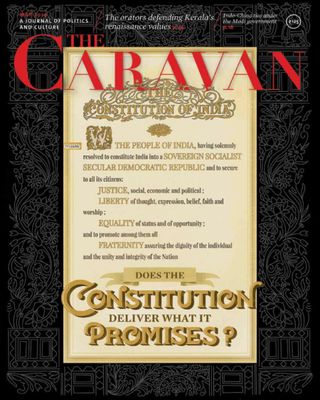

Diese Geschichte stammt aus der May 2019-Ausgabe von The Caravan.
Abonnieren Sie Magzter GOLD, um auf Tausende kuratierter Premium-Geschichten und über 9.000 Zeitschriften und Zeitungen zuzugreifen.
Sie sind bereits Abonnent? Anmelden
WEITERE GESCHICHTEN VON The Caravan
The Caravan
ANY RESEMBLANCE TO ACTUAL EVENTS IS NOT COINCIDENTAL
INTERFAITH ROMANCE FICTION IN THE ERA OF LOVE JIHAD

31 mins
December 2025
The Caravan
Manufacturing Legitimacy
How a Washington Post columnist laundered the Sangh's violent history
7 mins
December 2025

The Caravan
DEATH of REPORTAGE
THE DISMANTLING OF OUTLOOK'S LEGACY
32 mins
December 2025

The Caravan
FOG LIGHT
Samayantar's two-and-half-decade fight against the shrinking of Hindi's world
22 mins
December 2025

The Caravan
THE FINE PRINT
ON 19 MARCH 2005, thousands came out on the streets of Udupi, in coastal Karnataka, to protest a gruesome incident that had shaken the region a week earlier.
23 mins
December 2025

The Caravan
CHARACTER BUILDING
The enduring language of Indian streets
5 mins
December 2025

The Caravan
THE CONVENIENT EVASIONS OF RAJDEEP SARDESAI
DRESSED IN A turban and white kurta pyjama, Narendra Modi sat in the passenger seat of a van crossing the Patan district of Gujarat, in September 2012. Next to him sat Rajdeep Sardesai, the founder-editor of the news channel CNN-IBN.
63 mins
December 2025

The Caravan
Ahmed Kamal Junina: “Every class we hold is a defiant refusal to surrender”
A professor in Gaza on teaching during a genocide / Conflict
11 mins
December 2025

The Caravan
Bangla Pride, Urdu Prejudice
The language wars have primed West Bengal for the RSS
8 mins
November 2025

The Caravan
THE INTERVIEW
\"The people are naked before the government but the government is opaque to them\"
16 mins
November 2025
Translate
Change font size