Versuchen GOLD - Frei
False Steps
The Caravan
|May 2020
The commercial roots of a “traditional” folk dance / Arts

Whether or not you have been to Rajasthan, you have probably seen the famous Kalbeliya dance of the desert state. Visuals of Rajasthani women twirling at a dizzying pace, their carefully crafted black skirts a circular blur, are etched into our collective memory. At festivals, in folk-dance competitions, on television, the dance can be seen everywhere. You probably believe that this is the “traditional” dance form of the nomadic tribes of the Thar. Well, not quite.
According to Ayla Joncheere, a Belgian anthropologist who has spent the past decade researching the Kalbeliya community, this hugely popular dance form is an “invented tradition.” The term was first popularised by the historians Eric Hobsbawm and Terrence Ranger in their 1983 book, The Invention of Tradition. They noted that many traditions are recent creations, often invented to express the social cohesion of nations and communities, or to legitimise an existing order, institution or authority. From the foundational myths of nation-states to the pageantry of the British monarchy, from the Kechak dance of Indonesia to the Scottish tartan, there are many examples of inventions of recent vintage masquerading as traditions passed down over many generations.
The Kalbeliyas, most of whom are poor and uneducated nomads, have traditionally made a living as snake charmers and itinerant performers. They play musical instruments such as the pungi or the canga, and Kalbeliya women may sing from door to door. “They were little-known and marginalised before,” Joncheere told me. “The story of the Kalbeliya dance begins in the global music industry and India’s cultural policies in the 1980s.”
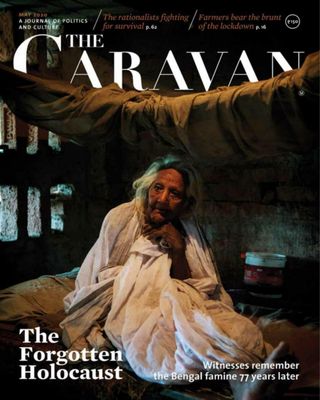

Diese Geschichte stammt aus der May 2020-Ausgabe von The Caravan.
Abonnieren Sie Magzter GOLD, um auf Tausende kuratierter Premium-Geschichten und über 9.000 Zeitschriften und Zeitungen zuzugreifen.
Sie sind bereits Abonnent? Anmelden
WEITERE GESCHICHTEN VON The Caravan

The Caravan
Dim Views
Punjab's new media suffers from old problems

22 mins
February 2026

The Caravan
ON FIRM GROUND
The civic struggle against uranium mining in the West Khasi Hills
6 mins
February 2026

The Caravan
DANGEROUS LIAISON
Why India enabled Israel's genocide in Gaza
44 mins
February 2026

The Caravan
Platform for Change
A women-led union gives voice to India's gig workers
6 mins
February 2026

The Caravan
NARAVANE'S Moment of Truth
An army chief's unpublished memoir exposes how the Modi government spun the China border crisis
44 mins
February 2026
The Caravan
A Brief History of the Slap
How Telugu cinema's heroes turn violence against women into romance
9 mins
February 2026
The Caravan
FACE PALM
Why the Congress keeps losing elections
33 mins
January 2025

The Caravan
The Great Transformation
Challenges facing independent news outlets in the digital age/Media
6 mins
January 2025

The Caravan
The Mob Comes for Film Critics
Dhurandhar and the manufacture of a national consensus
11 mins
January 2025
The Caravan
Memories Are Made of This
FOOD IN DALIT AND ADIVASI WRITING
15 mins
January 2025
Translate
Change font size