What's Wrong With The Democrats?
The Atlantic
|July/August 2017
Barack Obama's victories obscured failure at every level. The Party's choices have been about disastrous. If Democrats care about winning, they need to learn how to appeal to the white working class.

The strategy was simple. A demographic wave—long-building, still-building—would carry the party to victory, and liberalism to generational advantage. The wave was inevitable, unstoppable. It would not crest for many years, and in the meantime, there would be losses—losses in the midterms and in special elections; in statehouses and in districts and counties and municipalities outside major cities. Losses in places and elections where the white vote was especially strong.
But the presidency could offset these losses. Every four years the wave would swell, receding again thereafter but coming back in the next presidential cycle, higher, higher. The strategy was simple. The presidency was everything.
Anyone who examined the strategy that the Democratic Party has embraced ever more tightly in recent years could see its essential precariousness. And anyone could see that investing such grave hopes in the person of Hillary Clinton—who had lost the party’s nomination to a little-known senator in 2008; who had struggled to win it against a little-known socialist eight years later—was particularly risky.
But liberals’ fears were softened in 2016 by a widely shared belief: that the candidacy of Donald Trump would shatter the Republican Party, at least in the form in which we had long known it. His trail of wreckage would force a painful reckoning with the party’s shortcomings—the narrowness of its coalition, the cloistered cluelessness of its elites, its intramural disagreements about the future of the nation. After a season of Trump’s destruction, the party would lie in rubble.
On November 8, that prophecy was realized, true in every regard, except that it described the Democrats. On Inauguration Day, the party’s power ebbed to its lowest level since the 1920s.
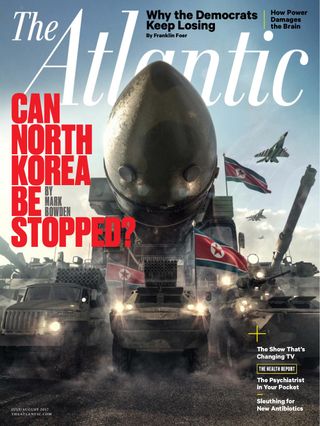

Diese Geschichte stammt aus der July/August 2017-Ausgabe von The Atlantic.
Abonnieren Sie Magzter GOLD, um auf Tausende kuratierter Premium-Geschichten und über 9.000 Zeitschriften und Zeitungen zuzugreifen.
Sie sind bereits Abonnent? Anmelden
WEITERE GESCHICHTEN VON The Atlantic

The Atlantic
You Had to Be There
An emerging field of history asks if we can ever really understand how our forebears experienced love, anger, fear, and sorrow.

23 mins
January 2026

The Atlantic
By the Horns
The week before the biggest bullfight of her career, in Cádiz, Spain, this past July, 24-year-old Miriam Cabas posted a carefully produced video on Instagram.
1 mins
January 2026

The Atlantic
The New German War Machine
After World War II, Germany embraced pacifism as a form of atonement. Now the country is arming itself again.
18 mins
January 2026
The Atlantic
The Eloquence
The prime minister was watching a disaster movie when we found him.
4 mins
January 2026

The Atlantic
What's for Dinner, Mom?
The women who want to change the way America eats
12 mins
January 2026

The Atlantic
How Terror Works
A 1947 German novel explores the sometimes corrosive, sometimes energizing nature of fear.
8 mins
January 2026

The Atlantic
Yesterday's Idea of a Modern Man
Sam Shepard, a self-made cowboy, was also a poet of masculine angst.
7 mins
January 2026

The Atlantic
ACCOMMODATION NATION
America's colleges have an extra-time-on-tests problem.
11 mins
January 2026

The Atlantic
Respect the Drummer
A new history of rock, told through its overlooked heroes
5 mins
January 2026

The Atlantic
THE MOST POWERFUL MAN IN SCIENCE
WHY IS ROBERT F. KENNEDY JR. SO CONVINCED HE'S RIGHT?
42 mins
January 2026
Translate
Change font size