Versuchen GOLD - Frei
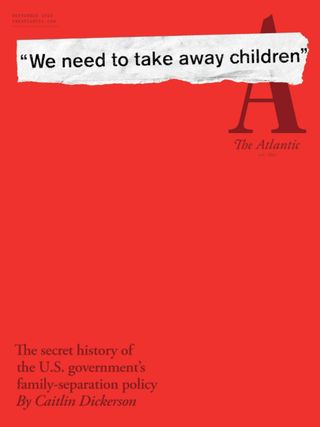
"We Need To Take Away Children."
The Atlantic
|September 2022
The secret history of the U.S. government's family-separation policy

As a therapist for children who are being processed through the American immigration system, Cynthia Quintana has a routine that she repeats each time she meets a new patient in her office in Grand Rapids, Michigan: She calls the parents or closest relatives to let them know the child is safe and well cared for, and provides 24-hour contact information.
This process usually plays out within hours of when the children arrive. Most are teens who have memorized or written down their relatives' phone numbers in notebooks they carried with them across the border. By the time of that initial call, their families are typically worried, waiting anxiously for news after having in an act of desperation-sent their children into another country alone in pursuit of safety and the hope of a future.
But in the summer of 2017, Quintana encountered a curious case. A 3-year-old Guatemalan boy with a toothy smile and bowl-cut black hair sat down at her desk. He was far too little to have made the journey on his own. He had no phone numbers with him, and when she asked where he was headed or whom he'd been with, the boy stared back blankly. Quintana scoured his file for more information but found nothing. She asked for help from an Immigration and Customs Enforcement officer, who came back several days later with something unusual: information indicating that the boy's father was in federal custody.
At their next session, the boy squirmed in his chair as Quintana dialed the detention center, getting his father on the line. At first the dad was quiet, she told me. "Finally we said, 'Your child is here. He can hear you. You can speak now.' And you could just tell that his voice was breaking he couldn't."
The boy cried out for his father. Suddenly, both of them were screaming and sobbing so loudly that several of Quintana's colleagues ran to her office.

Diese Geschichte stammt aus der September 2022-Ausgabe von The Atlantic.
Abonnieren Sie Magzter GOLD, um auf Tausende kuratierter Premium-Geschichten und über 9.000 Zeitschriften und Zeitungen zuzugreifen.
Sie sind bereits Abonnent? Anmelden
WEITERE GESCHICHTEN VON The Atlantic

The Atlantic
How America Celebrated Its 100th Birthday
The Centennial Exhibition of 1876 promised a glorious industrial future. Outside its gates, the country seethed with violence and corruption.

12 mins
June 2026

The Atlantic
THE CLOWN SHOW
The Savannah Bananas are reviving one of the most entertaining—and controversial—teams in Negro Leagues history.
21 mins
June 2026

The Atlantic
The Diva
Denyce Graves is retiring from performing after a career as one of opera's leading women. But there's more work for her to do.
10 mins
June 2026

The Atlantic
Cat Heir
Did Karl Lagerfeld really leave millions to Choupette?
26 mins
June 2026

The Atlantic
The Secret of Elizabeth Strout's Appeal
How she writes best sellers that are also critical darlings
10 mins
June 2026

The Atlantic
THE VENTURE-CAPITAL POPULIST
How David Sacks and the new tech right went full MAGA and captured Washington
32 mins
June 2026

The Atlantic
Glory Days
Heartland rock was shot through with nostalgia— but nostalgia for what?
9 mins
June 2026

The Atlantic
Alien Nation
Why Americans want to believe that the government is hiding the truth about extraterrestrial life
11 mins
June 2026

The Atlantic
Dinah's Hat
On the day Dinah lost her hat, I was sitting on the top step of my just-right Scamp trailer doing a crossword.
24 mins
June 2026

The Atlantic
THE AMERICA I'VE KNOWN
In my 93rd year, it's become ever more clear that patriotism requires sacrifice and collective effort.
7 mins
June 2026
Translate
Change font size