Versuchen GOLD - Frei
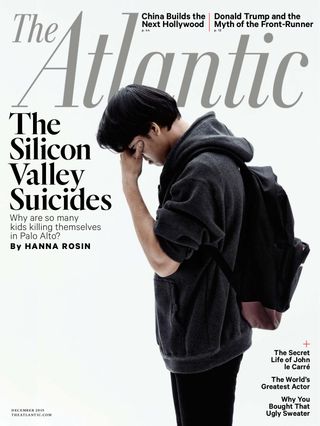
The Silicon Valley Suicides
The Atlantic
|December 2015
Why are so many kids with bright prospects killing themselves in Palo Alto?

The air shrieks, and life stops. First, from far away, comes a high whine like angry insects swarming, and then a trampling, like a herd moving through. The kids on their bikes who pass by the Caltrain crossing are eager to get home from school, but they know the drill. Brake. Wait for the train to pass. Five cars, double-decker, tearing past at 50 miles an hour. Too fast to see the faces of the Silicon Valley commuters on board, only a long silver thing with black teeth. A Caltrain coming into a station slows, invites you in. But a Caltrain at a crossing registers more like an ambulance, warning you fiercely out of its way.
The kids wait until the passing train forces a gust you can feel on your skin. The alarms ring and the red lights flash for a few seconds more, just in case. Then the gate lifts up, signaling that it’s safe to cross. All at once life revives: a rush of bikes, skateboards, helmets, backpacks, basketball shorts, boisterous conversation. “Ew, how old is that gum?” “The quiz is next week, dipshit.” On the road, a minivan makes a left a little too fast—nothing ominous, just a mom late for pickup. The air is again still, like it usually is in spring in Palo Alto. A woodpecker does its work nearby. A bee goes in search of jasmine, stinging no one.
In many parts of town, you can hear the warning of a passing train just about everywhere: the quad at Palo Alto High School; the tables at Piazza’s grocery store, where kids from Gunn High School hang out after school; the kids’ bedrooms after midnight.
A few students had gotten in early to take some photos dressed as

Diese Geschichte stammt aus der December 2015-Ausgabe von The Atlantic.
Abonnieren Sie Magzter GOLD, um auf Tausende kuratierter Premium-Geschichten und über 9.000 Zeitschriften und Zeitungen zuzugreifen.
Sie sind bereits Abonnent? Anmelden
WEITERE GESCHICHTEN VON The Atlantic
The Atlantic
You Had to Be There
An emerging field of history asks if we can ever really understand how our forebears experienced love, anger, fear, and sorrow.

23 mins
January 2026

The Atlantic
By the Horns
The week before the biggest bullfight of her career, in Cádiz, Spain, this past July, 24-year-old Miriam Cabas posted a carefully produced video on Instagram.
1 mins
January 2026

The Atlantic
The New German War Machine
After World War II, Germany embraced pacifism as a form of atonement. Now the country is arming itself again.
18 mins
January 2026
The Atlantic
The Eloquence
The prime minister was watching a disaster movie when we found him.
4 mins
January 2026

The Atlantic
What's for Dinner, Mom?
The women who want to change the way America eats
12 mins
January 2026

The Atlantic
How Terror Works
A 1947 German novel explores the sometimes corrosive, sometimes energizing nature of fear.
8 mins
January 2026

The Atlantic
Yesterday's Idea of a Modern Man
Sam Shepard, a self-made cowboy, was also a poet of masculine angst.
7 mins
January 2026

The Atlantic
ACCOMMODATION NATION
America's colleges have an extra-time-on-tests problem.
11 mins
January 2026

The Atlantic
Respect the Drummer
A new history of rock, told through its overlooked heroes
5 mins
January 2026

The Atlantic
THE MOST POWERFUL MAN IN SCIENCE
WHY IS ROBERT F. KENNEDY JR. SO CONVINCED HE'S RIGHT?
42 mins
January 2026
Translate
Change font size