
Mit Magzter GOLD unbegrenztes Potenzial nutzen
Erhalten Sie unbegrenzten Zugriff auf über 9.000 Zeitschriften, Zeitungen und Premium-Artikel für nur
Versuchen GOLD - Frei
Our Blinding, Blaring World
The Atlantic
|July - August 2022
By flooding the environment with light and sound, we're confounding the senses of countless animals. But we can still save the quiet and preserve the dark.

Within the 310,000 acres of Wyoming’s Grand Teton National Park, one of the largest parking lots is in the village of Colter Bay. Beyond the lot’s far edge, nestled among some trees, is a foul-smelling sewage-pumping station that Jesse Barber, a sensory ecologist at Boise State University, calls the Shiterator. On this particular night, sitting quietly within a crevice beneath the building’s metal awning and illuminated by Barber’s flashlight, is a little brown bat. A white device the size of a rice grain is attached to the bat’s back. “That’s the radio tag,” Barber tells me. He’d previously affixed it to the bat so that he could track its movements, and tonight he has returned to tag a few more.
From inside the Shiterator, I can hear the chirps of other roosting bats. As the sun sets, they start to emerge. A few become entangled in the large net Barber has strung between two trees. He frees a bat, and Hunter Cole, one of his students, carefully examines it to check that it’s healthy and heavy enough to carry a tag. Once satisfied, Cole daubs a spot of surgical cement between its shoulder blades and attaches the tiny device. “It’s a little bit of an art project, the tagging of a bat,” Barber tells me. After a few minutes, Cole places the bat on the trunk of the nearest tree. It crawls upward and takes off, carrying $175 worth of radio equipment into the woods.
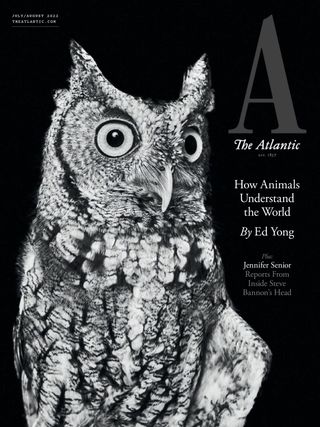

Diese Geschichte stammt aus der July - August 2022-Ausgabe von The Atlantic.
Abonnieren Sie Magzter GOLD, um auf Tausende kuratierter Premium-Geschichten und über 9.000 Zeitschriften und Zeitungen zuzugreifen.
Sie sind bereits Abonnent? Anmelden
WEITERE GESCHICHTEN VON The Atlantic
The Atlantic
The Eighth Deadly Sin
Humankind has devised a new form of debasement.

5 mins
May 2026
The Atlantic
The Art of the (New) Deal
What the murals of the Wilbur J. Cohen Federal Building can teach us about patriotism, propaganda, and beauty
12 mins
May 2026

The Atlantic
New Chairs
Collaboration, for Robert Rauschenberg and Merce Cunningham, began with the arrangement of chairs.
1 mins
May 2026
The Atlantic
HISTORY IS RUNNING BACKWARDS
Why reactionaries are taking over the world
21 mins
May 2026

The Atlantic
SOMEDAY IN TEHRAN
Like Donald Trump, I, too, once underestimated the Islamic Republic of Iran.
16 mins
May 2026

The Atlantic
On Losing a Daughter
The people we were died at the exact moment our child did.
19 mins
May 2026
The Atlantic
I Found It: The Best Free Restaurant Bread in America
Thirteen thousand miles. Infinite contenders. One beautiful loaf.
15 mins
May 2026
The Atlantic
EVERYTHING IS FREE AND NOTHING MATTERS
What I saw at Jeff Bezos's Campfire retreat
9 mins
May 2026

The Atlantic
Who Is Black Comedy For?
A new book is nostalgic for the '90s. But the era of crossover success was not necessarily the pinnacle of Black comedic achievement.
8 mins
May 2026
The Atlantic
The Feeling of Becoming Less and Less of a Person
In Ben Lerner's new novel, technology divides us further from one another, and ourselves.
9 mins
May 2026
Translate
Change font size